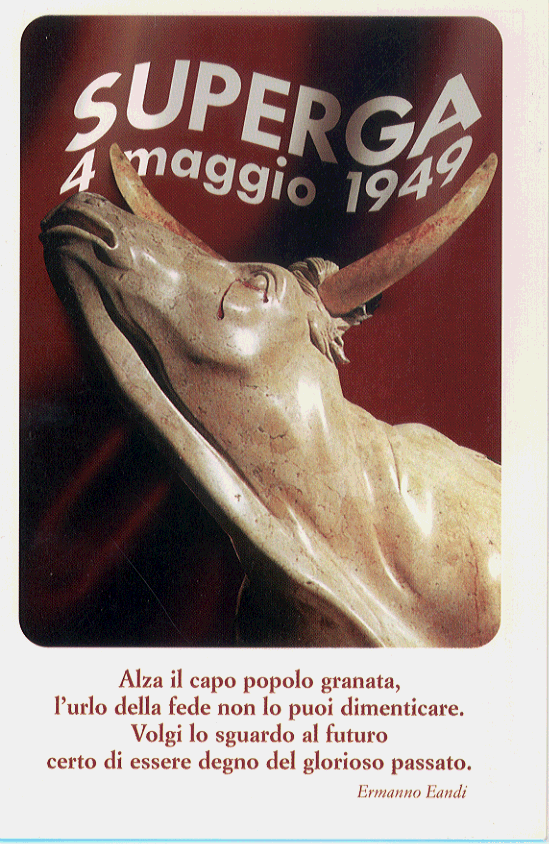
Superga Air Disaster
Valentino Mazzola was 30 years old. Captain of Torino, captain of Italy, the finest footballer of his generation. On the afternoon of May 4, 1949, he was aboard a Fiat G.212 airliner returning from Lisbon, where his team had played a friendly match honoring Benfica's captain Francisco Ferreira. The plane carried the entire squad -- 18 players, three coaches, club officials, journalists, and the flight crew. Thirty-one souls in all. At 5:03 p.m., as the aircraft aligned for approach to Turin's airport in thick fog, the pilot turned left, leveled out, and flew directly into the rear embankment of the Basilica of Superga. Visibility was 40 meters. Speed was 180 kilometers per hour. There was no attempt to go around. The only part of the aircraft that remained partially intact was the tail section.
The Team That Was Italy
To understand what was lost on that hillside, you need to understand what Grande Torino meant. This was not merely a dominant club team -- it was effectively the Italian national squad wearing different jerseys. In an era when Torino fielded as many as ten of Italy's eleven starters, the distinction between club and country had all but dissolved. The team had won four consecutive Serie A titles and was cruising toward their fifth championship in a row. Their style of play was revolutionary: fast, attacking, technically brilliant. Mazzola, the captain, was the fulcrum -- a complete midfielder whose vision and energy drove the entire system. Around him played Guglielmo Gabetto, Franco Ossola, Ezio Loik, Mario Rigamonti, and the Ballarin brothers, Aldo and Dino. Behind the squad stood two remarkable coaches: Erno Egri Erbstein, a Hungarian Jewish refugee who had survived the Holocaust, and Leslie Lievesley, an Englishman who had played for several clubs before turning to management.
Forty Meters of Visibility
The flight from Lisbon had been uneventful until the approach to Turin. The Fiat G.212, registration I-ELCE, was operated by Avio Linee Italiane. As the aircraft descended through heavy cloud cover and fog, the pilot, Pierluigi Meroni, likely believed the Superga hill was off to his right. It was not. The 672-meter hill, crowned by the Basilica and its massive retaining wall, materialized directly ahead with no time to react. At 5:03 p.m., the plane struck the rear embankment. Two minutes later, at 5:05, Aeritalia Tower called the aircraft's radio sign. There was no response. The wreckage gave no evidence that Meroni had seen the obstacle or attempted evasive action. The fog had swallowed everything -- the hill, the basilica, the margin for error.
What Rivals Did Next
News of the crash devastated Italy. The grief was not limited to Turin or to Torino's supporters. On May 6, just two days after the disaster, rival clubs made an extraordinary request: that Torino be proclaimed winners of the 1948-49 Serie A season without playing the remaining matches. The request was granted. It was the team's fifth consecutive title, and their last for decades. Eight of the 18 players, along with coaches Erbstein and Lievesley and journalist Renato Casalbore, were buried at the Cimitero Monumentale in Turin. The personal belongings recovered from the wreckage -- bags belonging to Mazzola, Virgilio Maroso, and Erbstein -- are now preserved in a museum in Grugliasco, near Turin. The Museo del Grande Torino e della Leggenda Granata opened in 2008, housed in the Villa Claretta Assandri.
Every Fourth of May
The crash is commemorated annually at the basilica. Torino supporters, players, and officials climb the Superga hill each May 4 to lay wreaths at the memorial plaque that marks the point of impact on the retaining wall. The ceremony is not a civic obligation or a media event -- it is a pilgrimage, sustained by a grief that has outlived everyone who witnessed the original tragedy. What was lost in those 40 meters of fog was not just a football team but an idea of what Italian football could be. The national team did not recover for years. Torino, stripped of its entire first team, filled the roster with youth players and amateurs from other clubs, a generosity that could not replace what was gone. The Grande Torino remains the standard against which all Italian football dynasties are measured -- and the reminder of how suddenly a standard can be destroyed.
From the Air
Located at 45.08N, 7.77E on the rear embankment of the Basilica of Superga, atop the 672-meter Superga hill east of Turin. The crash site is on the east-facing retaining wall of the basilica, not visible from the city below. Nearest airport is Turin-Caselle (LIMF), approximately 20 km to the northwest. The aircraft was approaching from the southeast, likely attempting to align with the runway at the former Aeritalia field. The hill rises sharply from the Po valley floor, and in low-visibility conditions it presents a significant terrain hazard. Best viewed from 3,000-5,000 feet, approaching from the east where the embankment and memorial are visible.