The Wooden Raft That Lifted a Navy
Before iron and steel transformed shipbuilding, a different kind of engineering problem kept Dutch naval commanders awake in the East Indies: how do you repair a ship's hull in a harbor where the ground is too soft for a stone dry dock? The answer arrived at Surabaya in the early 1850s -- a floating dry dock made almost entirely of pine, modeled on an American design from New York, assembled from timber shipped halfway around the world. At just 1,100 tons capacity, it was modest even by the standards of its day. But this wooden raft became the first floating dry dock in the Dutch East Indies, and for three decades it lifted warships, inspected copper sheathing, and kept the colonial fleet operational from a basin at the mouth of the Kali Mas river.
Soft Ground and Copper Bottoms
Surabaya sits on the Madura Strait at the mouth of the Kali Mas, a river that gave the port good connections to Java's interior. In the mid-1830s, the Dutch Navy chose it as the main base for its East Indies fleet, and by 1846 construction was underway on the Maritime Establishment -- a complex of wet docks, repair shops, and storage facilities just east of the river. What the base lacked was a way to get beneath a ship's waterline. Careening -- hauling a vessel onto its side on a beach -- was the traditional method, but larger ships were increasingly vulnerable to damage during the process. Worse, the growing practice of copper sheathing made careening destructive: the copper that protected hulls from tropical marine growth would be torn and bent. A proper dry dock was essential, but Surabaya's marshy soil could not support the stone walls of a conventional graving dock. The solution would have to float.
From New York to Amsterdam to Java
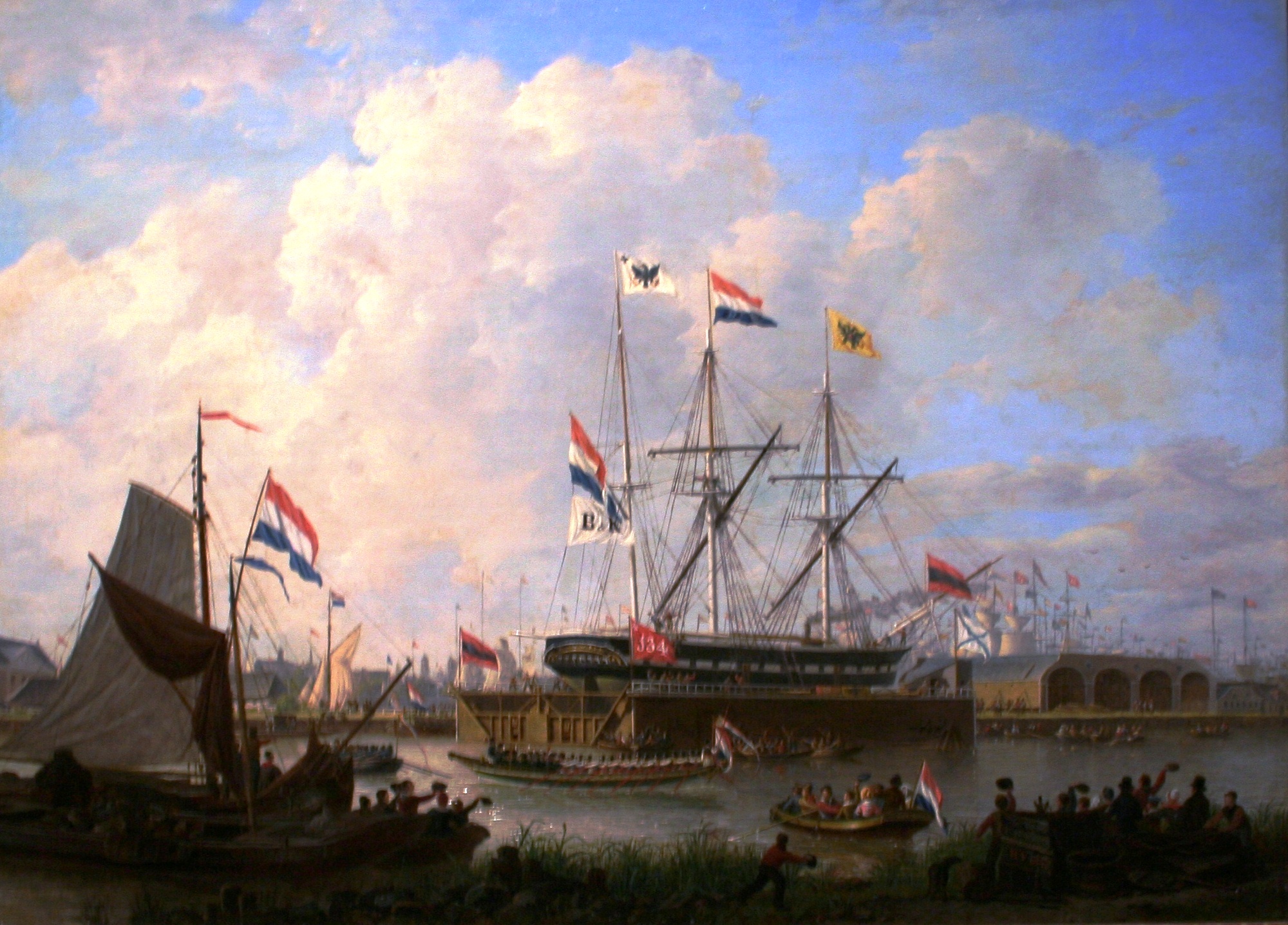
The breakthrough came from across the Atlantic. When the first modern floating dry dock began operating in New York harbor around 1839, a Dutch entrepreneur named Jan Daniel Diets recognized its potential. He purchased the American plans and built Amsterdam Wooden Drydock I, which lifted its first ship -- the frigate Koning Willem II -- on November 30, 1842. The concept proved immediately successful. Within a year, visitors from Le Havre had come to inspect the dock, and soon Diets was building floating dry docks for export. The Surabaya dock was built to similar specifications, though adapted for the longer voyage and tropical conditions. Its timber was pine from Narva on the Baltic, cut into planks 30 centimeters thick and assembled into a massive raft. The sides were essentially wooden tanks: fill them with water and the raft sank low enough for a ship to float over it; pump them dry and the raft rose, bringing the ship out of the water. The entire structure was shipped disassembled to Java, where it was put together in the Surabaya basin.
A Dock That Leaked and Lasted
The wooden dock entered service and quickly became indispensable. It handled the screw steamships that were becoming the mainstay of the Dutch navy in the far east, though not without difficulty -- the new steam corvettes pushed the dock close to its limits. In 1858, after one period of heavy use, the dock required towing back to Surabaya behind HNLMS Merapi for repairs. A short but major overhaul to hull and boilers followed in 1862. By the late 1860s, the dock was showing its age. When the much larger iron Onrust Dock of 3,000 tons arrived in 1869, the wooden dock was clearly outclassed. But it was not retired. Instead, it was hauled onto blocks for a thorough rebuild from 1871 to 1873, and returned to service labeled "aged, not worth any major repairs, requiring much maintenance" -- followed, in the same breath, by "of continuous useful service."
Useful to the Last
Through the 1870s, the old dock found a new role. As the Dutch navy transitioned to iron-hulled vessels like the Pontianak-class gunboats, these ships needed to be lifted twice a year for hull inspection. The wooden dock was big enough for the smaller iron warships, and it stayed busy. In 1879, it received new boilers despite continuously making water through its aging timbers. By the end of the decade, its lifting capacity had declined, and its final months of service saw mostly light craft on its pontoons -- 42 of its last 58 docking days were spent on small vessels. On April 16, 1881, the dock that had served the Dutch East Indies for roughly three decades was finally retired. It had leaked, been rebuilt, been declared unfit for further major repair, and gone right on working. Its career traced the entire arc of the colonial navy's transformation: from wooden sailing ships with copper bottoms to iron-hulled steamers, all lifted on a pine raft designed in New York and assembled in Java.
From the Air
Located at approximately 7.20°S, 112.74°E along the Surabaya waterfront on the Madura Strait, East Java. The former Maritime Establishment site sits east of the Kali Mas river mouth. Best viewed at 2,000-3,000 ft. The modern harbor and industrial waterfront are visible from the air, though no trace of the wooden dock remains. Nearest major airport: Juanda International (WARR), approximately 10 nm south. The Madura Strait and Suramadu Bridge are prominent visual landmarks.