Surin Islands
The Moken language has no word for "mine." On the Surin Islands, a five-island granite archipelago rising from the Andaman Sea 55 kilometers off Thailand's coast, this is not a philosophical curiosity but a way of life that has endured for centuries. Between 150 and 330 Moken people still live here, the last community of sea nomads in Thailand's waters, and their relationship with these islands upends nearly everything outsiders assume about ownership, permanence, and what it means to belong to a place.
Stone Born from Collision
The Surin Islands owe their existence to a tectonic event during the Mesozoic era, when the Burma and Sunda Plates collided beneath the Andaman Sea. The descending plate pushed granite structures upward, dislodging pinnacles and outcroppings that eventually broke the ocean's surface as island chains. These five islands are made of intrusive granitoids, a coarse-grained igneous rock that has spent millions of years accumulating a thick crust of limestone built from coral skeletons. Living corals continue to grow on the outer surfaces, so the islands are geological works in progress, granite cores wrapped in the slow labor of reef-building organisms. Beneath the waterline, the same tectonic process scattered underwater seamounts and pinnacles that today support some of Thailand's richest marine ecosystems.
People of the Kabang
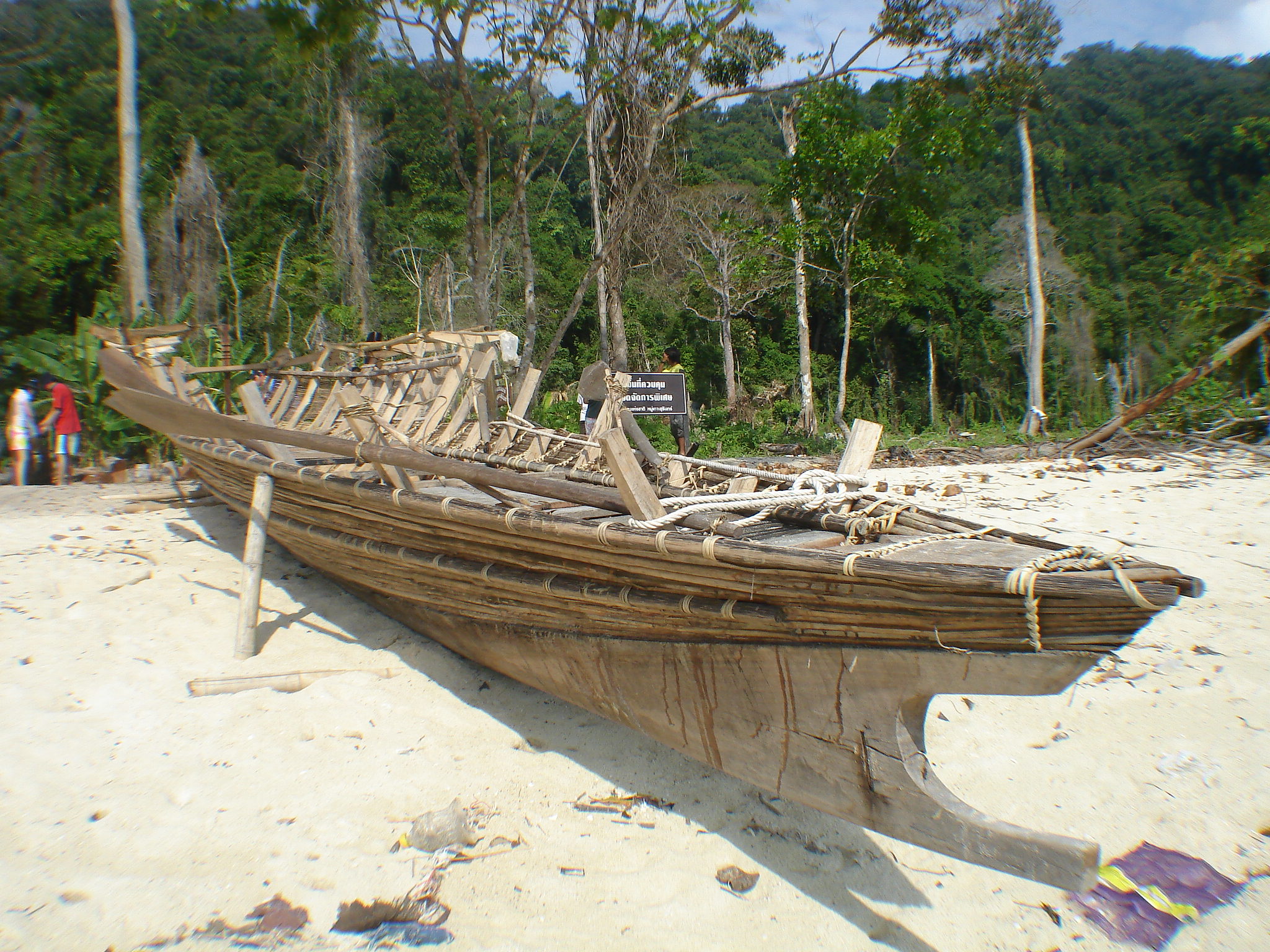
The Moken are one of three Austronesian sea-dwelling groups along the Andaman coast, distinct from the Moklen of Phang Nga Province and the Urak Lawoi who range from Phuket down to Satun Province. Traditionally, Moken families spent their lives aboard houseboats called kabang, drifting from bay to bay with the monsoon winds. The last kabang was reportedly built in 2006, though efforts to revive the tradition surfaced around 2018. Without a written language, the Moken pass everything through oral tradition: navigation routes, medicinal plant knowledge, spiritual practices, family histories. Their botanical expertise alone is staggering. They use 83 plant species for food, 33 for medicine, 53 for building huts, boats, and tools, and 54 for other purposes. Deceased family members are buried beneath the family's house with sea shells and offerings, a practice rooted in ancestor worship rather than any formalized religion. The community's emphasis on sharing runs so deep that the language itself contains no terms for individual possession.
An Undersea Census
Mu Ko Surin National Park protects waters that teem with life on a scale difficult to grasp from above. Surveys have recorded more than 260 species of reef fish, 68 species of coral, 48 species of nudibranch, and 31 species of shrimp within the park's boundaries. Whale sharks pass through between February and April, drawing divers from around the world to nearby Richelieu Rock. On land, the archipelago shelters seven reptile species including Asian water monitors, reticulated pythons, and the Surin bent-toed gecko, a species found nowhere else on Earth. Critically endangered hawksbill and green sea turtles still haul themselves onto the beaches to nest, and in the early 1990s, rare olive ridley turtles were spotted in the surrounding waters. BirdLife International designated the park as an Important Bird Area for its populations of near-threatened Nicobar pigeons and beach stone-curlews, alongside vulnerable large green pigeons.
The Wave the Elders Knew
When the 2004 Indian Ocean tsunami struck the Andaman coast, the Moken on the Surin Islands survived. Their oral tradition carried knowledge of the sea's warning signs, passed down through generations without ever being written. Forewarned by this inherited understanding, the entire Moken population moved to higher ground before the waves arrived. The event became a case study in indigenous disaster knowledge, documented by the United Nations Office for Disaster Risk Reduction. It was a vivid demonstration that knowledge does not require literacy to be precise, or ancient to be practical. The Moken's survival stood in stark contrast to the thousands of deaths along more developed stretches of the Thai coast, a reminder that modernity's tools are not the only ones that save lives.
Monsoon Rhythms
Life on the Surin Islands follows the monsoon calendar. A hot season runs from mid-February through May, yielding to rains from mid-May to October that dump an average of 1,350 millimeters annually across 104 rain days. December brings the highest winds, averaging 3.73 knots, and the humidity hovers around 71 percent year-round. These rhythms dictate everything: when divers can visit, when turtles nest, when the Moken historically launched their kabang for the open sea. The park closes during the monsoon months, and the islands return to the quiet that defined them for millennia before tourism arrived. In that silence, the coral keeps building, the Moken keep remembering, and the granite keeps slowly wearing into the sea that made it.
From the Air
Located at 9.42N, 97.87E in the Andaman Sea, approximately 55 km west of the Thai mainland coast of Phang Nga Province. The five islands of the archipelago are visible as a compact cluster from cruising altitude. Nearest significant airport is Phuket International (VTSP), about 120 km to the south. Ranong Airport (VTSR) lies roughly 100 km to the north. Best viewed at 3,000-5,000 feet for the island group and surrounding reef structure. The turquoise shallows contrast sharply with deep blue open water, making the islands easy to spot in clear conditions.