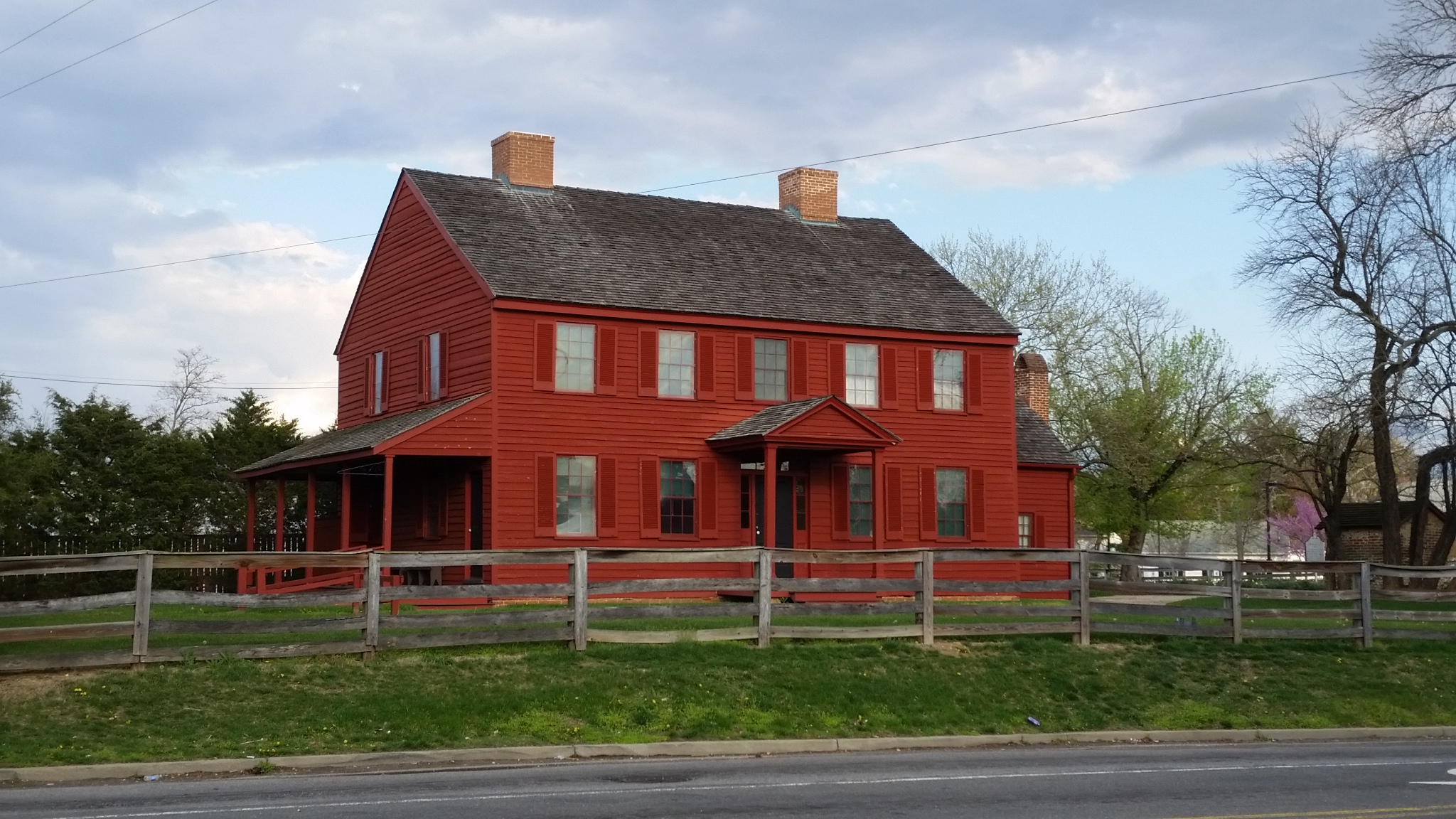
Surratt House Museum
On the night of April 14, 1865, John Wilkes Booth and David Herold rode hard through the Maryland darkness south of Washington. They stopped briefly at a two-story wood-frame tavern in Surrattsville to pick up two Spencer carbines, ammunition, and a pair of binoculars that had been hidden there weeks earlier. Then they vanished into the night. The tavern belonged to Mary Surratt, and within three months she would hang for her role in the conspiracy to assassinate President Abraham Lincoln. The building still stands at 9110 Brandywine Road in Clinton, Maryland, the town that quietly renamed itself to shed the Surratt association. Inside its restored rooms, the story of an ordinary household pulled into the most consequential crime in American history waits to be told.
A Crossroads Built on Ambition
John Harrison Surratt was an orphan adopted by a wealthy Washington couple. He married Mary Jenkins in August 1840, and within a year purchased farmland near what is now Clinton, Maryland. By 1853, he had constructed a tavern and inn that became the center of a small community. The area was officially named Surrattsville that same year, and a post office was installed inside the tavern with John as its first postmaster. He expanded relentlessly: a hotel addition in 1854, then a carriage house, corn crib, general store, forge, granary, gristmill, stable, tobacco curing house, and wheelwright's shop. The two-story house itself was a modest plantation-style structure with clapboard siding, a gable roof, five windows across each floor, and fireplaces at both ends. It was the kind of place travelers stopped on the road between Washington and southern Maryland, a crossroads that served whiskey and news in equal measure.
A Widow in Desperate Straits
John Surratt collapsed and died of a stroke in August 1862, leaving Mary alone with a farm, a tavern, and mounting debts. Her son, John Surratt Jr., was frequently away, and she struggled to keep the businesses afloat. By the fall of 1864, she decided to move to her townhouse at 541 H Street in Washington, D.C., renting out the Surrattsville property to a former policeman named John Lloyd. It was during this period that her son became entangled with John Wilkes Booth and the conspiracy that would first target Lincoln for kidnapping, then for murder. In March 1865, John Jr., George Atzerodt, and David Herold hid weapons and supplies at the family tavern. Mary made two trips to Surrattsville in April, claiming she needed to collect debts. On her second visit, April 14, she carried a package from Booth containing binoculars, to be left for pickup that night.
The Night Everything Changed
After shooting Lincoln at Ford's Theatre, Booth fled south with Herold. Their route was planned, and the Surratt tavern was their first stop. They retrieved the hidden carbines and binoculars, then continued their flight into southern Maryland. The manhunt that followed was the largest in American history to that point. Mary Surratt was arrested at her H Street boarding house on April 17 when investigators came looking for her son. She was tried by a military tribunal along with seven other conspirators. The evidence against her was debated then and remains contested now. Tavern keeper Lloyd testified that she had instructed him to have the "shooting irons" ready, though his credibility was questioned. Mary Surratt was sentenced to death on June 30, 1865. On July 7, she was hanged at the Old Arsenal Penitentiary in Washington at about 1:31 in the afternoon, becoming the first woman executed by the federal government.
From Tavern to Time Capsule
The house passed through private hands for a century after the assassination. In 1939, it suffered minor fire damage under the ownership of Mrs. Ella Curtin. On February 24, 1965, Clinton merchant B. K. Miller and his son Thomas donated the property to the Maryland-National Capital Park and Planning Commission. The house was listed on the National Register of Historic Places in 1973, and citizens formed the Surratt Society in 1975 to support its preservation. When the museum opened in 1976, the structure had been carefully restored to its 1865 condition, including a rebuilt southern addition. The house contains period furniture, though only one piece belonged to the Surratts: a writing desk owned by Mary. The James O. Hall Research Center operates on the grounds, and the museum is devoted to mid-nineteenth-century Maryland life and the Lincoln assassination. It remains one of the few places where visitors can stand inside the actual rooms where a pivotal chapter of American history unfolded.
From the Air
Located at 38.765N, 76.898W in Clinton, Prince George's County, Maryland, along Brandywine Road (MD-381). The house sits in a suburban area about 10 nm southeast of the National Mall. Nearest airports: KADW (Joint Base Andrews, 5 nm north), KVKX (Potomac Airfield, 8 nm south), KDCA (Reagan National, 12 nm northwest). Recommended altitude: 1,500-2,000 ft AGL. Look for the intersection of Brandywine Road and Woodyard Road as a visual reference.