Surrender of Japan: The Day the World Exhaled
They used a mess deck table. Not a mahogany diplomatic desk, not a gilded lectern -- an ordinary mess deck table draped in green felt, set on the starboard veranda deck of the battleship USS Missouri, anchored in Tokyo Bay. It was the morning of September 2, 1945, and around 250 Allied warships rode at anchor across the bay. Foreign Minister Mamoru Shigemitsu approached the table in a top hat and morning coat, walking on a wooden prosthetic leg he had worn since a 1932 bombing in Shanghai. General Yoshijiro Umezu followed in full military dress, his face rigid. Two copies of the Japanese Instrument of Surrender lay waiting -- one bound in leather for the Allied powers, the other in canvas for Japan. Within minutes, the deadliest war in human history would begin its formal end on that plain table, on that gray morning, on the water.
A Voice the Nation Could Barely Understand
The path to that table had begun eighteen days earlier with a voice most Japanese had never heard. On August 15, 1945, Emperor Hirohito addressed his subjects by radio for the first time, announcing Japan's acceptance of the Potsdam Declaration. The recording was poor. The Emperor spoke in Classical Japanese, a formal register far removed from everyday speech, and he never actually uttered the word 'surrender.' The broadcast was immediately followed by a clarification that Japan was, indeed, unconditionally surrendering. Reactions splintered across the nation. Some wept before the Imperial Palace gates. Some military officers chose suicide. Most people, as historian John Dower observed, shed tears that 'reflected a multitude of sentiments -- anguish, regret, bereavement and anger at having been deceived, sudden emptiness and loss of purpose.' Two days later, Hirohito delivered a second, shorter speech directly to his armed forces, asking them to 'bear the unbearable and leave an everlasting foundation of the nation.'
MacArthur Arrives
The occupation began before the ink was dry on any document. On August 19, Japanese officials flew to Manila to receive instructions from Supreme Commander Douglas MacArthur. On August 28, one hundred and fifty American personnel landed at Atsugi Airdrome in Kanagawa Prefecture, roughly thirty miles from Tokyo, and the physical occupation commenced. The 4th Marines came ashore along the Kanagawa coast. The 11th Airborne Division was airlifted in from Okinawa. MacArthur himself arrived in Tokyo on August 30 and immediately laid down three rules: no Allied personnel would assault Japanese people, no Allied personnel would eat scarce Japanese food, and the flying of the Rising Sun flag was severely restricted. These were not gestures of magnanimity alone -- they were calculated moves to prevent chaos in a nation of seventy million people teetering between compliance and collapse.
Perry's Flag and the Flypast
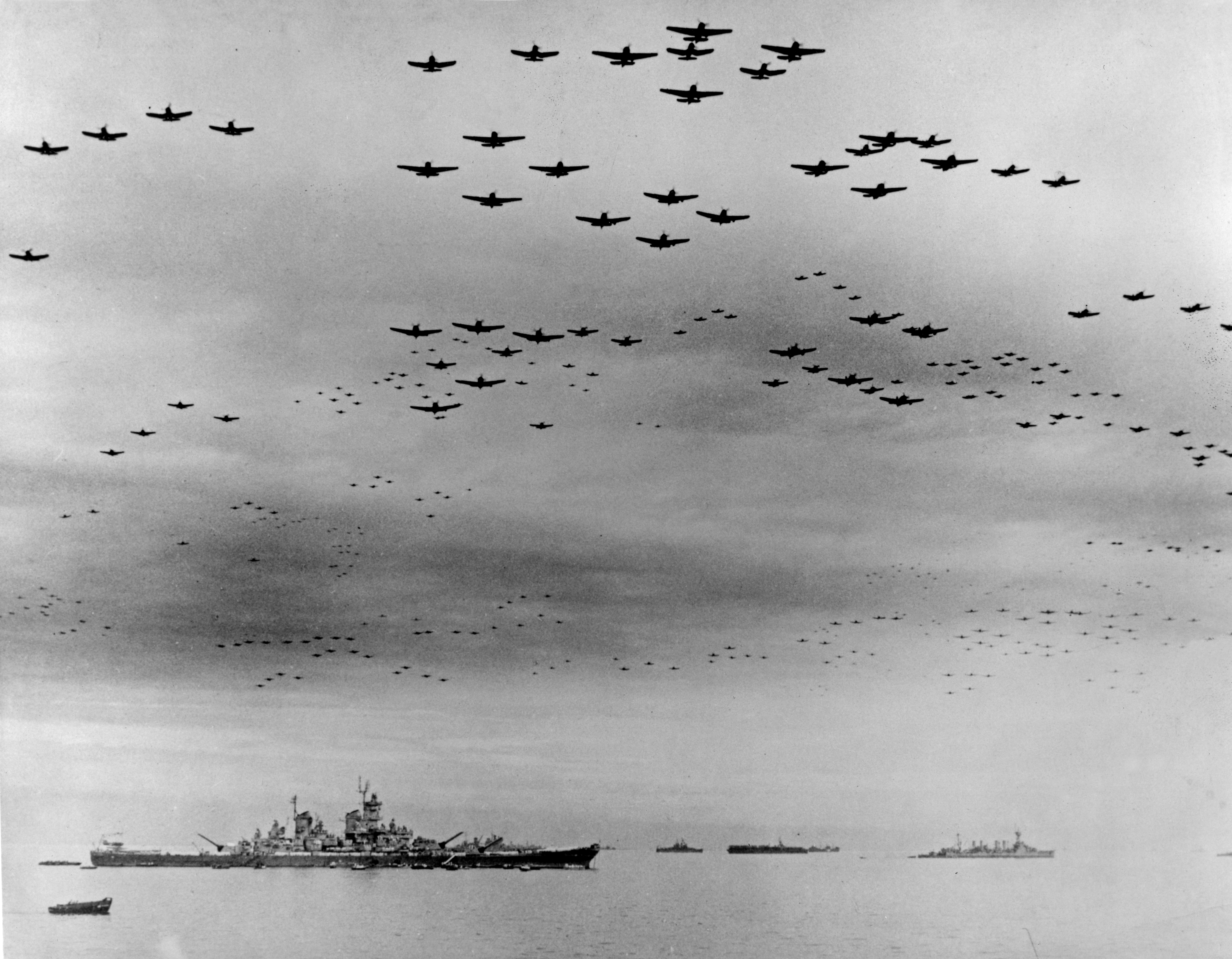
The ceremony aboard the Missouri on September 2 was choreographed down to the seating chart. MacArthur signed on behalf of all Allied nations, followed by Fleet Admiral Chester Nimitz for the United States. Representatives of eight other nations followed -- China, the United Kingdom, the Soviet Union, France, Australia, Canada, the Netherlands, and New Zealand. The ceremony was filmed in color by Navy photographer George F. Kosco, though the footage remained locked away until its public release in 2010. The future Prince Philip, Duke of Edinburgh, watched through binoculars from HMS Whelp nearby. But the most deliberate piece of theater hung behind the signatories: the same American flag that Commodore Matthew C. Perry had flown in 1853 when his expedition forced Japan to open its ports to Western trade. Ninety-two years of history closed into a circle on that deck. The ceremony concluded with a roar as more than 800 American aircraft -- including 462 B-29 Superfortresses from land bases -- filled the sky in a massed flypast over the Missouri and the assembled fleet.
Surrender Without End
The Missouri ceremony was only the beginning. That same day, a parallel surrender took place aboard another vessel at Truk Atoll in the Caroline Islands. Over the following weeks and months, Japanese forces across the Pacific and Southeast Asia laid down their arms -- in Penang on September 2, Labuan on September 10, Sarawak on September 11, Singapore on September 12, Kuala Lumpur on September 13. More than 5.4 million Japanese soldiers and 1.8 million sailors became prisoners of war. Full repatriation would not come until 1947 for most, and China still held over 60,000 Japanese prisoners as late as April 1949. The formal state of war did not end until the Treaty of San Francisco took effect on April 28, 1952 -- nearly seven years after the Missouri ceremony. Japan and the Soviet Union waited even longer, signing their joint declaration of peace in 1956.
The Men Who Never Surrendered
Not everyone heard the Emperor's broadcast, and not everyone believed it. Across the Pacific, Japanese holdouts on remote islands refused to accept the surrender, viewing it as Allied propaganda or considering capitulation incompatible with their military code. Teruo Nakamura, the last confirmed holdout, emerged from a hidden camp in what had become independent Indonesia in December 1974 -- twenty-nine years after the war's end. Two other Japanese soldiers who had joined Communist guerrillas in southern Thailand at the war's close continued fighting until 1990. On the waters of Tokyo Bay, the surrender had taken barely half an hour. Its aftershocks rippled across decades, across continents, and into the lives of men who never stopped fighting a war the world had long since declared over.
From the Air
Coordinates: 35.35°N, 139.76°E, in Tokyo Bay off the coast of Yokohama. The surrender ceremony took place aboard the USS Missouri anchored in the bay. From altitude, Tokyo Bay stretches between the Miura and Boso peninsulas, with the densely built Yokohama waterfront along the western shore. Best viewed at 3,000-5,000 feet AGL. Nearby airports include Tokyo Haneda (RJTT) approximately 15 nm north and Naval Air Facility Atsugi (RJTA) approximately 20 nm west-northwest. The Bay's outline is unmistakable from cruising altitude, with the Tokyo Bay Aqua-Line bridge-tunnel visible crossing its mouth.