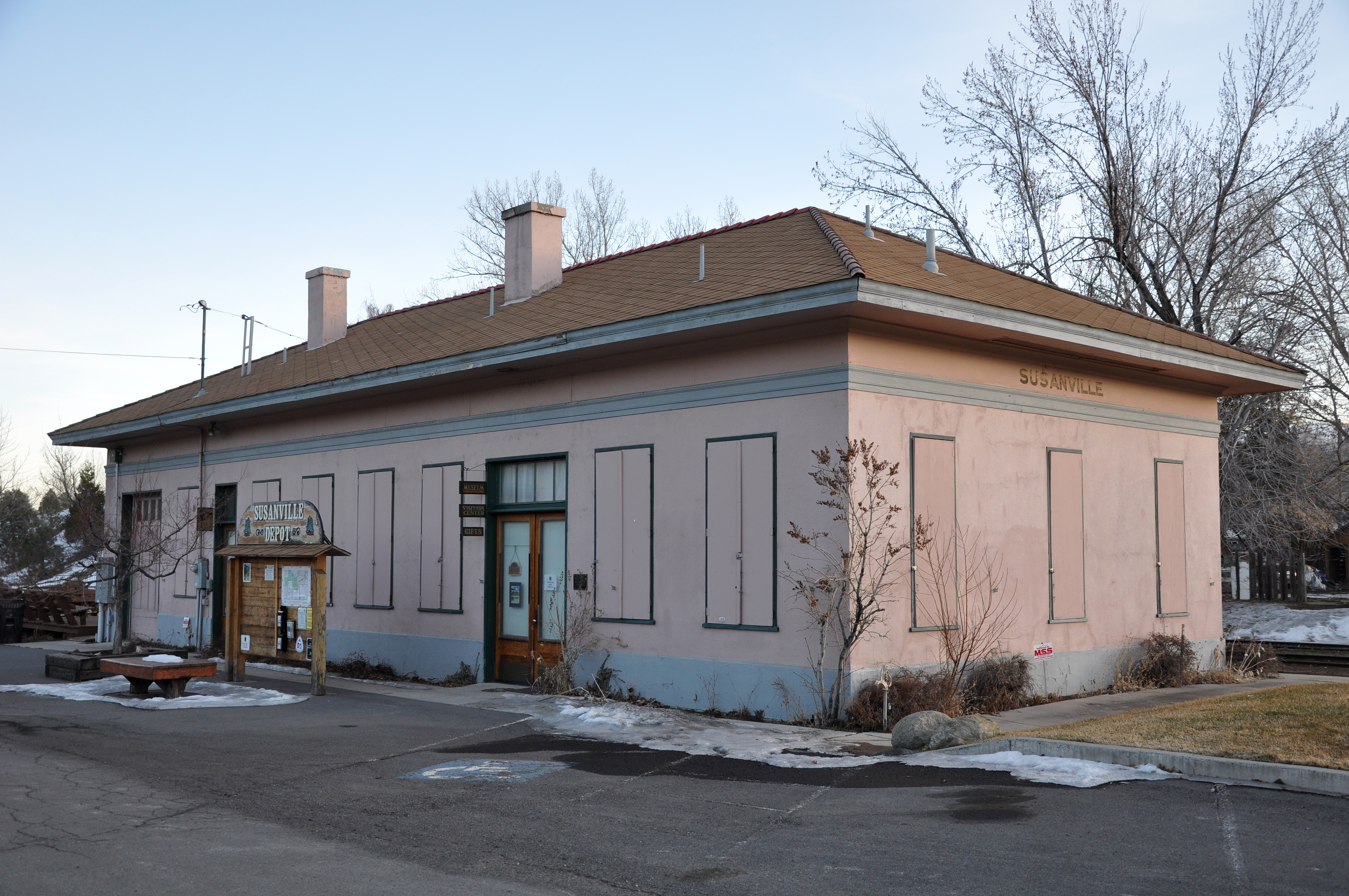
Susanville Railroad Depot
In 1987, the fire department of Susanville, California received an unusual offer: a free building to burn down for training. The Susanville Railroad Depot had sat vacant for eight years, vandalized and seemingly beyond saving. But when word spread of the planned destruction, something unexpected happened. The community said no. That protest launched a nonprofit, a renovation, and the transformation of a forgotten station into a museum and the starting point for one of California's premier rail-trails.
Timber, Rails, and the Southern Pacific
The Fernley and Lassen Railway was never meant to serve passengers. Southern Pacific built the line between 1912 and 1914 to haul timber from the lumber operations around Westwood. The rails originated at the Southern Pacific mainline in Fernley, Nevada, crossed the state border, and wound through the mountains to the mills. Susanville happened to be in the way. In April 1913, the railroad opened a depot in a converted boxcar. By September, they had built a proper combination station and freight shed. It served the purpose, but as the town grew, so did demands for something more dignified.
A Proper Station
The current depot opened in 1927, built adjacent to the original structure. It is a modest but handsome building: single-story stucco over a concrete foundation, topped with a hipped roof. A bay window projects from the south side toward the tracks. Inside, the original layout divided the space into three areas. The west end held a waiting room with lavatories and a phone booth. The center contained the ticket office, separated from passengers by a wooden counter. The east end housed the express office with sliding doors on both the track and street sides. Pine tongue-and-groove wainscoting lined the walls. The hardware was brass. The floor was linoleum.
The Long Decline
The Great Depression killed passenger service in 1933, but freight trains continued until 1956, when a washout destroyed a trestle west of town. Repairing the line was not economically justified. The trains stopped, but the station lingered on, used for office space and storage until October 1979, when Southern Pacific abandoned the entire Fernley and Lassen line. The depot sat empty through the early 1980s, accumulating damage from vandals and the elements. By 1987, demolition seemed the only practical option. That is when the fire department training proposal emerged, and that is when Susanville residents decided their station deserved better.
Rescue and Revival
A nonprofit formed to save the building. In November 1988, they purchased the 1.3-acre property from Southern Pacific Transportation Company. Renovation began in 1993, funded in part by two U.S. Forest Service Challenge Cost Share Grants totaling $88,584. Workers removed the 1950s alterations that had lowered ceilings and eliminated hallways. They replaced damaged fixtures, installed a new furnace and security system, and painted a pattern on the floor to replace the original linoleum. A redwood deck appeared at the east end. The parking lot was paved and landscaped with native plants. A section of original track remains on the south side of the building.
Trailhead to the Past
The depot reopened in 1994 and now houses the Lassen Land and Trails Trust offices and a small museum. But its most significant role may be as the eastern terminus of the Bizz Johnson Trail, a 25-mile path that follows the abandoned Fernley and Lassen right-of-way west through the Susan River canyon. Hikers, bikers, and horseback riders start their journeys where passengers once bought tickets and freight handlers loaded boxcars. Each fall, the trust hosts a Rails to Trails festival at the station. The original 1913 structure burned in 1989, leaving the 1927 depot standing alone as a monument to a railroad that served its purpose and a community that refused to let that history disappear.
From the Air
The Susanville Railroad Depot is located at 40.41N, 120.66W in the city of Susanville, Lassen County, California. From altitude, look for the small historic structure near the eastern edge of town where the Bizz Johnson Trail begins its westward route along the old railroad grade. Susanville Municipal Airport (KSVE) is approximately 5 nautical miles south. Best viewed at 2,000-3,000 feet AGL. The trail corridor is visible heading west into the Susan River canyon.