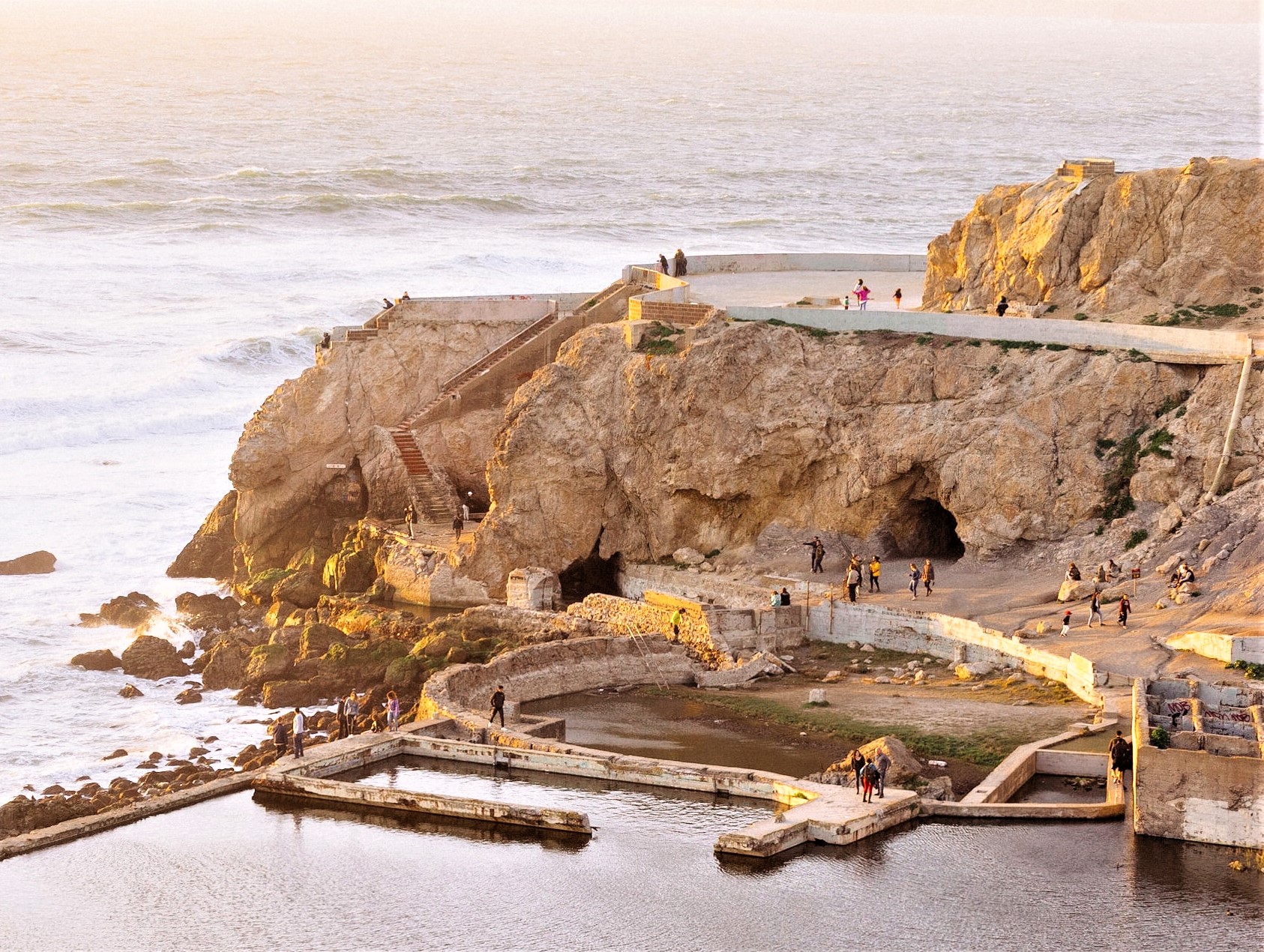
Sutro Baths Ruins
At the edge of San Francisco, where the Pacific Ocean crashes against the Lands End cliffs, concrete foundations and rusting metal trace the outline of what was once the world's largest indoor swimming facility. Sutro Baths opened in 1896 - a glass-enclosed palace covering 3 acres, containing seven pools of varying temperatures, a concert hall for 3,700, a museum, restaurants, and an ice skating rink. Adolph Sutro, the silver millionaire who built it, believed working-class San Franciscans deserved recreation as grand as any private club. For a dime, anyone could swim in heated seawater while looking out at the Pacific. The Baths thrived, declined, sat abandoned, and finally burned in 1966 - a suspected arson fire that destroyed what time had already doomed. The ruins remain, a sculptural remnant of Victorian ambition eroding into the sea.
The Builder
Adolph Sutro was one of San Francisco's great eccentrics. A Prussian immigrant, he made his fortune engineering the Sutro Tunnel, which drained and ventilated Nevada's Comstock Lode silver mines. He moved to San Francisco, bought the Cliff House and the land around it, and set about building a recreational empire for the common people. He opposed the Southern Pacific Railroad's monopoly on transit, running his own streetcar line to bring visitors to the beach. He collected books obsessively, amassing one of the largest private libraries in America. He became mayor of San Francisco in 1894. But his greatest monument was the Baths.
The Baths
Sutro Baths was engineering as spectacle. The structure covered nearly 3 acres under a curved glass roof. Ocean water filled the pools through a system of tunnels and pumps, heated to different temperatures for different experiences. At capacity, 10,000 people could swim simultaneously. For those who didn't swim, there was a museum of curiosities, including Egyptian mummies and Tom Thumb memorabilia. A 2,700-seat amphitheater hosted concerts and performances. Promenades lined the pools, allowing spectators to watch. The entrance fee was 25 cents - within reach of working families. On weekends, crowds of San Franciscans rode Sutro's streetcar to the beach.
The Decline
Sutro died in 1898, only two years after his dream opened. His heirs lacked his civic vision and resources. The Baths required constant maintenance; the salt water corroded everything. By the 1920s, competition from private pools and changing tastes reduced attendance. The Depression nearly killed it. By the 1950s, portions had been converted to an ice skating rink in desperate attempts at relevance. The last owner planned to demolish the structure and develop the land for apartments. In 1966, while demolition was underway, fire swept through the building. The cause was never determined, but arson was suspected. What the sea hadn't corroded, the fire consumed.
The Ruins
The National Park Service acquired the site in 1973, incorporating it into the Golden Gate National Recreation Area. Rather than clear the ruins, they've been left to erode naturally - a decision that created one of San Francisco's most evocative landscapes. Concrete foundations trace the pool outlines. Steel reinforcement rusts red against the cliff. The tunnel that brought ocean water is still visible, waves crashing through. The ruins have a post-apocalyptic beauty, especially in fog. Visitors wander through what was once the promenade, imagining the crowds, the splashing, the band playing. The ocean continues its work, claiming the ruins piece by piece.
Visiting Sutro Baths
Sutro Baths Ruins are located at 680 Point Lobos Avenue in San Francisco, adjacent to the Cliff House (which was rebuilt after its own fire and now houses a restaurant). The ruins are open to exploration during daylight hours - wear sturdy shoes, as the concrete is broken and surfaces are slippery. Trails lead down from the visitor parking area to the ruins and the cave at the north end. The Lands End Trail connects to the Sutro Baths and offers spectacular coastal hiking. The site is part of the Golden Gate National Recreation Area. Public transit via Muni (lines 38 and 18) reaches the area. SFO is 20 miles south. Fog is common; dress in layers.
From the Air
Located at 37.78°N, 122.51°W at the far northwestern tip of the San Francisco Peninsula. From altitude, the ruins are visible as geometric concrete foundations at the base of cliffs, waves breaking through what were once enclosed pools. The Cliff House sits above. The Lands End trail traces the clifftops. Lincoln Park Golf Course is adjacent. The site marks the entrance to the Golden Gate strait; the bridge is visible 2 miles to the north. The Pacific Ocean stretches to the western horizon. SFO is 20 miles south.