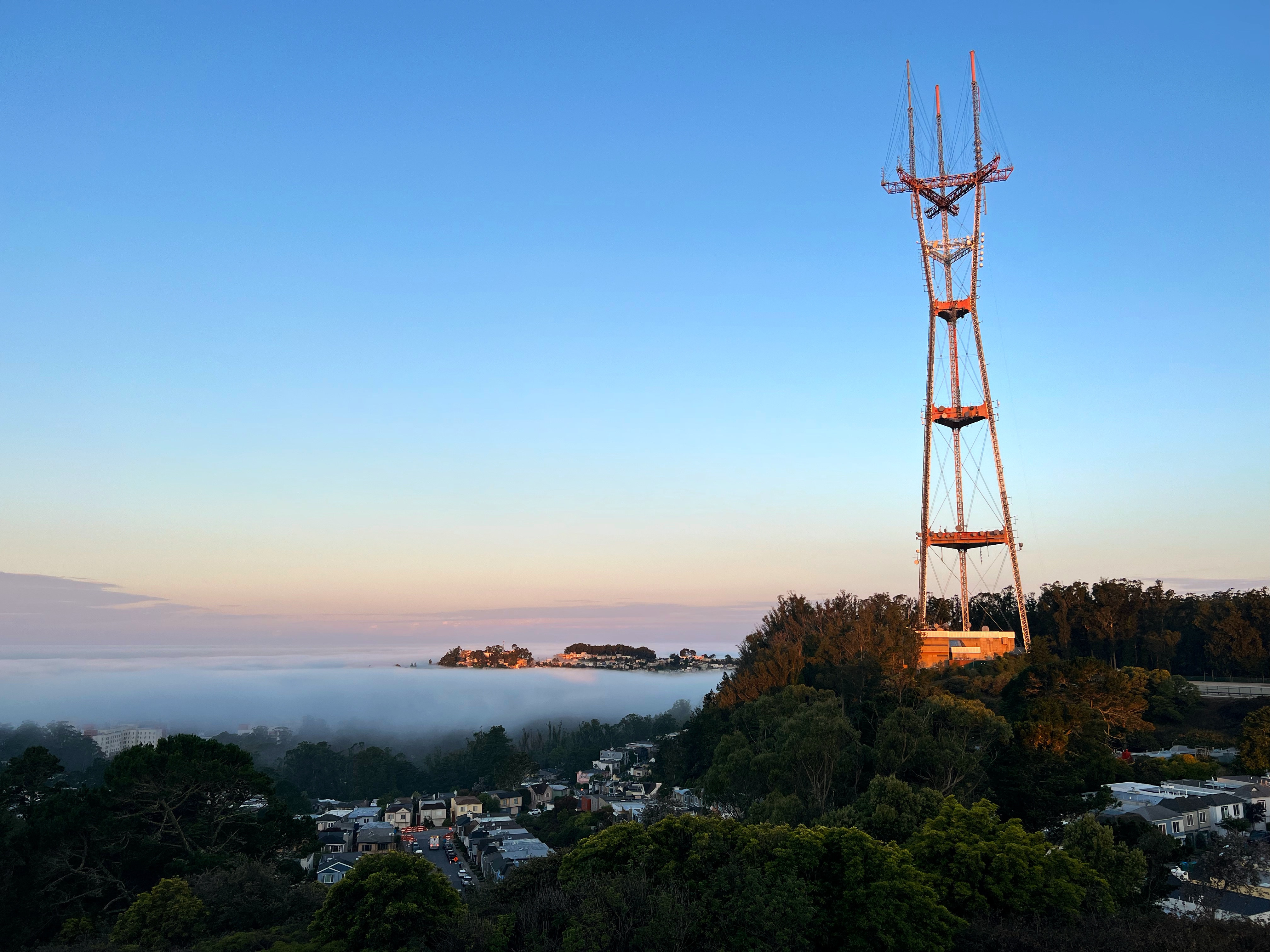
Sutro Tower
On Twin Peaks, the highest point in San Francisco, a 977-foot tower rises into the fog. Sutro Tower was built in 1973 to consolidate television and FM broadcast antennas, and San Franciscans immediately despised it. The design - a three-legged structure that appears to split into prongs at the top - was called ugly, industrial, and completely wrong for a city that prided itself on aesthetic sensitivity. Petitions circulated to paint it sky blue for camouflage. The fog ignored the controversy, wrapping the tower daily, making it appear to float, headless, above the city. Fifty years later, Sutro Tower is beloved. It's become a wayfinding landmark, a fog gauge, a strange friend visible from everywhere. The tower has its own merchandise, its own social media presence, and a dedicated fan base. San Francisco's Eiffel Tower, they call it - if the Eiffel Tower had been designed by aliens. The tower that everyone hated became the tower no one would demolish.
The Problem
By the late 1960s, San Francisco's broadcast situation was chaos. Television and FM stations had antennas scattered across the hills, creating interference and coverage gaps. The city's terrain - hills, valleys, fog - made broadcasting challenging. The solution was a consolidated tower on Twin Peaks, the highest point with clear sightlines to the entire Bay Area. Three companies - Sutro Tower Inc., a consortium of local broadcasters - proposed a 977-foot tower that would combine all antennas in one structure. The city approved it. Then residents saw the design.
The Design
Sutro Tower looks like nothing else. The base is three steel legs meeting at a platform. Above that, the tower splits into three prongs, each carrying broadcast antennas. The structure is painted in orange and white aviation warning colors. From certain angles, it resembles a tuning fork. From others, a trident. From still others, an alien landing craft. The design was purely functional - engineer Albert Locke created a structure that could hold antennas while withstanding earthquake forces and 100-mph winds. Aesthetics were not a consideration. The result was something too strange to be ugly, though plenty of people tried to call it that anyway.
The Controversy
When construction began in 1971, protests erupted. The tower would ruin views. It was an eyesore. It was industrial brutalism on San Francisco's sacred hills. A petition to paint it sky blue gathered thousands of signatures. Another group suggested covering it with climbing plants. The broadcasters, having spent $4 million, were unmoved. The tower was completed in 1973 and began operations. The complaints continued for a decade, then faded. Something changed. Perhaps the tower became invisible through familiarity. Perhaps San Franciscans realized the tower was genuinely useful - when you could see it, you knew exactly where you were. Perhaps they just decided to like it.
The Icon
Today, Sutro Tower is a beloved San Francisco icon. Its visibility from anywhere in the city makes it a constant companion - emerging from fog, silhouetted at sunset, blinking red at night. Social media accounts track its moods. Local businesses sell Sutro Tower merchandise. The tower marks the weather: when fog envelops the prongs, rain is coming; when it's fully visible, expect sunshine. Residents who grew up seeing it daily feel affection for its strangeness. It's become part of San Francisco's identity, as essential as the Golden Gate Bridge, as weird as the city itself.
Visiting Sutro Tower
Sutro Tower is not open to the public - it's a working broadcast facility. The best views are from Twin Peaks, where a parking area allows close approach to the tower's base. Corona Heights Park and Tank Hill offer other vantage points. The tower is visible from most of San Francisco; finding a view is rarely difficult. Binoculars allow appreciation of the structure's complexity - the antennas, the guy wires, the aviation lights. Fog creates the most dramatic effects: the tower emerging from white, its top invisible, its legs planted in cloud. San Francisco International Airport is 13 miles south. The tower is a landmark for arriving flights - when you see it, you're about to land.
From the Air
Located at 37.76°N, 122.45°W on Twin Peaks in San Francisco, California. From altitude, Sutro Tower is the most visible man-made structure in San Francisco - its 977-foot height makes it taller than any building in the city. The orange and white coloring stands out against the green of Twin Peaks. Downtown San Francisco is to the northeast; Golden Gate Bridge to the northwest; the Pacific Ocean to the west. The tower is often surrounded by fog while other parts of the city are clear. San Francisco International Airport is 13 miles south; Oakland International is 15 miles east.