The Fort That Gold Destroyed
On January 28, 1848, a carpenter named James Marshall walked into the main building of Sutter's Fort and closed the door behind him. He had ridden hard from Coloma, roughly forty miles to the east, where he had been building a sawmill along the American River. He opened his hand and showed John Sutter what he had found in the millrace four days earlier: flakes of gold. The two men tested the metal with nitric acid, weighed it, consulted an encyclopedia. It was real. Sutter begged Marshall to keep the discovery secret, understanding instinctively that the news would destroy everything he had spent a decade building. He was right. Within months, the workers who tended his fields and livestock had abandoned him, the squatters who would contest his land grants had begun arriving, and the fort that was supposed to anchor a Swiss émigré's personal utopia became the birthplace of a city that had no use for him.
New Helvetia, Built on Stolen Labor
Sutter arrived in the Sacramento Valley in August 1839, sailing up the Sacramento River from Yerba Buena -- the settlement that would become San Francisco -- and landing at the junction with the American River. He secured a 50,000-acre land grant from the Mexican governor of Alta California and began constructing what he called New Helvetia: New Switzerland, a utopian colony in the middle of a landscape the Nisenan and Miwok peoples had inhabited for thousands of years. The fort's main building, a two-story adobe structure with walls two and a half feet thick and fifteen to eighteen feet high, was built between 1841 and 1843. Its construction relied on Indigenous forced labor under conditions that contemporary accounts describe as plantation-style or feudal. Sutter controlled the labor, the land, and the trade routes; New Helvetia became the first non-Indigenous settlement in the Central Valley, a waystation at the end of the California and Siskiyou Trails where emigrants could rest, resupply, and begin new lives. Among the most desperate to arrive were the survivors of the Donner Party in 1847, staggering out of the Sierra Nevada after a winter that had reduced their company to cannibalism.
Gold and Ruin
Marshall's discovery at the sawmill in Coloma on January 24, 1848, set off the California Gold Rush, and the rush consumed Sutter's empire whole. His laborers vanished to the goldfields. Squatters occupied his land. Speculators carved his holdings into city lots and sold them at prices the original owner could not contest. Disillusioned, Sutter handed control of his affairs to his son, John Sutter Jr., who partnered with the entrepreneur Samuel Brannan to develop the embarcadero at the river confluence into a proper settlement. They called it Sacramento City. The fort itself was abandoned as the new town spilled outward around it, its adobe walls left to crumble while the city that owed its existence to Sutter's misfortune grew into the capital of a new American state. The irony was total: the man who had built the gateway to California was ruined by the very thing that made California matter.
The Road That Carried the Rush
A dirt track called Coloma Road connected the fort to the goldfields beginning in 1847, and after Marshall's discovery it became one of the most heavily traveled routes in the West. Thousands of miners walked, rode, and hauled their way along it, heading east toward claims in the Sierra foothills. California's first stage line, the California Stage Company founded by James E. Birch, began running coaches along the road in 1849. Three separate sections of the route are now designated California Historical Landmarks. The road was the supply line, the escape route, and the pathway of fortune -- all flowing in both directions, from the fort to the gold and from the gold back to the fort, carrying news, supplies, hope, and occasionally the disillusioned.
Adobe Walls, Still Standing
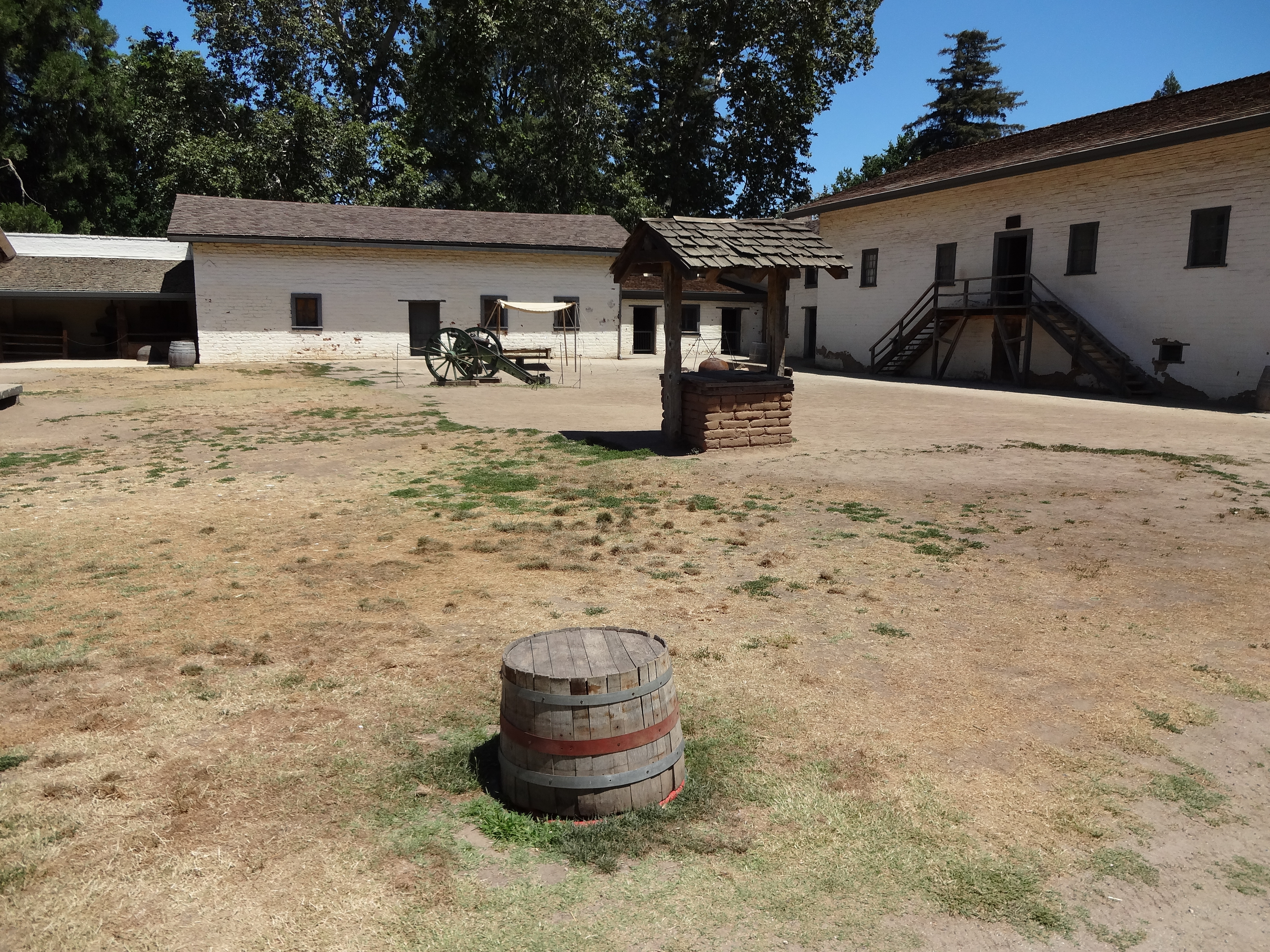
The main building of Sutter's Fort is the only original structure surviving at what is now Sutter's Fort State Historic Park, administered by the California Department of Parks and Recreation. The rest has been reconstructed around it, the adobe walls restored to approximate their 1840s condition. In 1961, the fort was designated a National Historic Landmark. Nearby, the California State Indian Museum tells the parallel story the fort's original narrative left out -- the story of the Indigenous peoples whose labor built the walls and whose displacement made the colony possible. The New Helvetia Cemetery, once known as the Sutter Fort Burying Ground, holds the remains of some of Sacramento's earliest non-Indigenous residents. Walking through the reconstructed compound today, the stillness is deceptive. This was once the loudest, most chaotic place in the American West -- the funnel through which an entire continent's ambitions poured into the goldfields beyond.
From the Air
Located at 38.57N, 121.47W in midtown Sacramento. The fort compound and its surrounding park are visible from the air as a distinctive rectangular enclosure east of the Capitol building. The American River runs roughly 1 mile north; the Sacramento River is about 1.5 miles west. Sacramento Executive Airport (KSAC) is 3nm south; Sacramento International (KSMF) is 10nm northwest. Coloma Road historically ran northeast from here to Marshall Gold Discovery State Historic Park. Best viewed at 1,500-3,000 feet AGL.