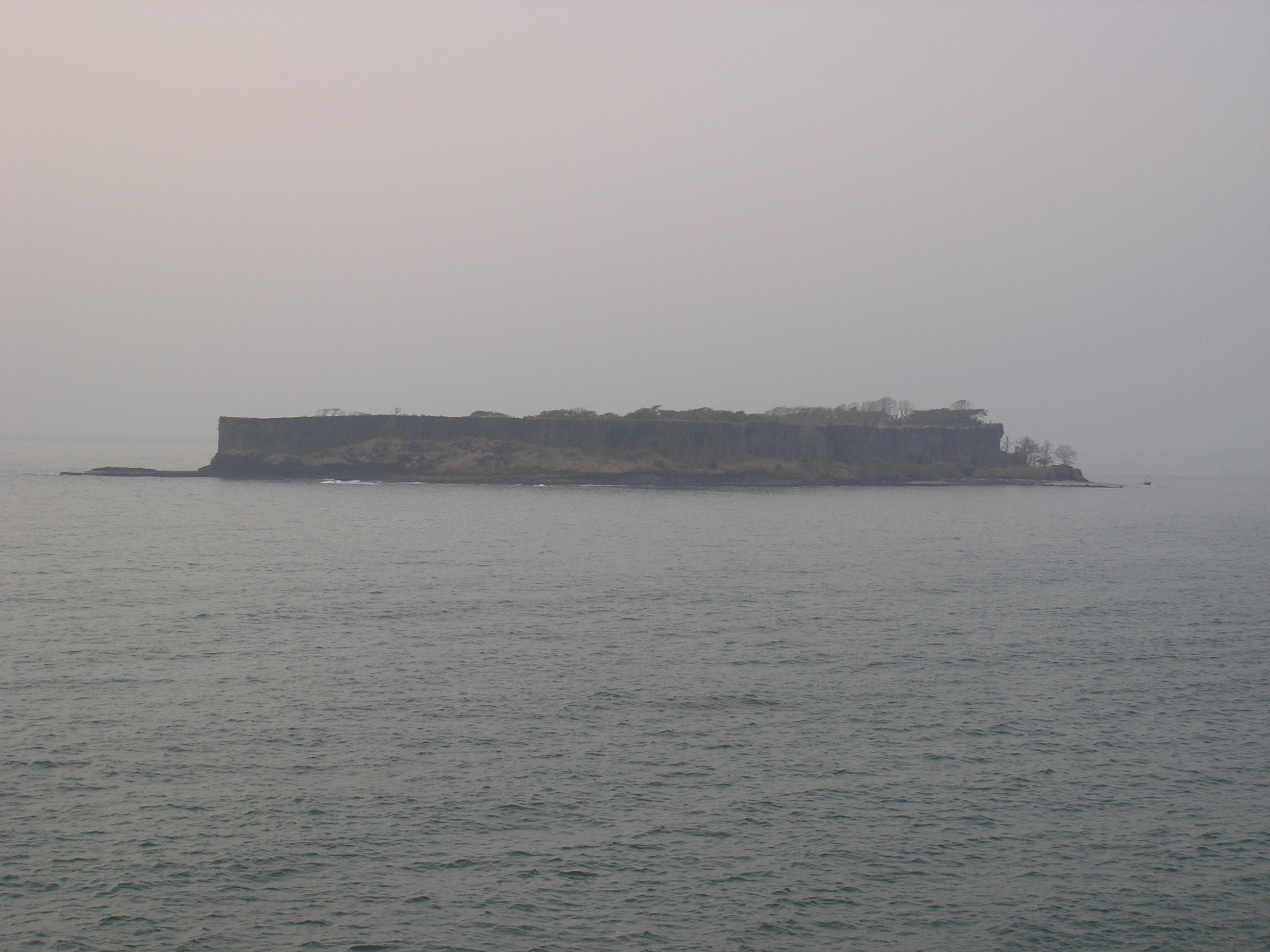
Suvarnadurg
The British called him a pirate. His own people called him the Shivaji of the Sea. Kanhoji Angre, Admiral of the Maratha Navy, stationed his fleet at Suvarnadurg in 1696 and spent decades confronting the European trading companies that claimed ownership of India's coastal shipping lanes. The island fortress he commanded -- its name means "Golden Fort" in Marathi -- sits in the Arabian Sea off Harnai, between Mumbai and Goa, a rocky sentinel that still bears the scars of cannon fire and siege. Modern historians have since vindicated Angre, recognizing him not as a pirate but as the legitimate naval commander of an Indian kingdom that refused to cede its own coastline.
Fortress on the Waves
Suvarnadurg rises from a small island in the Arabian Sea, within Ratnagiri district on Maharashtra's Konkan coast. There is no jetty -- visitors must arrange boats through local fishermen at Harnai, landing on a sandy beach among the rocks. The nearest town, Dapoli, sits 17 kilometers inland. On the headland opposite, the companion fort of Kanakadurga once served as a lookout post and strategic link to the sea fort, its lighthouse still standing among the ruins of two dilapidated bastions. A narrow channel separates the island from the mainland, and the natural harbor at Harnai, right at the edge of land protruding into the Arabian Sea, thrives today as a fishing port. Chhatrapati Shivaji Maharaj, founder of the Maratha Empire, is credited with building Suvarnadurg in 1660. The Adilshah Navy had originally established the site for defense, but it was the Marathas who transformed it into something more ambitious: not just a fort but a shipbuilding yard, capable of producing warships to patrol the entire western coast.
Admiral of the Konkan
Kanhoji Angre received formal control of Suvarnadurg in 1713 from Shahu Raja, though his fleet had operated from the fort since 1696. From this island base, the Angre family built a naval empire. They constructed warships in the fort's own shipyard and created a network of smaller fortifications -- Guva, Kanakadurga, Bankot, Fattegad, and Gova -- designed to protect Suvarnadurg from any landward approach. For decades, the Angre fleet challenged the British, French, and Dutch East India Companies, asserting Maratha sovereignty over the coastal lanes that European powers assumed were theirs to control. Historian Simon Leyton has written that Kanhoji "is more properly thought of as the 'Admiral' of the Marathas, who for many years confronted European attempts to claim navigational rights over coastal shipping lanes." The Angres were not rogue pirates. They were defending a coastline.
The Siege of 1755
After Kanhoji's death, his sons divided the inheritance -- and turned on each other. Sambaji, a legitimate son, controlled Suvarnadurg, while Tulaji, a stepbrother, steadily grew more powerful, his ships sailing with an audacity that surpassed even his father's. By 1749, Tulaji's dominance had become intolerable to the Peshwas, the Maratha prime ministers, who made a fateful decision: they invited the British to help suppress him. The joint siege began on 25 March 1755 and lasted until 2 April. British Commodore William James captured the fort on 12 April 1755 and handed it to the Peshwas, but the alliance came at a steep price. In exchange for their support, the British extracted control of the Bankot fort, gaining a strategic foothold on the coast. The Peshwas got Suvarnadurg; the British got the beginning of an empire.
The Last Retreat
Suvarnadurg's final decades as a Maratha stronghold were marked by desperation. In 1802, Bajirao Peshwa, under attack by the Holkars, tried to take refuge in the sea fort but was chased all the way to Vasai before he could reach safety. The fort that had once projected Maratha power across the Arabian Sea had become a place to flee toward rather than fight from. On 4 December 1818, Captain William led a British force that took full control of Suvarnadurg, ending over a century of Maratha dominion. The other forts in the chain soon followed. Today the island sits quietly in the sea, its walls weathered, its step well still holding water in the cooler months. Nine ponds inside the companion fort of Kanakadurga -- eight separated by stone walls, the ninth set apart to the west -- still collect rainwater, a reminder that this was once a living garrison, not a ruin.
Between Golden Cap and Open Water
The Marathas called Suvarnadurg the "feather in the golden cap" of their empire. For over 150 years, the fort served as shipyard, naval base, and symbol of indigenous resistance to colonial encroachment on India's western seaboard. Its story is inseparable from the Angre family, whose reputation has shifted over centuries from pirate to patriot as historians have reexamined the colonial narratives that first defined them. The fort that once launched warships now launches fishing boats from Harnai's harbor. Mumbai lies 230 kilometers to the north, and the nearest railway station is at Khed on the Konkan Railway. Reaching Suvarnadurg still requires negotiating with local fishermen for a boat ride -- the same approach that any visitor, invader, or admiral would have taken centuries ago.
From the Air
Suvarnadurg is located at 17.82N, 73.08E on a small island off the Konkan coast in the Arabian Sea, within Ratnagiri district, Maharashtra. Best viewed at 2,000-3,000 feet AGL in clear conditions. The island fort is visible as a distinct rock formation off Harnai port. The companion Kanakadurga fort sits on the headland opposite. Nearest airport is Mumbai (VABB), approximately 230 km north. The Konkan coastline with its series of headlands and natural harbors provides excellent visual navigation references.