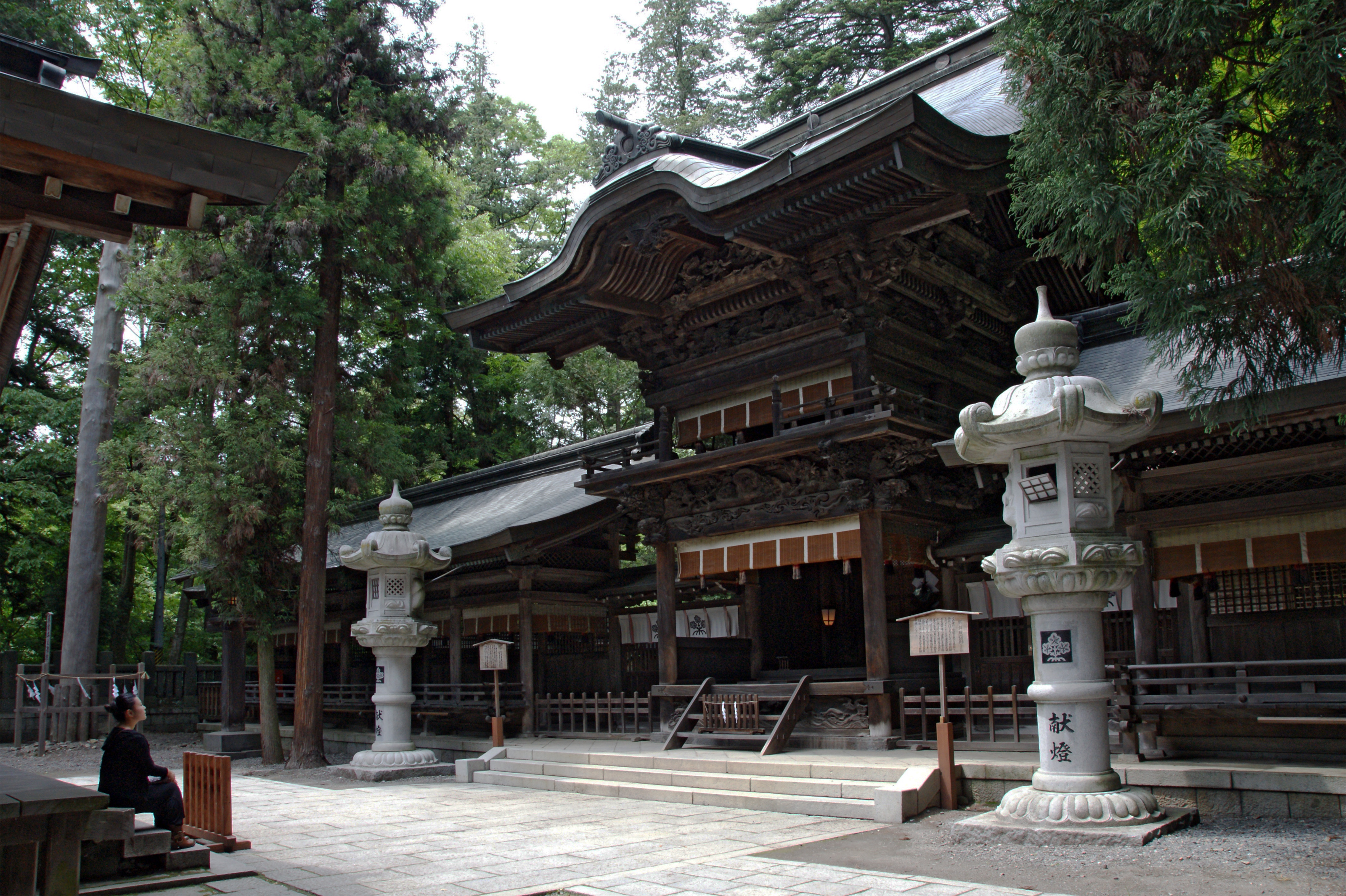
Suwa-taisha
The high priest was eight years old when he became a god. In the mountains of Nagano Prefecture, at one of Japan's oldest shrine complexes, the Suwa clan installed a child as their Ohori -- not merely a spiritual leader, but a living incarnation of the deity Takeminakata, whose words carried the weight of divine command. Warlords knelt before him. Samurai obeyed his pronouncements as the voice of Suwa Myojin himself. This extraordinary tradition anchored Suwa-taisha for centuries, binding together four shrines, sixty auxiliary sanctuaries, and a belief system so deeply layered that scholars still puzzle over its contradictions.
A God Who Lost and Won
The mythology of Suwa-taisha begins with defeat. According to the Kojiki, compiled around 712 CE, Takeminakata was a son of the great god Okuninushi who fled to Suwa after losing a humiliating contest against the warrior god Takemikazuchi. Yet in Suwa itself, the same deity is remembered as a conquering force -- an interloper who wrested the region from the native god Moriya before making him a collaborator. Other legends cast him as a king from India who slew a dragon in Persia, or as the warrior Koga Saburo, who journeyed through the underworld and emerged transformed into a serpent. These competing stories reflect the shrine's tangled origins, where Yamato expansion, local resistance, and centuries of mythmaking collided into something richer than any single narrative.
Four Shrines, Two Worlds
The complex divides into the Upper Shrine (Kamisha) and Lower Shrine (Shimosha), each with two main sites, each historically independent with its own priesthood and ceremonies. The Upper Shrine's Honmiya sits in the foothills of Mount Moriya, where medieval records describe the most sacred space as nothing more than a rock -- an iwakura serving as the deity's dwelling, marked by a torii gate and a simple fence. Three of the four main sites lack a honden, the building that normally houses a shrine's kami. In their place stand twin thatched-roof treasure halls called hoden, rebuilt in alternating cycles every six years during the legendary Onbashira Festival. The oldest surviving structure, a gate donated by Tokugawa Ieyasu in 1608, sits between these constantly renewed buildings, a fixed point amid ritual transformation.
Talismans for Forbidden Meat
In an era when Buddhist strictures against meat consumption pervaded Japanese society, the shrines of Suwa offered a remarkable loophole. The shrine's priests produced special talismans called kajikimen -- literally 'permits to eat venison' -- along with consecrated chopsticks, that were held to grant divine permission to consume meat. Hunting occupied a central role in the shrine's rituals, with deer offered before the Ohori alongside chestnuts, rice, and sake. This appetite for the hunt attracted the samurai class, who found in Suwa Myojin both a martial deity and a practical patron. When the Kamakura shogunate banned falconry in 1212, warriors discovered that Suwa's shrines were exempt due to the sacred importance of hunting in their rites. Eager noblemen built branch shrines across Japan, ostensibly for 'Suwa style' falconry, and by the medieval period Suwa branch shrines numbered in the thousands.
Warlords and Sacred Helmets
The shrine's most dramatic chapter belongs to Takeda Shingen, the legendary Sengoku-era warlord. After the Suwa clan's leader Yorishige was betrayed and forced to commit suicide, Shingen took Yorishige's daughter as his wife. Their son Katsuyori would eventually bring down the Takeda house. But Shingen's devotion to Suwa Myojin was genuine and calculated: he carried war banners inscribed with the deity's Buddhist name and wore the famous Suwa Hossho helmet into battle. When he conquered all of Shinano Province, he ordered the revival of religious rituals that had lapsed during the chaos of war. In 1582, Oda Nobunaga's son Nobutada burned the Upper Shrine to the ground. It was rebuilt within two years, a testament to how deeply this sacred place had rooted itself in the landscape.
Where the Lake Once Reached
In antiquity, Lake Suwa's waters stood five to six meters higher than today, lapping at the very edges of the Honmiya compound. The wooden torii gate at the shrine's northwest corner is still called the Namiyoke -- the 'Wave-Repelling' gate -- though the lake now sits 5.2 kilometers away. This retreat of water mirrors the shrine's own transformation: from a sacred rock in the open air to an elaborate complex of halls and corridors, from a regional cult to one of Japan's most important Shinto institutions. The Meiji Restoration of 1868 forcibly separated Buddhism from Shinto here, stripping away centuries of syncretic practice, laicizing monks, and abolishing the hereditary priesthood. The living god became an ordinary citizen. Yet the shrine endured, rising through government ranks until it achieved the highest classification in 1916, and today Suwa-taisha draws visitors who sense, beneath the formality, something far older than any title can contain.
From the Air
Suwa-taisha's four shrine sites are spread around the southern shore of Lake Suwa at approximately 36.00N, 138.12E. The Upper Shrine (Kamisha) is nestled in the foothills south of the lake, while the Lower Shrine (Shimosha) sits near the town of Shimosuwa at the lake's northwest end. Lake Suwa itself is a prominent visual landmark from the air. The nearest airport is Matsumoto Airport (RJAF), approximately 40 km northwest. At cruising altitude, the Suwa basin is framed by the Yatsugatake range to the southeast and the Kiso Mountains to the west. Best viewed at 3,000-5,000 feet AGL for shrine compound detail against the lake backdrop.