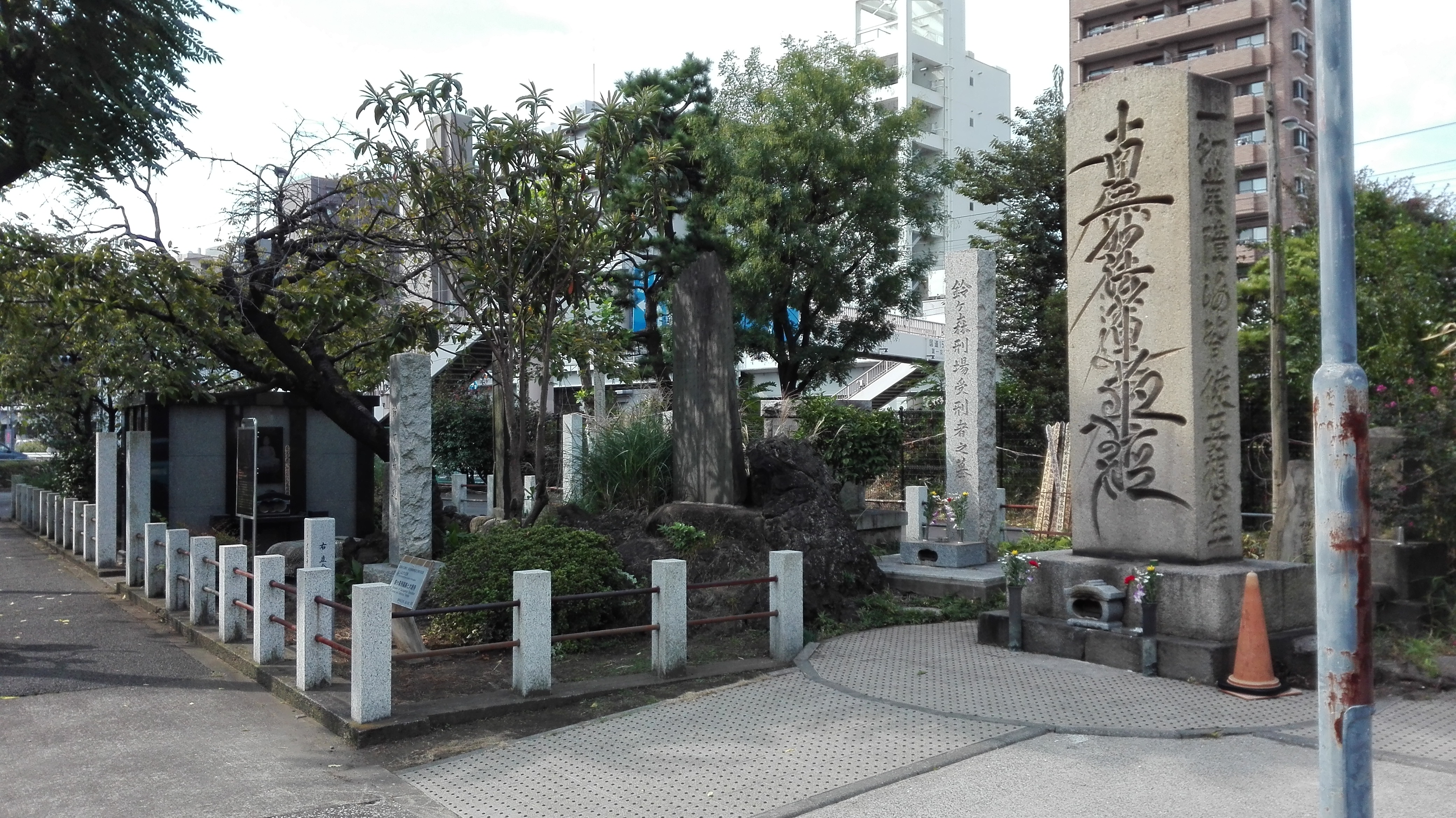
Suzugamori Execution Grounds
The iron post is still there. Blackened and weathered, it once held human beings over flames. A stone base nearby -- its surface worn smooth by centuries of rain -- once supported the wooden pillars used for crucifixion. These artifacts sit on a narrow triangle of land in Shinagawa, hemmed in on every side by Route 15 and the roar of the Keihin Expressway, ten minutes on foot from Omori-Kaigan Station. Commuters pass within meters of them every day. Most do not stop. The Suzugamori execution grounds operated for 220 years, from 1651 to 1871, and by conservative estimates the Tokugawa shogunate put 100,000 people to death on this patch of reclaimed shoreline at the southern entrance to Edo.
The Gate of No Return
Location was the point. Suzugamori sat along the Tokaido, the great coastal highway connecting Edo to Kyoto, positioned deliberately at the city's southern threshold. Every traveler entering or leaving the shogun's capital would pass the grounds and see the consequences of defiance. The logic was spiritual as well as political -- executions were pushed to the outskirts to prevent 'spiritual pollution' of the city proper. A parallel site, Kotsukappara, served the same function at Edo's northern entrance along the Nikko Kaido. Together, these killing grounds bracketed the city like warnings carved in flesh. The site measured roughly 74 by 16 meters, a surprisingly compact strip of land for the scale of death it witnessed. At its peak, Suzugamori was on the shore of Edo Bay itself, and the tide played a role in certain executions -- prisoners were suspended upside down and left to drown as the water rose.
Marubashi and the Sixteen-Year-Old Arsonist
The first person executed at Suzugamori is believed to have been Marubashi Chuya, a masterless samurai who plotted to overthrow the shogunate in the Keian Uprising of 1651. He had already died -- some accounts say by suicide during his arrest -- but the authorities drowned his corpse at Suzugamori anyway, a public spectacle designed to extinguish any sympathy for the rebellion before it could take root. The execution grounds saw all manner of condemned. Among the most famous was Yaoya Oshichi, a sixteen-year-old greengrocer's daughter who set fire to her family's neighborhood in 1683, allegedly hoping that the resulting evacuation would reunite her with a young temple page she had fallen in love with during a previous fire. She was burned at the stake. Her story passed into kabuki theater, bunraku puppet plays, and Japanese literature, becoming one of the most retold tragedies of the Edo period. The bandit-priest Ten'ichi-bo, known for swindling and murder, also met his end here.
Methods of the Shogunate
The executions at Suzugamori were not discreet. The shogunate employed a hierarchy of punishments calibrated to the severity of the crime, and each was designed to be witnessed. Burning at the stake, crucifixion, and beheading were standard. The physical evidence that survives -- the iron post for burning, the stone base for crucifixion pillars, and a well used to wash the severed heads that were then displayed publicly -- gives a visceral sense of what took place. The condemned included common criminals, political conspirators, and Christians, whose faith the shogunate had outlawed in the early 1600s. For more than two centuries, professing Christianity in Japan could mean death at a place like Suzugamori. The executions continued until 1871, two years after the Meiji Restoration, when the new government abolished the old penal code and the killing grounds fell silent.
Concrete and Memory
Today the memorial occupies a triangle of land where Kyu-Tokaido Avenue and Dai-Ichi Keihin Route converge, flanked by Route 15. It is a jarring juxtaposition. The iron post stands behind a low fence. The stone crucifixion base has been shifted from its original position but remains on site. A well, said to have been used for washing remains, is enclosed nearby. Cherry trees and a few stone markers surround the artifacts. There are no ticket booths, no museum, no guided tours -- just the objects themselves and the unrelenting sound of traffic. The site is designated as a historic landmark by Shinagawa City. It is one of the most accessible and most overlooked remnants of Edo-period justice in Tokyo, a place where the machinery of state violence has been left exactly where it was used, overtaken by highway overpasses rather than erased.
From the Air
Located at 35.592N, 139.736E in the Minami-Oi area of Shinagawa ward, southern Tokyo. From the air, the memorial is a small triangular green space at a highway intersection near the waterfront, difficult to spot without low altitude. It sits about 2 nm north-northwest of Haneda Airport (RJTT). The site is along the historic Tokaido route, now paralleled by Route 15 and the Keihin Expressway, both clearly visible as major highway corridors running south from central Tokyo toward the bay. Best viewed below 2,000 feet AGL. The adjacent Tokyo Bay waterfront and Shinagawa rail yards provide orientation landmarks.