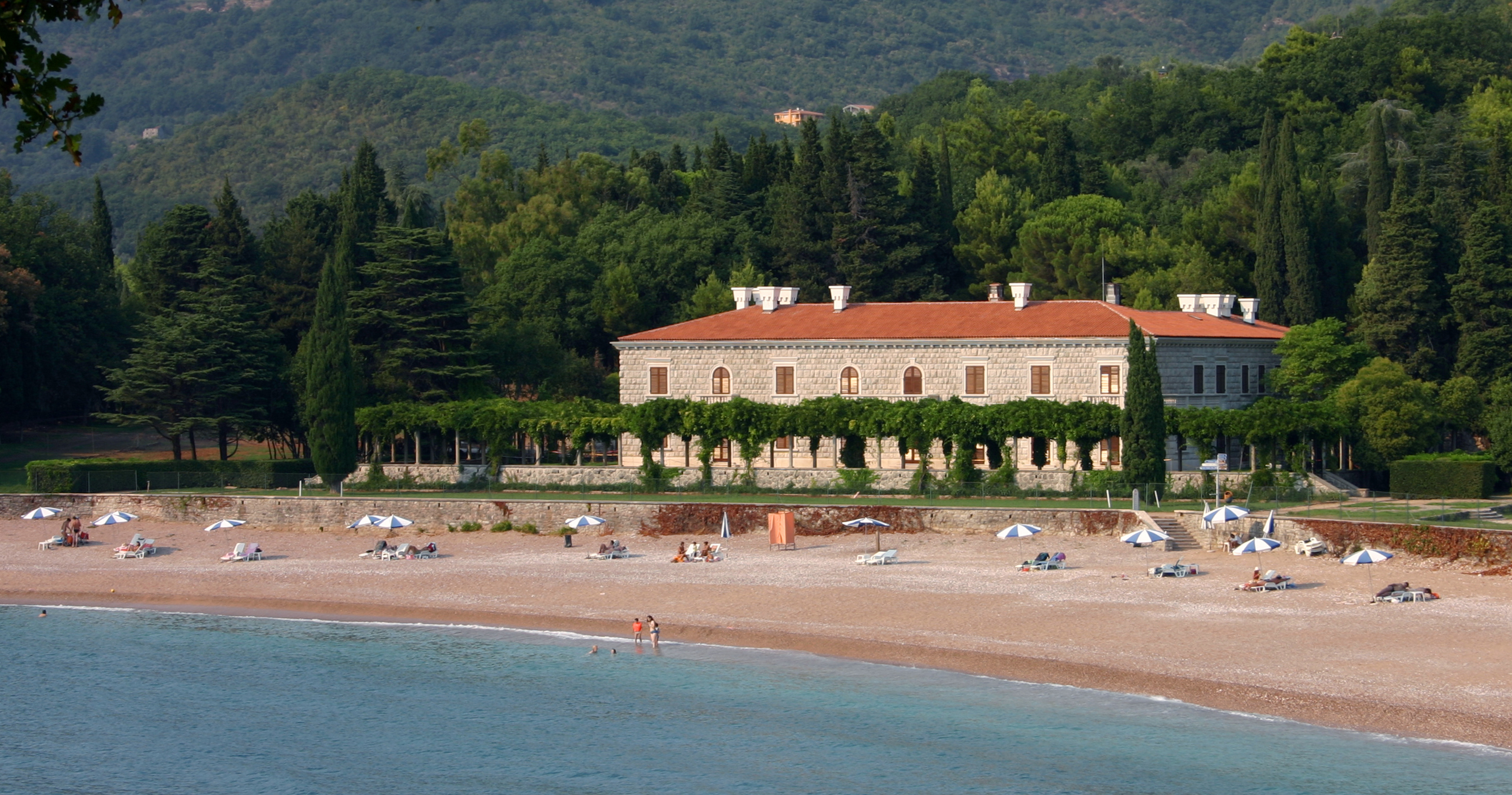
Sveti Stefan
From the coast road above, Sveti Stefan looks almost too perfect -- a compact island of red-roofed stone houses connected to the mainland by a narrow sand isthmus, as if someone had designed a postcard and then built it at full scale. The reality is considerably rougher. This island fortress was built in the 15th century by the Pastrovic tribes using war trophies seized from Ottoman galleys, and for four hundred years it served as a court of justice, a military refuge, and home to fishermen who lived by rules older than most European nations. Today its stone lanes are silent except for resort guests paying some of the highest room rates on the Adriatic. The journey from tribal fortress to luxury hotel is one of the stranger transformations on the Mediterranean coast.
War Trophies in Stone
The founding story of Sveti Stefan reads like a folk epic because it is one. According to local tradition -- confirmed by documents from 1442 that mention the site as an advanced guard house -- the Pastrovic clans learned that a Turkish fleet had anchored at Jaz beach during bad weather while its soldiers marched overland to attack Kotor. The Pastrovics took a shortcut to help defend Kotor, then doubled back to attack the unguarded galleys. With the captured ships and their cargo, the twelve Pastrovic tribes built a fortress on the rocky island, constructing a house for each tribe and a church dedicated to St. Stefan, their patron saint. They sank the captured galleys, leaving no trace. The fort served as shelter for women, children, and the elderly during enemy attacks, and as storage for grain, oil, wine, meat, and honey.
The Place of Justice
In ancient documents, Sveti Stefan carries a second name: the Place of Justice. For roughly four centuries, the tribal court known as the Bankada convened at the Pjaca, the open space just inside the entry gate, where disputes among the Pastrovic clans were settled under customary law. The court operated until 1929, a remarkable span of continuous local jurisprudence. At its peak in the first half of the 19th century, the island held 100 houses, three churches, and 400 inhabitants -- a remarkable density on a rocky outcrop bounded by sea walls. By the early 20th century, the population had begun to collapse. Men left for wars and for America. By 1912, 150 people remained. By 1954, only 20.
From Fishing Village to Celebrity Retreat
In 1954, a group of architects and artists, backed by Yugoslavia's communist government, began converting the near-abandoned village into something unprecedented: a town-hotel, where each old fisherman's house became a luxury suite. The remaining twenty residents were relocated to the mainland. The adaptation was done with unusual care -- exteriors preserved exactly as they had been, while interiors were richly decorated and modernized. By the 1960s and 1970s, Sveti Stefan had become a destination for international celebrities. Guest lists from the era included Sophia Loren and Carlo Ponti, Kirk Douglas, Willy Brandt, and, according to local accounts, Marilyn Monroe. (Bobby Fischer and Boris Spassky did visit the island, but in 1992 for their famous chess rematch, not as leisure guests in this earlier period.) The resort remained Montenegro's most exclusive address until the 1990s, when the breakup of Yugoslavia brought decline.
An Island You Cannot Enter
In 2007, Amanresorts, a Singapore-based luxury hotel operator, won a 30-year lease on Sveti Stefan along with the nearby Milocer and Kraljicina beach properties. The island is now closed to anyone who is not a resort guest or who has not booked a meal at one of the hotel's restaurants -- a less expensive but still significant commitment. Visitors can walk the mainland beaches north and south of the isthmus, where parking costs twelve euros and entry to the North Beach runs fifty. The coastal path from Budva, roughly ten kilometers of tunnels, beach villages, and cliff-side trails, remains one of the finest walks on the Montenegrin coast and ends with the view that has launched a thousand postcards: red roofs, blue water, and a thread of sand connecting two worlds that no longer speak the same language.
From the Air
Located at 42.2561N, 18.8914E on the Montenegrin Adriatic coast, approximately 6 km southeast of Budva. The island and its sand isthmus are unmistakable from the air -- a compact cluster of red-roofed buildings connected to the green coastal hillside by a narrow white sand bar. Nearest airport is Tivat (LYTV), about 25 km northwest. Podgorica Airport (LYPG) is 70 km northeast. Recommended viewing altitude 1,500-3,000 feet AGL to appreciate the isthmus geometry. The coastline here is backed by steep, forested hills with scattered resort developments.