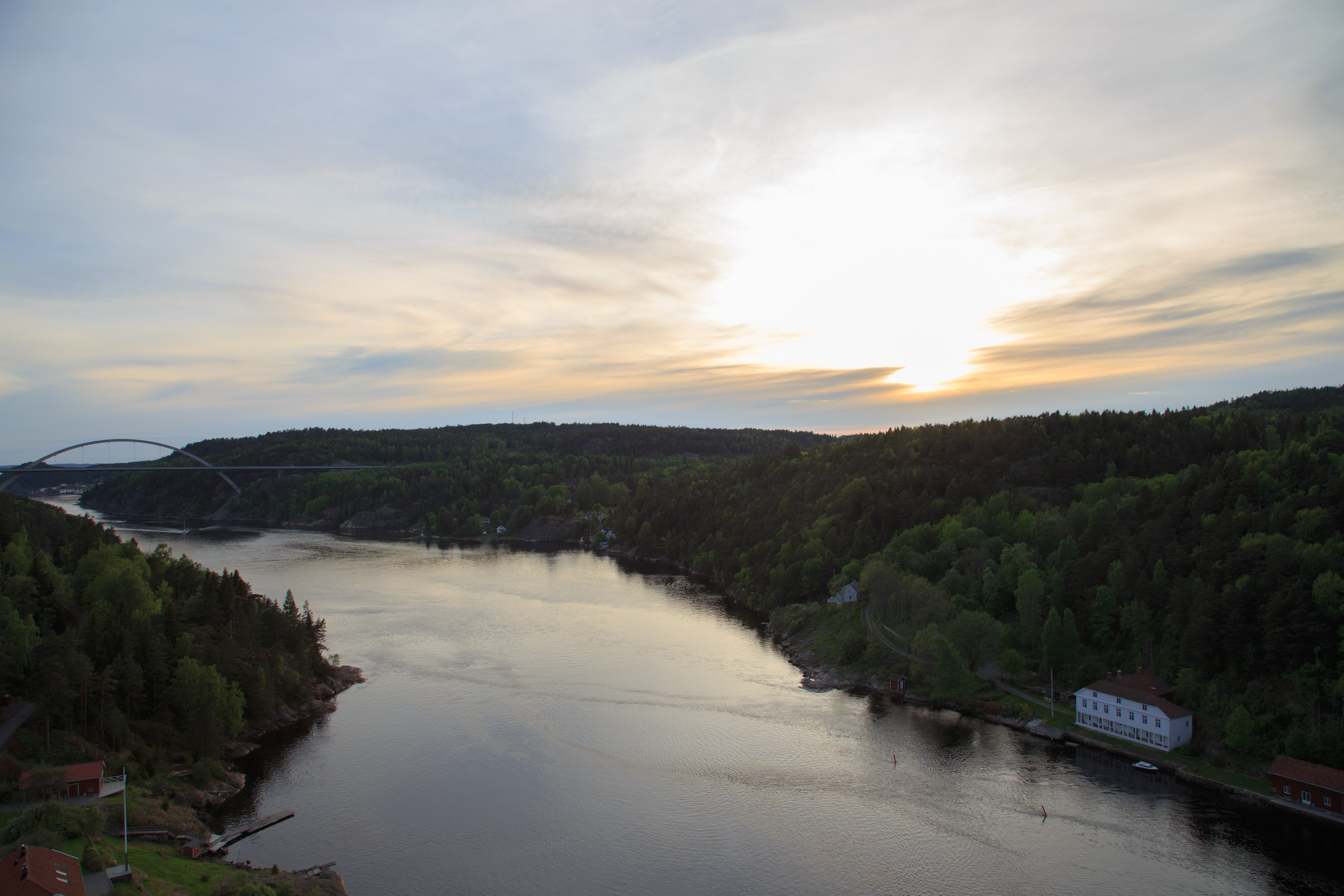
Svinesund Bridge
Two bridges span the narrow waters of Svinesund, and together they tell a story of Scandinavian cooperation, wartime disruption, and engineering ambition. The sound that gives them their name separates Sweden's Stromstad municipality from Norway's Halden, making this the westernmost crossing point between the two countries. Every day, European route E6 carries traffic between Oslo and Gothenburg across the newer span, a single concrete arch rising dramatically above the dark waters of the Iddefjord. But to understand what this crossing means, look east to the older bridge, still standing despite the lightning strike that once ignited explosives placed along its deck.
A Bridge Born in War
Construction on the original Svinesund Bridge began in 1939, the worst possible year to start a peacetime infrastructure project. World War II engulfed Europe, and the neutral Scandinavian nations found themselves navigating impossible circumstances. Work continued sporadically through the conflict years, but in 1942, disaster struck. Lightning hit the bridge and ignited explosives that had been placed there as a defensive measure, partially destroying the structure. Workers rebuilt what the storm had damaged, and on June 15, 1946, barely a year after the war's end, the bridge finally opened. For nearly sixty years, this single span carried all traffic between the two nations at this point.
The Arch Rises
By the early 2000s, the old bridge could no longer handle modern traffic volumes. Norwegian and Swedish road authorities joined forces to build something spectacular. Construction began in 2003 on a new crossing just west of the original, designed around a single massive concrete arch. The engineering presented unusual challenges. Rather than building the arch from temporary scaffolding, workers used cantilever construction supported by temporary cable stays. The two halves grew toward each other from opposite shores, each segment of approximately 60 cubic meters of high-strength concrete added at a rate of about one per week. Around 50 segments per side eventually met in the middle.
Engineering at the Edge
The completed arch is hollow, containing interior maintenance pathways, heating coils to prevent ice and snow accumulation, and navigation lights for vessels passing below. Two separate steel box-girder bridge decks run on either side of the arch, connected by traverse beams where the arch rises above the roadway. The total cost reached 500 million Norwegian kroner for the bridge itself, with the full project including approach roads, customs facilities at this EU border, and toll plazas coming to 1.4 billion Swedish kronor. On June 10, 2005, dignitaries inaugurated the new span. Three days later, traffic began flowing across it.
The Center Floats Into Place
Most of the roadway segments were installed conventionally, lifted into position from the completed arch structure. But the center section presented a unique challenge. Too large to maneuver into place from above, it was instead floated in on barges as a complete prefabricated unit and raised into its final position. This dramatic installation method, visible to anyone watching from shore, demonstrated the creative problem-solving that characterized the entire project. Once the stays, temporary towers, and cable conveyors had been removed, the bridge achieved its elegant final form, a single sweeping curve of concrete framing views of the fjord below.
Two Bridges, One Border
The old bridge remains in service, now limited to lighter vehicles after heavy trucks shifted to the new crossing. Together, the two spans handle the significant trade that flows between Norway and Sweden, a reminder that national borders can be bridged rather than barricaded. Toll collection ended on March 15, 2021, making the crossing free for the first time. From the air, the two bridges create a striking visual pair, the older steel arch modest and functional, the newer concrete bow dramatic and confident. They mark not just a geographic boundary but a testament to what neighboring nations can achieve when they choose cooperation over division.
From the Air
Located at 59.09N, 11.25E at the Norway-Sweden border crossing Iddefjord at Svinesund. Both the new concrete arch bridge (2005) and the older steel bridge (1946) are visible landmarks. The distinctive single arch of the new bridge is unmistakable from the air. Nearest airports are Moss Airport Rygge (ENRY) approximately 40 km north in Norway, and Gothenburg-Landvetter (ESGG) approximately 130 km south in Sweden. Best viewed at 2,000-4,000 feet to appreciate both bridges and the fjord geography.