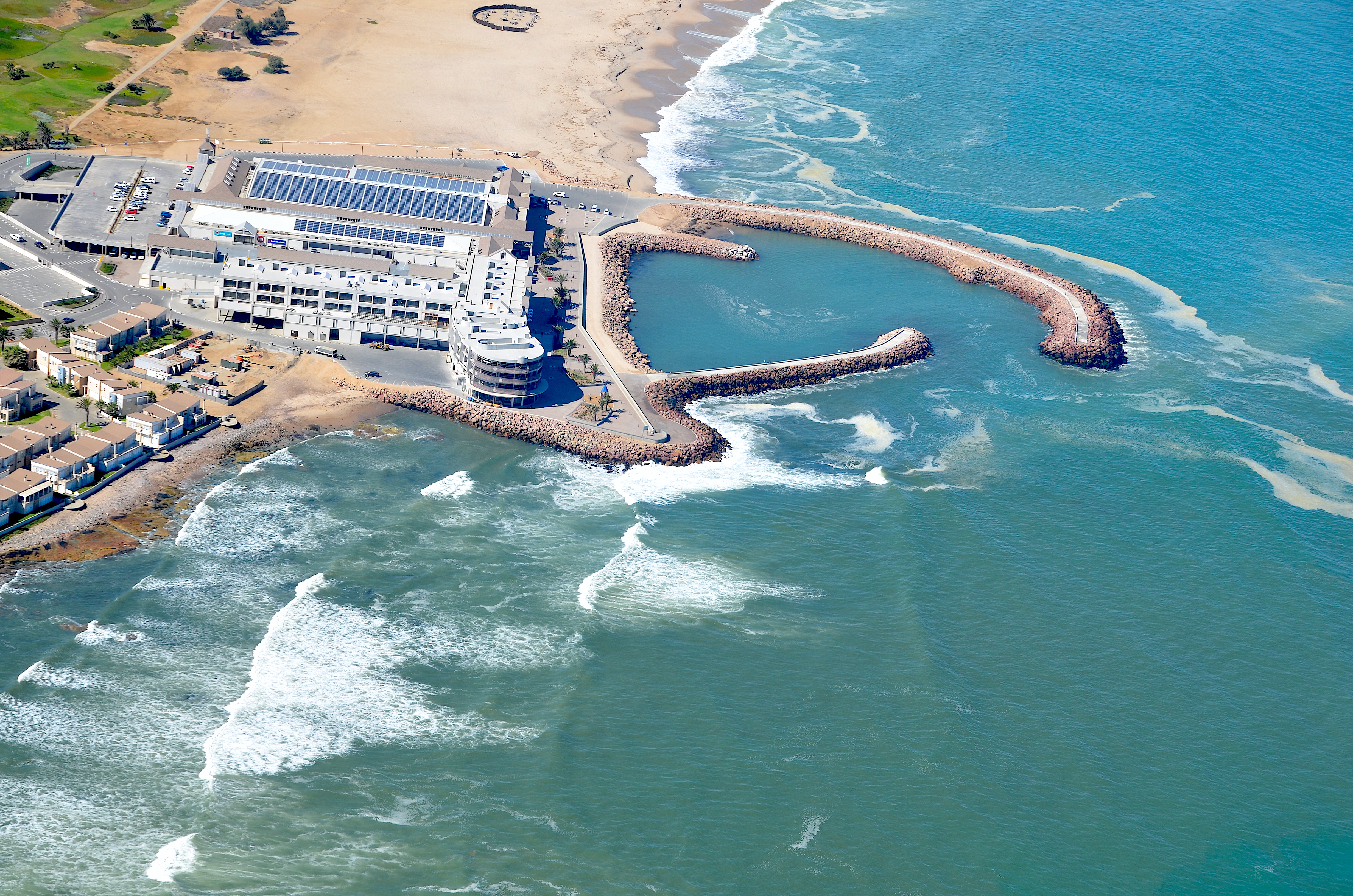
Swakopmund
The first thing that strikes you about Swakopmund is the dissonance. Bavarian-style buildings with ornate facades and wrought-iron balconies line streets that end in sand dunes. A Lutheran church spire rises against a sky that delivers fewer than 20 millimeters of rain per year. The Woermannhaus, with its half-timbered gables, could pass for a trading house on the North Sea -- except that the sea in question is the South Atlantic, the temperature rarely climbs above 25 degrees, and the morning fog rolls in so thick that it has wrecked ships for centuries along the Skeleton Coast to the north. Swakopmund is what happens when German colonial architects build a North Sea resort on the edge of the world's oldest desert.
A Port Nobody Wanted
When Dutchmen Sebastian van Reenen and Pieter Pienaar described this stretch of coast in 1793, they found lush vegetation, elephants, and rhinos. A century later, the German Empire chose the site for a port -- not because it was suitable, but because the British already held Walvis Bay, 35 kilometers to the south. The architects were instructed to make the town resemble the German homeland as closely as possible, and they obliged with a thoroughness that still defines the city. The boom years lasted until World War I, which interrupted construction of the massive pier that remains one of Swakopmund's landmarks. After the war, the colony passed to the Union of South Africa, and all shipping moved to Walvis Bay. Swakopmund was left behind -- a beautiful, impractical town at the edge of a desert, its reason for existing suddenly gone.
The Fog That Feeds and Wrecks
Swakopmund's climate is an anomaly. The Benguela Current, flowing north along the coast from Antarctica, chills the ocean to temperatures that would shock a swimmer standing in warm sand just meters from the waterline. When moist marine air meets this cold water, it condenses into fog -- dense, persistent fog that blankets the coast for days at a time. The fog sustains the Welwitschia mirabilis, a plant that lives over a thousand years and survives solely on atmospheric moisture in a place where it may not rain for decades. It also makes the coastline deadly for navigation, earning this stretch the name Skeleton Coast for the ships and sailors it has consumed. For Swakopmund's residents, the fog is simply part of daily life -- cooling summer temperatures below 10 degrees Celsius on days when the interior desert bakes, and creating UV conditions treacherous enough to cause severe sunburn even under overcast skies.
Adventure at the Desert's Edge
Swakopmund reinvented itself as Namibia's adventure capital, and the menu is extraordinary. Sandboarding -- riding down dune faces on a board, either standing or prone at terrifying speeds -- takes advantage of the world's tallest sand dunes near Walvis Bay and smaller dunes closer to town. Quad-biking tours push into the Namib for views of dunes meeting ocean. Skydiving operations run from the local airport. For something quieter, the Swakop River mouth holds a freshwater lagoon with good birding, and the Mile 4 salt works north of town attract flamingos to open saline lakes. Offshore, surfers chase breaks with names like Thick Lip and The Wreck, while fishermen head out on deep-sea charters. At Cape Cross, 120 kilometers north, roughly 100,000 Cape fur seals breed each year between October and December -- a spectacle of noise, motion, and pungent smell that overwhelms every sense at once.
Jagermeister Country
The German community that built Swakopmund never entirely left. Walk the downtown streets and the evidence is everywhere: in the architecture, in restaurant menus that pair schnitzel with fresh Atlantic seafood, in the locally brewed Hansa Draught and the independent Namib Dunes craft brewery. The old imperial barracks now serve as a youth hostel. The former railway station houses a luxury hotel, a casino, and several restaurants. The Woermannhaus contains what is reportedly one of the best libraries in Africa. A craft market near the lighthouse sells traditional African silver jewelry and items difficult to find elsewhere in Namibia. The town's population reached 45,000 by 2011, making it Namibia's fourth most populous city, and it draws domestic holidaymakers, international tourists, and German-speaking pensioners who have chosen to retire where the cuisine tastes like home and the winter never bites.
Moon Landscape and Living Fossils
Southeast of town, the Moon Landscape drive crosses terrain so barren it was used to test Mars rover prototypes. The route follows the Swakop River -- which contains no water, because this is the Namib -- across a sandy riverbed with no bridge. An ordinary sedan can make the crossing with deflated tires and an experienced driver, but forgetting a tire pump means the rest of the journey will destroy both rubber and rims. The destination is a stand of Welwitschia mirabilis, among the oldest and strangest plants on Earth. Each consists of just two leaves that grow continuously, splitting and curling over centuries until the plant resembles a pile of green leather straps. Some specimens are over a thousand years old. They exist only in this part of the Namib, within about 120 kilometers of the coast, and they are protected by law -- visitors are warned not to approach too closely, as the shallow roots damage easily. It is, like much of what surrounds Swakopmund, a landscape that seems designed to remind visitors that the desert was here first and will be here last.
From the Air
Located at 22.67S, 14.53E on Namibia's Atlantic coast, at the mouth of the Swakop River where the Namib Desert meets the ocean. The German colonial architecture and pier are visible from low altitude. Approach from the east for the dramatic transition from desert to coast. Nearest airport with scheduled service: Walvis Bay (FYWB), 35 km south. Swakopmund has a local airstrip used for charter flights and skydiving. Windhoek Hosea Kutako International (FYWH) is 362 km inland. Coastal fog is frequent and can significantly reduce visibility, especially mornings.