Swami's
In 1937, Paramahansa Yogananda's Self-Realization Fellowship completed a meditation hermitage on the sandstone bluffs above a reef break in Encinitas. The hermitage's golden lotus towers became a landmark, and surfers began naming the break below after the swami — the Indian spiritual teacher who had brought yoga and meditation to Western audiences and whose ashram now overlooked the waves. Swami's has carried that name ever since, and the story of the place layers geology, religion, music, ecology, and surf culture into something distinctly Californian.
The Only Right in North County
Most surfable waves in Southern California break left — the wave peels to the surfer's left as they ride it toward the shore, which is the natural consequence of how swells interact with the coastline's orientation. Swami's breaks right, which means surfers face the wave and ride it in the other direction. The reef configuration that produces this rarity is a function of the underwater topography at this particular point on the Encinitas coast, and it cannot be replicated elsewhere along the North County shoreline. In a region with hundreds of miles of coastline, there is exactly one right point break.
This scarcity has given Swami's a significance in the local surf culture that transcends its actual wave quality, which is excellent but not extraordinary. Professional surfers Rob Machado and Taylor Knox count the break among their home spots, and the reef has been surfed continuously since the 1930s by a succession of Encinitas surfers for whom it represents the home break in the most literal sense — the wave they return to regardless of where they travel in pursuit of surf.
The Beach Boys' 1963 recording of 'Surfin' U.S.A.' includes Swami's in its catalog of California surf spots, a mention that embedded the break in the broader mythology of California surf culture at the moment when that culture was being defined and distributed nationally through popular music. The song was released when Swami's was already a local institution; the Beach Boys' recognition confirmed what the surfers already knew.
The Ashram on the Bluff
Paramahansa Yogananda was one of the first Indian spiritual teachers to spend significant time in the West, arriving in the United States in 1920 and eventually establishing the Self-Realization Fellowship as his organizational vehicle. He wrote 'Autobiography of a Yogi,' which became one of the most widely read spiritual memoirs of the twentieth century and introduced millions of Western readers to the practices and philosophy of yoga and meditation.
The Encinitas hermitage, completed in 1937 and expanded over subsequent decades, occupies the blufftop above the surf break with a presence that is impossible to miss from the water. The golden lotus towers that mark the ashram's entrance are visible from the beach below, and the meditation gardens that extend toward the cliff edge create a visual and spiritual border between the contemplative life of the ashram and the physical engagement of the surf below.
Yogananda died in 1952, but the Self-Realization Fellowship has continued to maintain the Encinitas hermitage as an active center. The ashram and the surf break it watches over have coexisted for nearly ninety years — a pairing that is strange, in the abstract, and entirely natural in the context of Encinitas, a community that has always managed to accommodate both the intensity of athletic culture and the quieter pursuits of spiritual practice.
Fossils, Fish, and Protection
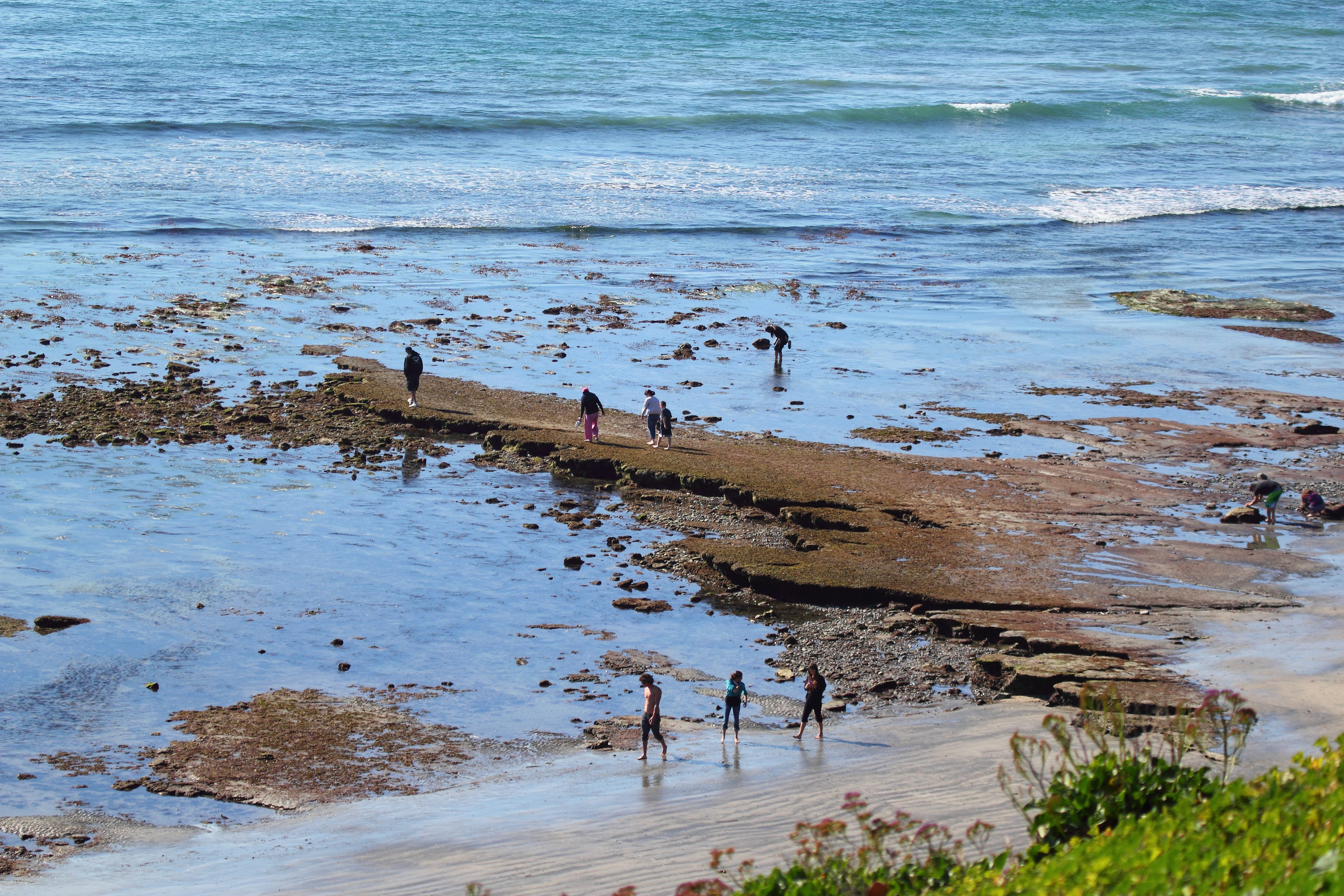
The reef at Swami's is exposed at low tide, revealing rock formations layered with fossils approximately 45 million years old. The fossil record preserved in these sedimentary rocks documents marine life from the Eocene epoch, a period when the California coast was considerably different from what it is today — warmer, more tropical, occupied by species that no longer exist. The exposed reef at low tide functions as an accessible geological record, visible to anyone who walks down to the water when the tide recedes.
Surrounding the surf break, the state of California has designated the largest State Marine Conservation Area in San Diego County. The protected area restricts certain types of fishing and harvesting to allow the reef ecosystem to maintain its biological integrity. Marine protected areas along the California coast form a network intended to protect representative samples of the state's diverse marine habitats — rocky reefs, kelp forests, sandy seafloor — from the cumulative pressures of commercial and recreational fishing.
Swami's sits at the intersection of multiple Californias: the California of surf culture and coastal recreation, the California of spiritual seeking and alternative community, the California of deep geological time and biological protection. The reef that produces the right-hand wave also holds the fossils and the protected fish. The blufftop that hosts the ashram also overlooks the break that the Beach Boys put in a song. None of these things are contradictions. In Encinitas, they are simply the same place.
From the Air
Swami's reef break sits at approximately 33.03°N, 117.29°W at the southern end of Old Encinitas, below the Self-Realization Fellowship ashram on the coastal bluffs. Flying south along the coast at 2,000–4,000 feet MSL, look for the distinctive golden lotus towers of the SRF hermitage on the blufftop — a clear visual landmark above the surf break. The State Marine Conservation Area extends around the reef point. Nearest airports: KCRQ (McClellan-Palomar, Carlsbad, 6 miles north) and KMYF (Montgomery-Gibbs Executive, 18 miles southeast). San Elijo Lagoon and Cardiff State Beach are visible immediately to the south.