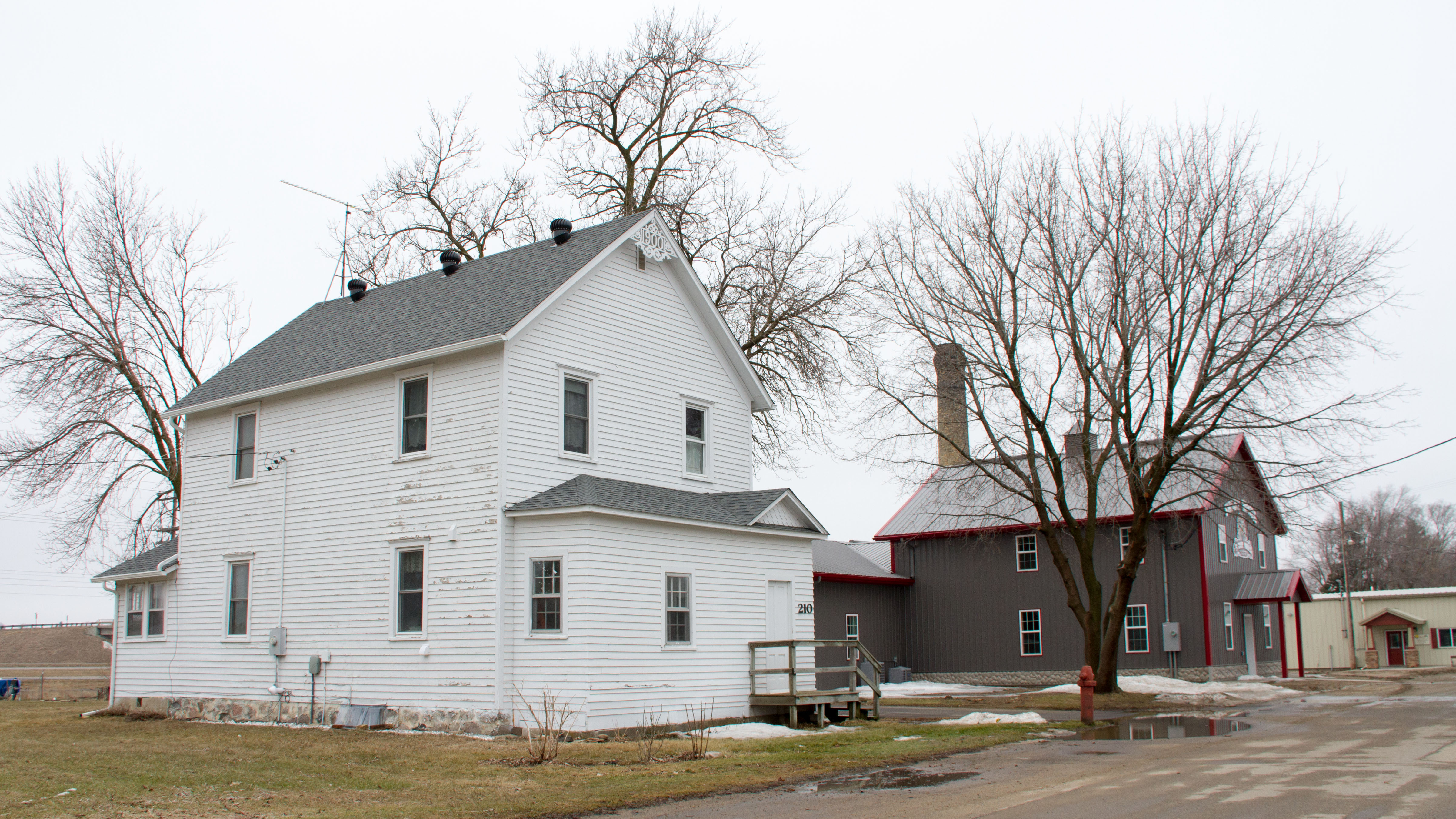
Swany White Flour Mills
The name was aspirational marketing disguised as poetry. When brothers Hubert and Peter Thelen bought a small flour mill in Freeport, Minnesota, in 1903, they needed a brand that would stand out on store shelves across the Upper Midwest. They chose Swany White -- flour as white as a swan. It was a bold claim for a modest operation in a town of a few hundred people, competing in a state where flour milling was big business and Minneapolis called itself the Mill City. Yet Swany White outlasted nearly all of them. By the time fire consumed the mill on December 27, 2011, it was the last remaining 19th-century flour mill still operating in Minnesota.
A Community Investment That Kept Giving
Anton Hoeschen built the original mill in 1898, not as a personal venture but as an investment in Freeport's future. He hoped someone would buy it and become the town's miller. The property changed hands several times in its first years before the Thelen brothers took ownership in 1903 and gave it permanence. Around 1913 to 1914, they remodeled extensively, adding a basement and a third story to expand capacity. When Hubert and Peter died, their sons Walter and Jack carried on. Walter recognized opportunities beyond conventional white flour and began producing organic and specialty products at competitive prices. His son Gary purchased the mill in 1998 and ran it with his wife Sharon, making them the fourth generation of Thelens to work the same grain. Through all those decades, the complex grew to include an attached brick powerhouse, a miller's house built in 1900, and a freestanding brick smokestack.
Small Mill, Big Reputation
Swany White's milling capacity was a fraction of the industrial operations that dominated the industry. That was the point. While conglomerates consolidated and small regional mills vanished one by one -- absorbed, outcompeted, or simply abandoned -- the Thelens kept grinding. Their most popular product was a bleached flour sold under the brand name Faith's Best, which accounted for roughly 60 percent of all sales. Conventional products reached distributors and retailers across the Upper Midwest. Organic lines traveled farther, finding customers who valued provenance over price. The mill also maintained a retail outlet right in Freeport, where locals could buy flour directly from the people who milled it. In 1982, the Minnesota Historical Society recognized the property's significance by placing it on the National Register of Historic Places -- a working mill earning museum-level respect while still filling bags of flour every day.
The Night the Skyline Burned
At 4:48 on the afternoon of December 27, 2011, an employee reported a fire inside the mill. Five surrounding fire agencies responded, but the three-story wooden structure was already beyond saving. Within two hours the building collapsed, taking 114 years of history with it. The cause was never determined. Damage was estimated at $850,000. No one was injured, but Freeport had lost what many considered the defining feature of its skyline. Gary Thelen initially said he would not rebuild. The economics of small-scale milling were already difficult. Insurance would cover the loss. Walking away would have been the rational choice. But rationality does not always win when four generations of your family have done the same work in the same place.
Rising from the Ashes
Construction on a new mill began June 12, 2012, less than six months after Thelen's initial reluctance. The new facility rose between the surviving miller's house and the old brick smokestack, modern equipment tucked into a structure that acknowledged its predecessor without trying to replicate it. Swany White Flour Mills resumed operations, still family-owned, still independent, still milling in Freeport. The original property was delisted from the National Register of Historic Places in 2024 -- the 19th-century structure that earned the designation no longer existed. But the brand that Hubert and Peter Thelen named after a swan's whiteness more than a century ago continues. In an industry defined by consolidation, Swany White remains a stubborn exception: a family mill in a small town, doing one thing well, generation after generation.
From the Air
Located at 45.662N, 94.688W in the agricultural flatlands of Stearns County, central Minnesota. Freeport is a small town along Interstate 94 between St. Cloud and Albany. The mill site is in the center of town, identifiable by the surviving brick smokestack near the newer mill building. The nearest major airport is St. Cloud Regional Airport (KSTC), approximately 20 nm to the east-southeast. Sauk Centre Municipal Airport (KD39) lies roughly 25 nm to the northwest. The terrain is flat agricultural land with scattered woodlots and small lakes. Best viewed from 2,000-3,000 feet AGL to spot the town along I-94 and the smokestack landmark.