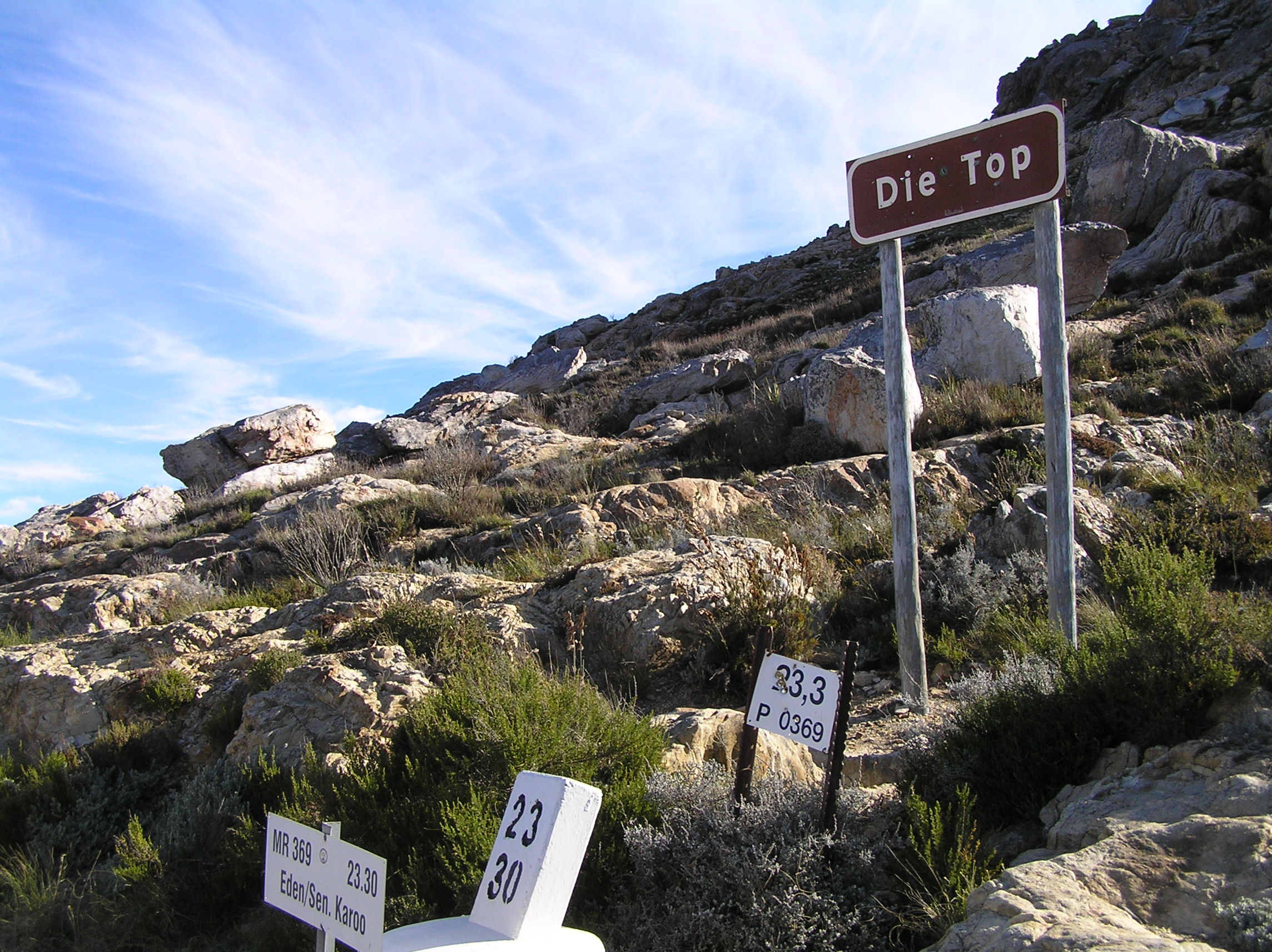
Swartberg Pass
Jan Tassies ran out of money after six kilometers. He had brought a hundred workers from Mozambique to build a road through mountains that the Khoikhoi had long known as the Swartberg -- the black mountain -- but after thirteen months of hacking at quartzite cliffs, the funds were gone and the road barely begun. It would take Thomas Bain, son of the legendary pass-builder Andrew Geddes Bain, another five years to finish what Tassies had started. On 10 January 1888, the Swartberg Pass opened to traffic, and two halves of the Karoo were finally joined by a single unpaved road that remains, more than 130 years later, one of South Africa's most spectacular drives.
A Road Between Two Deserts
The Swartberg range runs roughly east to west along the northern edge of the Little Karoo, a semi-arid valley hemmed in by fold mountains. To the south lies Oudtshoorn, the ostrich capital; to the north, Prince Albert and the vast emptiness of the Great Karoo. Before Bain's road, crossing between these two worlds meant a punishing detour or an impossible scramble over peaks that rise above 2,000 meters. The pass changed everything. Built with convict labor between 1883 and 1888, it followed the earlier Meiringspoort route that the Bain family had cut through the same mountains further east in 1858. But where Meiringspoort followed a river through a gorge, the Swartberg Pass climbed over the top, threading switchbacks through some of the most dramatic geology on the continent. It remains the only road into Gamkaskloof, the remote valley locals call Die Hel.
Walls of Stone, Walls of Fire
The Swartberg mountains are among the finest exposed fold mountain chains in the world, and the pass slices through their geological story like a cross-section diagram come to life. Anticlines and synclines -- the great folds and compressions of ancient rock -- are visible in the cliff faces, their layers contorted by forces that predate any human presence on the planet. The quartzite here takes on vivid coloration, reds and ochres streaking through the grey stone. At the northern end of the pass, the geology becomes extraordinary. Seven-hundred-meter-high quartzite cliffs of the upper Table Mountain Group stand tilted through ninety degrees, sometimes more, as if the earth itself had been turned on its side. The most famous of these formations is the Wall of Fire, a cliff face whose coloring and angle create the impression of frozen flame rising from the valley floor.
Bain's Handiwork
Thomas Bain's engineering endures in the dry-stone retaining walls that support the pass's hairpin bends. These walls were built without mortar, stone fitted against stone by convict laborers who shaped each piece to lock into its neighbors. After more than 130 years of Karoo weather -- the searing summers, the winter frosts, the occasional floods that send water sheeting across the unpaved surface -- the walls still hold. The pass remains untarred, which means it can turn treacherous after rain and occasionally closes for snow in winter. But the rough surface is part of the experience: it forces a slow pace that suits the views. From the top, at roughly 1,585 meters, the Little Karoo opens to the south in a haze of sage and brown, while the Great Karoo stretches north toward a horizon that seems to curve with the earth. Hundreds of plant species cling to the slopes, part of the Swartberg's rich fynbos heritage that earned much of the range its UNESCO World Heritage designation.
The Living Pass
Every May, runners from Prince Albert gather for the Swartberg Pass Half Marathon, a race that sends them out of town and into the mountains with sheer rock walls rising on both sides. The warped and twisted formations that geologists study become the scenery of a footrace, and the event coincides with Prince Albert's Olive Festival, a celebration of the groves that thrive in the Great Karoo's surprising microclimate. The pass is not a relic. Farmers still use it, tourists navigate its switchbacks in rental cars with white knuckles, and cyclists treat it as a pilgrimage. Each traveler experiences what Bain's convict laborers must have known intimately: this is a landscape that resists easy passage but rewards the effort with something close to awe.
From the Air
Coordinates: 33.35S, 22.05E. The pass is visible as a thin thread of unpaved road winding through the Swartberg range between Oudtshoorn (south) and Prince Albert (north). Best viewed at 8,000-10,000 ft AGL to appreciate the switchbacks and fold geology. The Wall of Fire formation is prominent at the northern end. Nearest airports: Oudtshoorn (FAOH), George (FAGG). Mountain weather can produce turbulence and low cloud; mornings tend to be clearest.