Sweepstakes (Schooner)
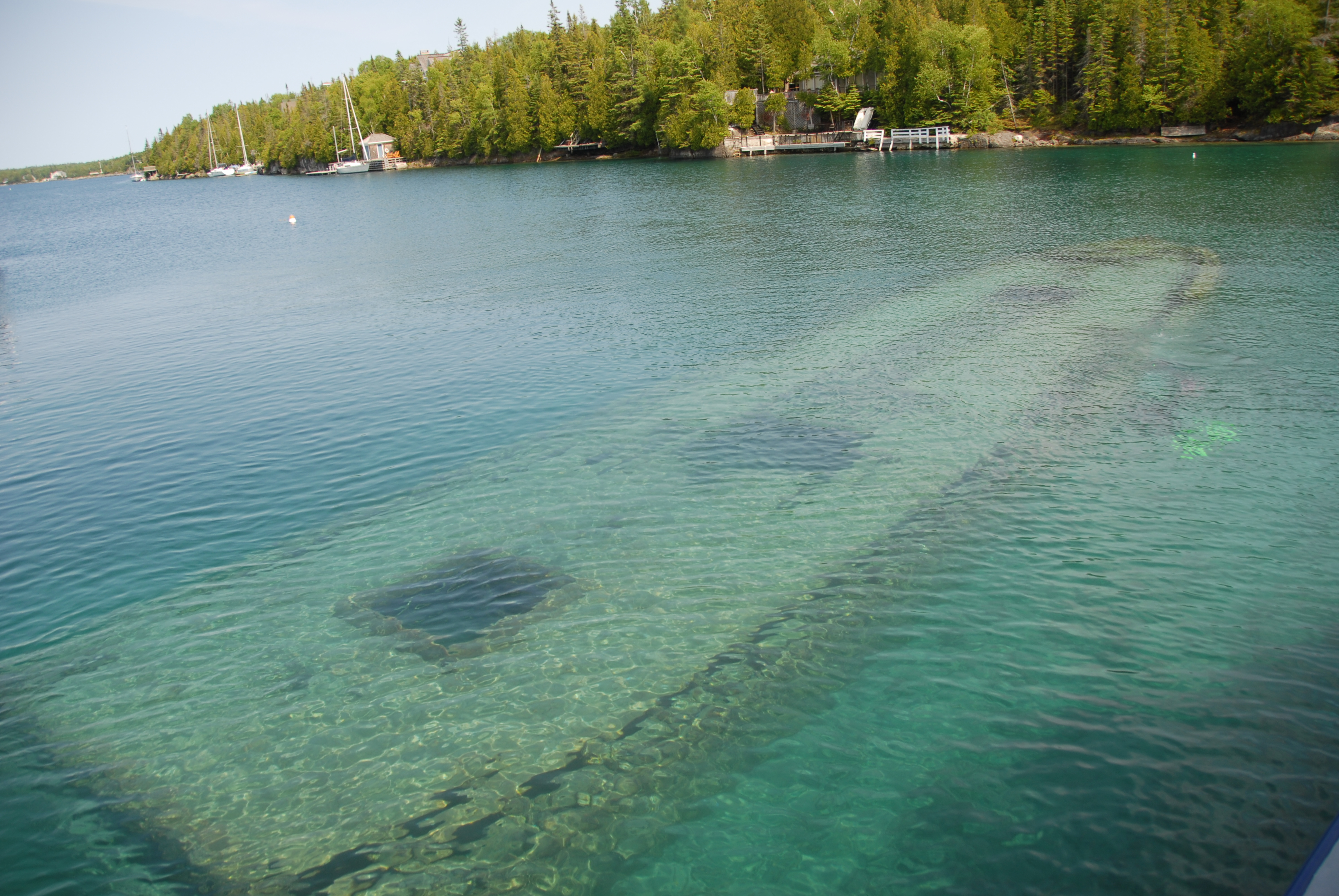
The water in Big Tub Harbour is so clear that the first thing most visitors notice is that there is a ship beneath them. Six metres down, the two-masted schooner Sweepstakes lies on the bottom with her hull still intact, her centerboard still seated in its box, her windlass still mounted at the bow. Built in 1867 at Burlington, Ontario, by shipwright Melancthon Simpson, she spent eighteen years hauling cargo across the Great Lakes before a collision off Cove Island ended her working life. The tugboat Jessie towed her damaged hull into the sheltered harbour at Tobermory, where she settled to the bottom in September 1885. She has been there ever since -- not lost and forgotten, but watched over, visited, and slowly becoming one of the most famous shipwrecks in Canada.
A Working Life on Freshwater Seas
The Great Lakes in the 1860s and 1870s were highways. Lumber, coal, grain, and stone moved by schooner because the railways had not yet reached every harbour, and wind was still cheaper than steam. Sweepstakes was a typical working vessel of her era -- a two-masted wooden schooner of modest size, built to carry bulk cargo along the Lake Huron and Georgian Bay coastline. Her last owner, George Stewart of Mooretown, Ontario, kept her running the coal trade. In August 1885, while carrying a load of coal, she sustained serious damage near Cove Island at the mouth of Georgian Bay. The exact nature of the damage is uncertain, but it was severe enough that repairs could not be completed before the hull gave way. The coal was salvaged after she sank, but Sweepstakes herself stayed where she settled in the sheltered harbour head.
The Glass-Bottom Museum
What makes Sweepstakes extraordinary is not the drama of her sinking but the clarity of her afterlife. Big Tub Harbour sits at the northern tip of the Bruce Peninsula, where Lake Huron's cold, limestone-filtered water produces visibility that can exceed twenty metres on calm days. The schooner rests upright in roughly six metres of water, her deck close enough to the surface that snorkelers can hover directly above it. The bow section remains remarkably intact -- the windlass still sits in place, portions of the starboard railings are undamaged, and the centerboard box runs from keel to deck amidships. The aft-deck has collapsed over the decades, dropping the stern-post to the harbour floor, but the overall shape of a nineteenth-century Great Lakes cargo schooner is unmistakable. Tour boats with glass-bottom panels drift over the wreck daily in summer, giving visitors who never get wet a startlingly intimate view of a vessel that was already old when their great-grandparents were young.
Fathom Five's Underwater Archive
Sweepstakes is the marquee attraction of Fathom Five National Marine Park, but she is far from alone. The waters around Tobermory hold more than twenty known shipwrecks, a concentration that reflects both the dangerous geography of the Bruce Peninsula's rocky tip and the sheer volume of shipping traffic that once passed through these narrows. Nearby in Big Tub Harbour lies another popular wreck, the City of Grand Rapids, which burned and sank in 1907. Fathom Five, established in 1987 as Canada's first national marine park, protects these wrecks as underwater heritage sites. Parks Canada has made targeted repairs to Sweepstakes over the years, reinforcing structural elements to slow the deck's collapse. The schooner deteriorates a little more each season -- wood softens, iron corrodes, storms shift timbers -- but she remains one of the best-preserved nineteenth-century Great Lakes vessels ever found. Divers, snorkelers, and glass-bottom boat passengers return year after year to check on her condition, the way you might visit an aging relative.
Tobermory's Quiet Fame
Tobermory itself is a village of a few hundred permanent residents at the end of Highway 6, the road that runs the length of the Bruce Peninsula. In winter it is quiet, windswept, and largely shut down. In summer it transforms into a staging ground for divers, hikers headed to the Bruce Trail's northern terminus, and day-trippers catching the Chi-Cheemaun ferry to Manitoulin Island. Sweepstakes is woven into the town's identity -- her image appears on postcards, tourism brochures, and the signs that welcome visitors to the harbour. She represents something particular about the Great Lakes: these inland seas swallowed hundreds of vessels over the centuries, but in a few rare places, the water is clear enough and calm enough to give those ships back to view. At Big Tub Harbour, the past does not require excavation or imagination. It sits six metres down, plainly visible, still holding its shape after more than a century on the bottom.
From the Air
Located at 45.255N, 81.681W in Big Tub Harbour at the tip of the Bruce Peninsula, Tobermory, Ontario. The harbour is a small, sheltered inlet clearly visible from altitude -- look for the narrow harbour mouth opening to Georgian Bay. The wreck itself is not visible from flight altitude, but Big Tub Harbour's distinctive shape is easy to identify. The Bruce Peninsula's rocky limestone shoreline and the Tobermory Islands archipelago provide strong visual references. Nearest airport: Wiarton-Keppel International Airport (CYVV) approximately 40nm southeast. The Chi-Cheemaun ferry route to South Baymouth on Manitoulin Island is often visible as a white wake crossing the open water. Best viewed at 2,000-3,000 ft AGL to appreciate the peninsula's dramatic terminus where Lake Huron meets Georgian Bay.