Swellendam
In 1745, the Dutch East India Company needed a magistrate to keep order on the frontier. They built the Drostdy in what was then the edge of the known colonial world, a place where the Langeberg Mountains raked the clouds and the Breede River valley opened into wheat fields and grazing land. That building still stands. So does the town that grew around it, though Swellendam has outlasted the Company by more than two centuries and traded its frontier roughness for oak-shaded streets and the quiet confidence of a place that knows exactly what it is.
Cape Dutch Time Capsule
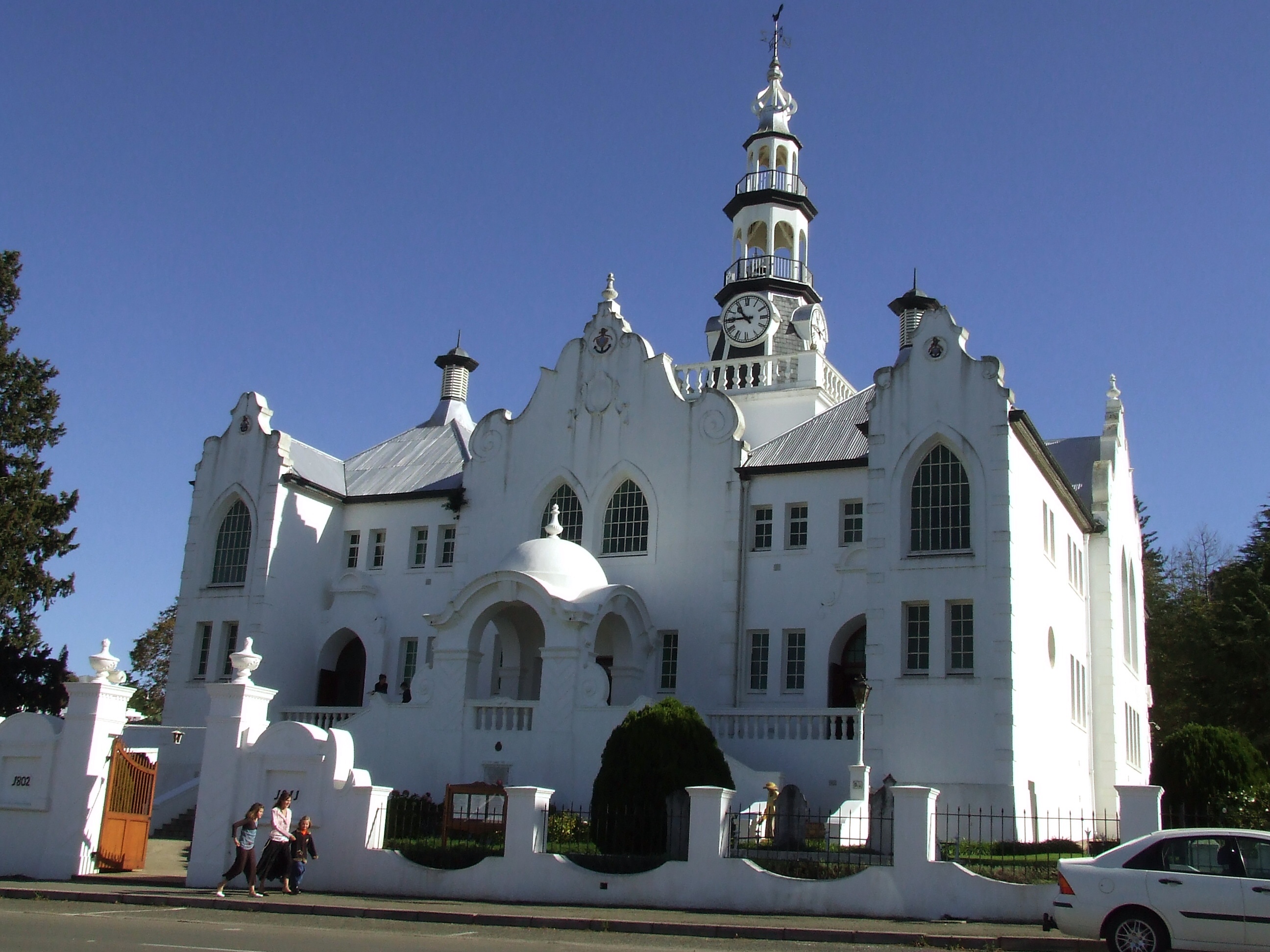
More than fifty buildings in Swellendam carry provincial heritage status, and the architectural throughline is unmistakable: whitewashed walls, ornamental gables, thatched roofs darkened by age. The Drostdy, built in 1747 as the magistrate's seat, anchors the collection. It is Cape Dutch architecture at its most restrained and purposeful, designed not to impress visiting dignitaries but to project authority on a remote frontier. Walk the oak-lined streets radiating outward from it and you pass through centuries compressed into a few blocks, from VOC-era homesteads to Victorian shopfronts to the Dutch Reformed Church, whose ornate tower rises above the treeline like an exclamation point at the end of a very long sentence. The town's population of roughly 35,000 lives among these layers without making a fuss about them, which may be the most Cape Dutch thing of all.
Seventeen Bontebok
By 1931, there were seventeen bontebok left on Earth. The chocolate-and-white antelope, once common across the southern Cape's fynbos plains, had been hunted to the edge of oblivion. That year, a national park was established just outside Swellendam to protect the remnant herd. Bontebok National Park started as an act of desperation and became one of South Africa's quieter conservation victories. The population has recovered to sustainable numbers, and the park's lowland fynbos now supports eland, red hartebeest, and Cape mountain zebra alongside the bontebok. Hiking trails wind through the reserve along the Breede River, where the mountains fill the northern horizon and the only sounds competing with birdsong are the occasional splash of a fish eagle striking the water. For a park born from near-extinction, it carries remarkably little anxiety.
Into the Langeberg
The Marloth Nature Reserve climbs the southern slopes of the Langeberg range directly behind town, and its trails offer everything from gentle river walks to full-day mountain ascents. The Twaalfuurkop Peak trail covers 12.4 kilometers and gains enough elevation to reach 1,450 meters, where views stretch across the Ruensveld plains to the Indian Ocean. Below the peaks, the Duiwelsbos Waterfall hike is a shaded two-kilometer stroll that ends at a natural pool, small enough to feel like a secret. The fynbos along these trails shifts with altitude, from dense protea scrub at lower elevations to the delicate ericas and restios that thrive in the wind-scoured heights. Between the mountains and the coast, the De Hoop Nature Reserve draws whale watchers to its limestone cliffs, while Witsand, fifty kilometers south, sits beside one of the largest whale nurseries on the southern African coast.
A Town That Feeds You Properly
Swellendam's main street is lined with owner-managed restaurants rather than chain outlets, and the difference registers on the plate. The town takes a particular pride in this distinction, treating good food as civic infrastructure rather than luxury. There are no fast-food franchises competing for attention, just kitchens run by people who live in the town and know their regulars. The surrounding Overberg region supplies the raw materials: wheat from the Breede River valley, wine from Robertson and Worcester an hour to the north, lamb from the Karoo fringe. Swellengrebel Airfield handles private planes and pilot training, while the railway station sits silent, its regular service long discontinued. A hospital train still visits annually, and private companies run occasional steam-engine tourist trips, connecting Swellendam to a rail heritage that the highway otherwise threatens to erase.
From the Air
Swellendam sits at 34.02°S, 20.44°E, nestled between the Langeberg Mountains to the north and the Breede River valley to the south. Swellengrebel Airfield (no ICAO code assigned) handles private and training flights. The nearest major airport is George Airport (FAGG), approximately 170 km east. From altitude, look for the distinctive white gables of the Drostdy and the Dutch Reformed Church tower along the oak-lined main street. The Langeberg range provides a dramatic northern backdrop, while Bontebok National Park is visible as a green lowland area just south of town along the Breede River.