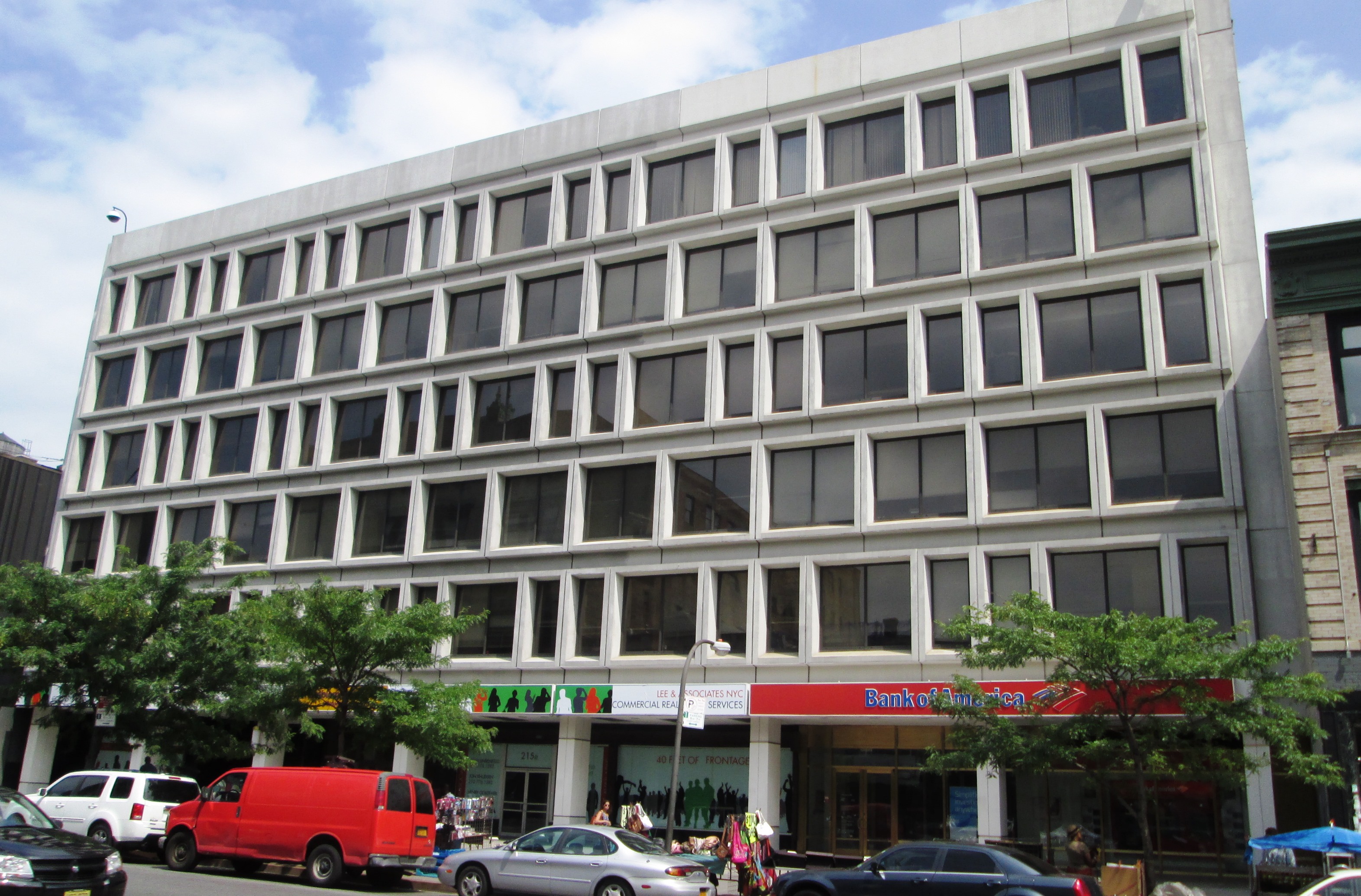
Sydenham Hospital
In 1977, the United States Secretary of Health, Education and Welfare, Joseph A. Califano Jr., called Harlem a "health disaster area." Three years later, the neighborhood's last remaining hospital closed. The story of Sydenham Hospital -- eighty-eight years of service compressed into a single act of fiscal austerity -- is a story about who gets care, who provides it, and what a community loses when both are taken away. Located at 124th Street and Manhattan Avenue, Sydenham opened in 1892, occupying nine houses on 116th Street near 2nd Avenue. It closed on a November day in 1980, after angry demonstrators had stormed the building and occupied it for ten days in a desperate final stand.
Nine Houses on 116th Street
Sydenham began small -- nine converted houses serving a patient population that was, by 1911, mostly African American. Around 1924, the hospital moved to a new 200-bed building at the intersection of West 125th Street and Lenox Avenue. In 1944, a Time magazine report noted that every staff doctor at Sydenham was white, despite the community it served being overwhelmingly Black. That would change. Sydenham became known for hiring African-American physicians and nurses at a time when other nearby hospitals would not. In 1971, Florence Gaynor became the first African-American woman to head a major teaching hospital when she took over as executive director. Ethelene Crockett, who would become Michigan's first Black woman certified in obstetrics and gynecology, completed her residency at Sydenham. The hospital was where W. C. Handy, the "Father of the Blues," died of bronchial pneumonia in 1958.
The Fiscal Knife
Sydenham was always small, and small hospitals run expensive. On March 3, 1949, New York City took control of the struggling institution, folding it into the municipal hospital system. For decades the arrangement held, but the city's near-bankruptcy in the 1970s made every line item a target. Sydenham, with just 119 beds, was the smallest and costliest municipal hospital in the system -- daily patient care ran $382 per day, about $100 more than comparable facilities. New York State's unusual requirement that localities pay 25 percent of Medicaid costs compounded the pressure. Deputy Mayor Robert F. Wagner III warned that the municipal hospital system was "the one agency that could plunge us back into a fiscal crisis." In December 1978, Mayor Ed Koch's administration proposed closing or shrinking four hospitals. Sydenham was on the list.
The People's Administration
A "Coalition to Save Sydenham" organized rallies, filed lawsuits, and lobbied elected officials. Researchers documented what the federal government had already acknowledged: Harlem was medically underserved. But in the spring of 1980, as closure became imminent, resistance escalated beyond petitions. Demonstrators stormed the hospital and occupied it for ten days under what they called a "People's Administration." On June 24, 1980, city, state, and federal officials proposed a compromise -- keep nearby Metropolitan Hospital open with improvements and convert Sydenham into a drug treatment and outpatient clinic. Community activists rejected the plan. In November 1980, Sydenham's doors closed for good. Metropolitan Hospital survived.
An Unintended Consequence
Historians have traced the decline of Black hospitals to an ironic source: the Civil Rights Act of 1964 and Medicare's enactment in 1965. Desegregation forced white hospitals to admit Black patients, and Black physicians followed their patients into previously all-white institutions. But white patients did not cross over to historically Black hospitals. The flow was one-directional, and the results were devastating. In 1944, the United States had 124 historically Black hospitals. By 1989, only ten remained. Sydenham was part of that larger collapse -- a hospital that existed because segregation required it, and that could not survive integration's uneven consequences. The building still stands on Manhattan Avenue, a quiet marker of a community's fight to keep the institution that, for nearly a century, had been the only one willing to treat them.
From the Air
Located at 40.810N, 73.954W at 124th Street and Manhattan Avenue in Harlem, Manhattan. The former hospital site sits in the dense urban grid of central Harlem, a few blocks west of Marcus Garvey Park. Nearby airports include KLGA (LaGuardia, 6 nm east) and KTEB (Teterboro, 10 nm northwest). Best viewed at 2,000-3,000 ft AGL. Look for the intersection of major Harlem avenues with Central Park visible to the south.