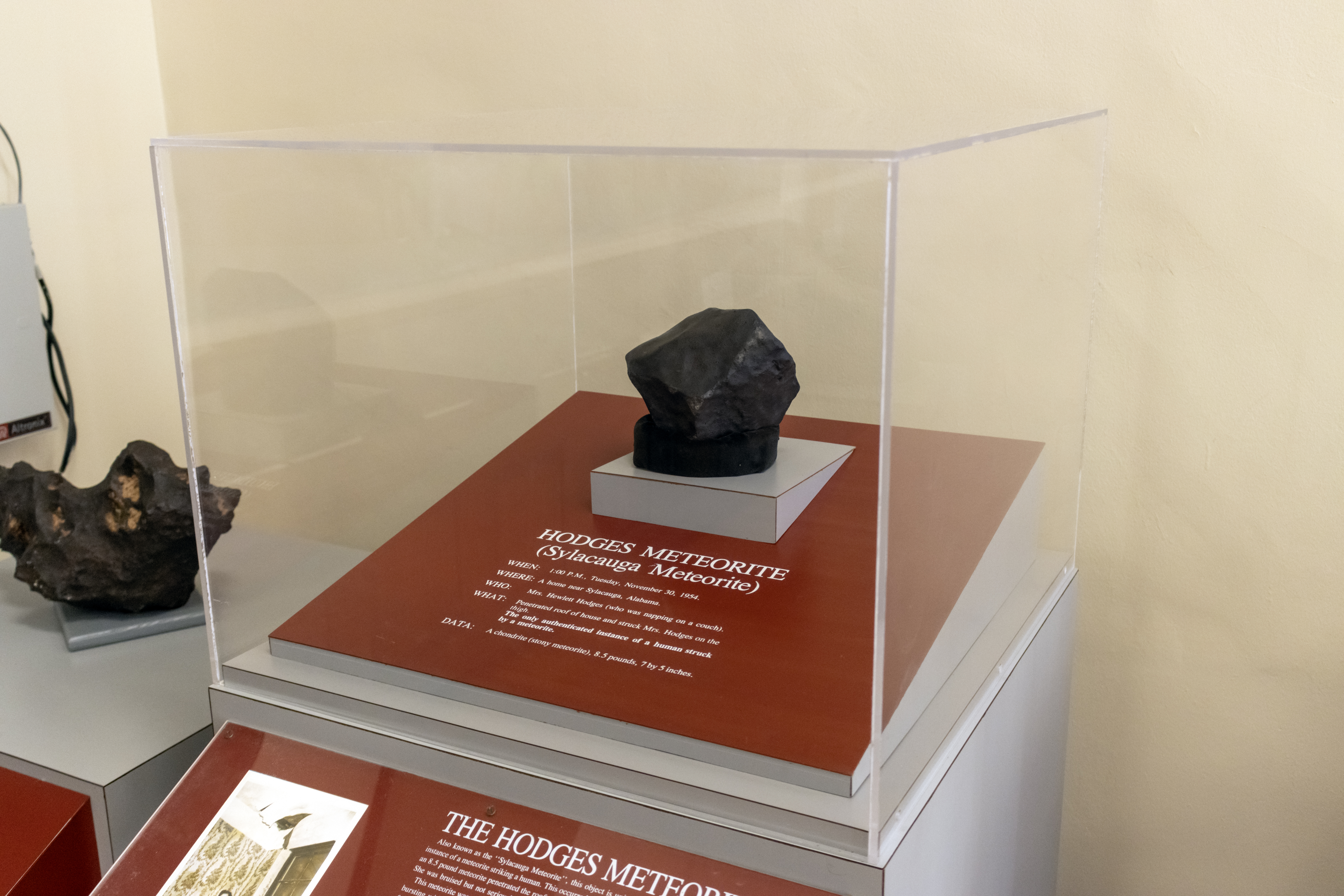
Sylacauga Meteorite
Ann Hodges was napping on her couch when the universe decided to pay a house call. At 12:46 p.m. on November 30, 1954, a grapefruit-sized chunk of space rock punched through the roof of her farmhouse in Oak Grove, Alabama, bounced off a wooden console radio, and struck the 34-year-old woman on her left side. She was badly bruised but alive, making her the only verified person in recorded history to be hit by a meteorite. The rock had traveled millions of miles through the void of space, survived a fiery plunge through the atmosphere visible from three states, and ended its journey on the hip of a woman taking an afternoon nap near the small town of Sylacauga.
Fire Across Three States
Even in the early afternoon, the Sylacauga meteorite announced itself with spectacle. The fireball blazed bright enough to be seen from three American states as it tore through the atmosphere. Witnesses on the ground reported hearing explosions and loud booms, the telltale signature of a shock wave trailing a chunk of rock entering Earth's atmosphere at cosmic velocity. As it descended, the meteoroid fractured into at least three pieces. The largest fragment, the one that would make history, crashed through Ann Hodges' roof. A second fragment was discovered the next day by Julius Kempis McKinney. A third is believed to have struck the earth somewhere near Childersburg, a few kilometers northwest of Oak Grove, though it was never recovered. Scientists would later classify the Sylacauga meteorite as an ordinary chondrite of the H4 group, a common type of stony meteorite. Its orbit had carried it in from the sunward side of Earth, meaning it had already passed its closest approach to the Sun and was traveling outward when it crossed paths with our planet.
A Rock, a Radio, and a Rude Awakening
The chain of events inside the Hodges farmhouse reads like something engineered by a mischievous cosmic screenwriter. The meteorite fragment penetrated the roof, struck the large wooden console radio in the living room, and ricocheted into Ann Hodges as she lay on the couch. The impact left her badly bruised across one side of her body, but she was able to walk and even pose for photographs showing the fresh wound. The stone that hit her was roughly the size of a grapefruit, a modest fragment of the original meteoroid but substantial enough to make international news. Within hours, the Sylacauga police chief confiscated the rock and turned it over to the United States Air Force. What followed was a legal tangle that proved almost as dramatic as the impact itself.
Who Owns a Piece of the Sky?
The meteorite ignited a bitter ownership dispute that consumed the Hodges family. Ann and her husband Hewlett claimed the rock as theirs, since it had literally struck Ann. Their landlord, Bertie Guy, countered that the meteorite had fallen on her property and therefore belonged to her. The legal wrangling dragged on, and the relentless public attention that came with being history's only confirmed meteorite victim wore on Ann Hodges. She became deeply uncomfortable with the spotlight. In the end, the Hodgeses settled with Guy and took possession of the stone, but the experience had soured them. In 1956, they donated the meteorite to the Alabama Museum of Natural History, where it remains on display. Meanwhile, the McKinney fragment, found by Julius Kempis McKinney the day after the fall, took a different path. An Indianapolis-based lawyer purchased it, and it eventually made its way to the Smithsonian Institution, where it now resides alongside some of the most storied objects in American science.
Cosmic Odds and a Lasting Legacy
The Sylacauga meteorite remains singular in the annals of science. While the 1908 Tunguska event in Siberia reportedly caused casualties, and a small fragment struck a boy in Mbale, Uganda in 1992 without injury after being slowed by a tree, no other documented case matches the directness of what happened to Ann Hodges. As recently as 2021, a meteorite fell through a roof in Golden, British Columbia, landing on a sleeping woman's pillow without harming her, a near-miss that only underscored how extraordinary the Sylacauga event was. The quiet crossroads of Oak Grove, set amid the rolling hills of Talladega County, remains an unlikely landmark in the story of humanity's relationship with the cosmos. The event turned Sylacauga into a household name overnight and gave scientists a rare opportunity to study a freshly fallen meteorite with a precisely documented point of impact.
From the Air
Located at 33.19N, 86.29W in rural Talladega County, Alabama. The impact site is near Oak Grove, a small community southwest of Sylacauga. From the air, the area is characterized by rolling forested hills and farmland. The nearest airport is Talladega Municipal Airport (ASN). Birmingham-Shuttlesworth International Airport (KBHM) is approximately 55 nm to the northwest. Best viewed at 3,000-5,000 feet AGL to appreciate the rural character of the landscape where a piece of space fell to Earth.