Todai-ji
More than 2.6 million people donated their rice, wood, metal, cloth, and labor to build it. Three hundred and fifty thousand of them worked directly on the statue alone. When Emperor Shomu commanded the construction of the Great Buddha of Nara in 743, he was not merely commissioning a religious monument. He was attempting to hold together a nation unraveling under plague, rebellion, and famine. The result, Todai-ji, became the most ambitious building project in Japanese history, and the colossal bronze Daibutsu it shelters has survived fire, earthquake, and the collapse of the very civilizations that built and rebuilt it.
Born from Catastrophe
Japan in the 730s was a country in crisis. A smallpox epidemic swept through the islands between 735 and 737, devastating the population. Consecutive years of failed crops compounded the suffering. Political turmoil followed: an alleged coup by Prince Nagaya in 729, a rebellion led by Fujiwara no Hirotsugu in 740, and Emperor Shomu was forced to relocate his capital four times. In desperation, the emperor turned to Buddhism. In 743, he issued an edict calling on the people themselves to help build temples nationwide, believing collective piety would earn divine protection. The centerpiece would be a colossal image of Vairocana, the Cosmic Buddha, housed at Todai-ji in Nara. Construction began at Shigaraki but was moved to Nara in 745. The monk Gyoki traveled the provinces soliciting donations. The Indian priest Bodhisena performed the eye-opening ceremony when the statue was completed in 752, consecrating a project that had consumed much of Japan's bronze supply and required entirely imported gold.
The Hall That Keeps Shrinking
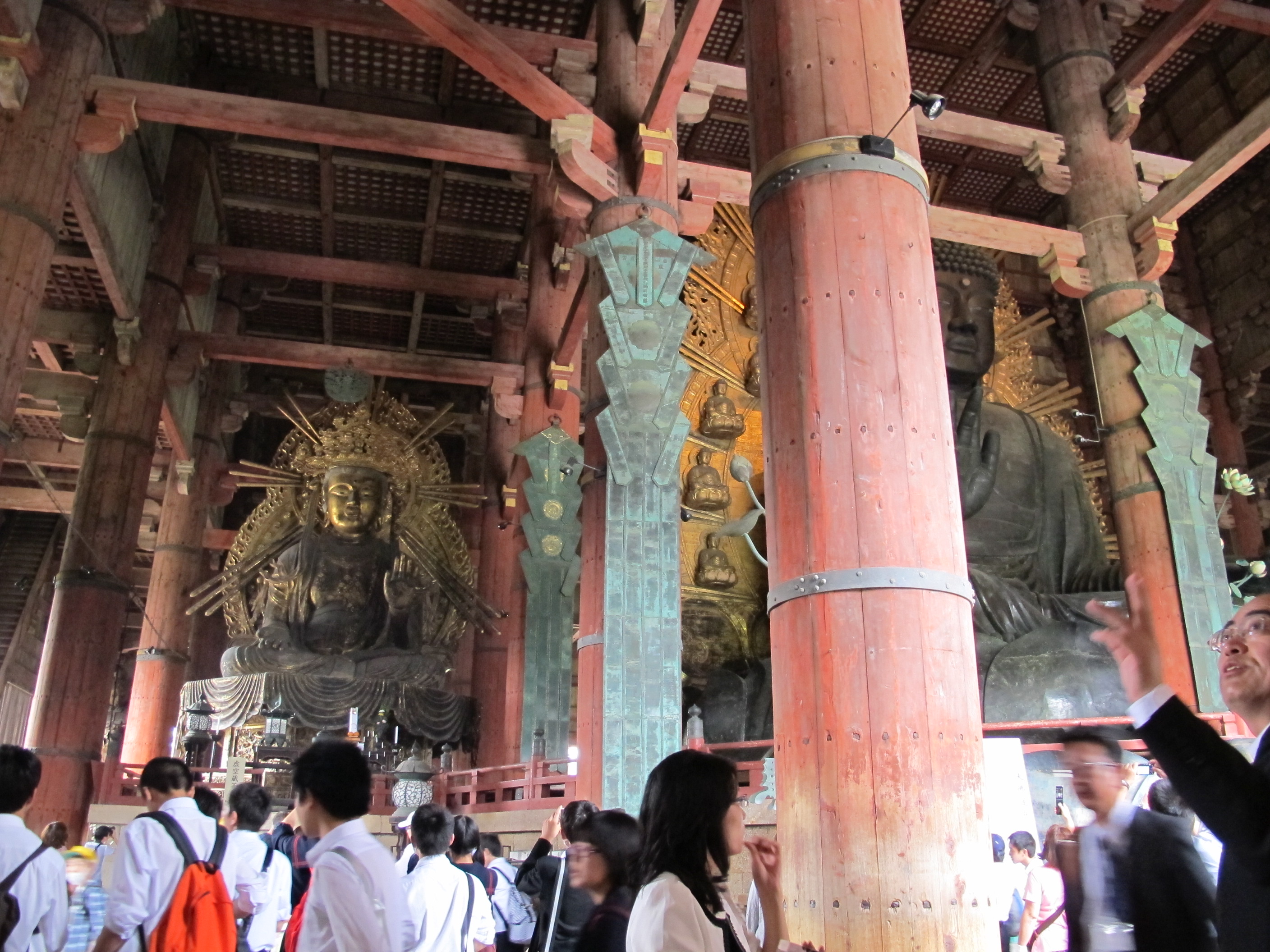
The Daibutsuden, or Great Buddha Hall, has been destroyed and rebuilt twice. The current structure, completed in 1709, is actually 30 percent smaller than the previous version, reduced from eleven bays to seven because funds ran short. Even diminished, it remained the world's largest wooden building until 1998. Forty-eight lacquered cinnabar pillars, each 1.5 meters in diameter and 30 meters long, support its blue-tiled roof. The original complex was even more staggering. Twin pagodas rose 100 meters on either side, making them among the tallest structures on Earth at the time. Earthquakes eventually destroyed them both. One of their sorin finials was reproduced for the 1970 Osaka Expo and still stands at the spot where a pagoda once reached for the sky. Inside the hall, one wooden pillar has a hole cut through its base, said to be the exact size of the Daibutsu's nostril. Visitors who squeeze through it are promised enlightenment in their next life.
Secrets Inside the Knee
The Great Buddha statue has been recast multiple times across the centuries. Its current hands were made during the Momoyama period (1568-1615), and its head dates to the Edo period (1615-1867). In 855, the head fell clean off and had to be replaced with donations from across the empire. Yet the statue has always held secrets. X-ray examination revealed that hidden inside the Buddha's knee are a human tooth, pearls, mirrors, swords, and jewels, believed to be relics of Emperor Shomu himself. The statue's shoulders span 28 meters, and 960 curls sit atop its head. Its golden halo holds 16 smaller images. The sheer scale defies casual comprehension. A caretaker standing at the base barely reaches the statue's ankle. The Daibutsu weighs approximately 500 tons of bronze and sits on a lotus pedestal incised with delicate images of bodhisattvas, a reminder that even the most monumental expressions of faith rest on foundations of exquisite care.
Guardians at the Gate
The Nandaimon, or Great South Gate, is a reconstruction from the late 12th century built in the Daibutsuyo architectural style after the original was destroyed by a typhoon. Standing within its massive frame are two Nio guardian figures created by the master sculptors Unkei and Kaikei and their workshop around 1203. The pair follows the A-un convention: Agyo stands with mouth open, representing the first sound, while Ungyo's mouth is closed, representing the last. Between 1988 and 1993, a team of 15 conservators from the National Treasure Repairing Institute in Kyoto undertook a $4.7 million restoration, the first time the sculptures had been moved from the niches where they were originally installed nearly eight centuries earlier. Beyond the gate, Todai-ji's grounds encompass gardens, subsidiary halls, and the Shosoin storehouse, a treasure repository holding artifacts from the Tenpyo period that constitute an unparalleled record of 8th-century Asian material culture.
A Temple That Understands Fire
Todai-ji knows what it means to lose everything and rebuild. The Great Buddha Hall was burned in warfare in 1180 and again in 1567. Minamoto Yoritomo funded the first reconstruction in 1181, entrusting the work to the monk Chogen. By the 19th century, the hall had warped so severely under the weight of its roof that collapse seemed imminent. A first restoration between 1904 and 1913 added support beams. A second, far more ambitious project from 1974 to 1980 mobilized 100,000 workers, removed the entire roof, and reinforced the wooden structure with concealed steel frames and concrete. When Notre-Dame de Paris burned in April 2019, Todai-ji's custodians placed a donation box behind the Great Buddha, declaring in Japanese and English: we have been reconstructed every time we burned down, thanks to the significant effort of many people. The gesture was not mere sympathy. It was recognition from one survivor to another that sacred architecture lives only as long as people are willing to raise it from ashes.
From the Air
Located at 34.689N, 135.840E in the heart of Nara, a UNESCO World Heritage city. The massive Daibutsuden roof is visible from altitude as one of the largest roofed structures in the area. Nearest airport is Osaka Itami (RJOO), approximately 30 km west-northwest. Kansai International (RJBB) lies about 70 km to the south. From above, Todai-ji sits within Nara Park, identifiable by the large deer park and surrounding forested hills of Kasugayama. The Nandaimon gate axis runs due south. Best viewed at 2,000-4,000 feet AGL. The adjacent grid pattern of central Nara provides good visual orientation.