Tofuku-ji
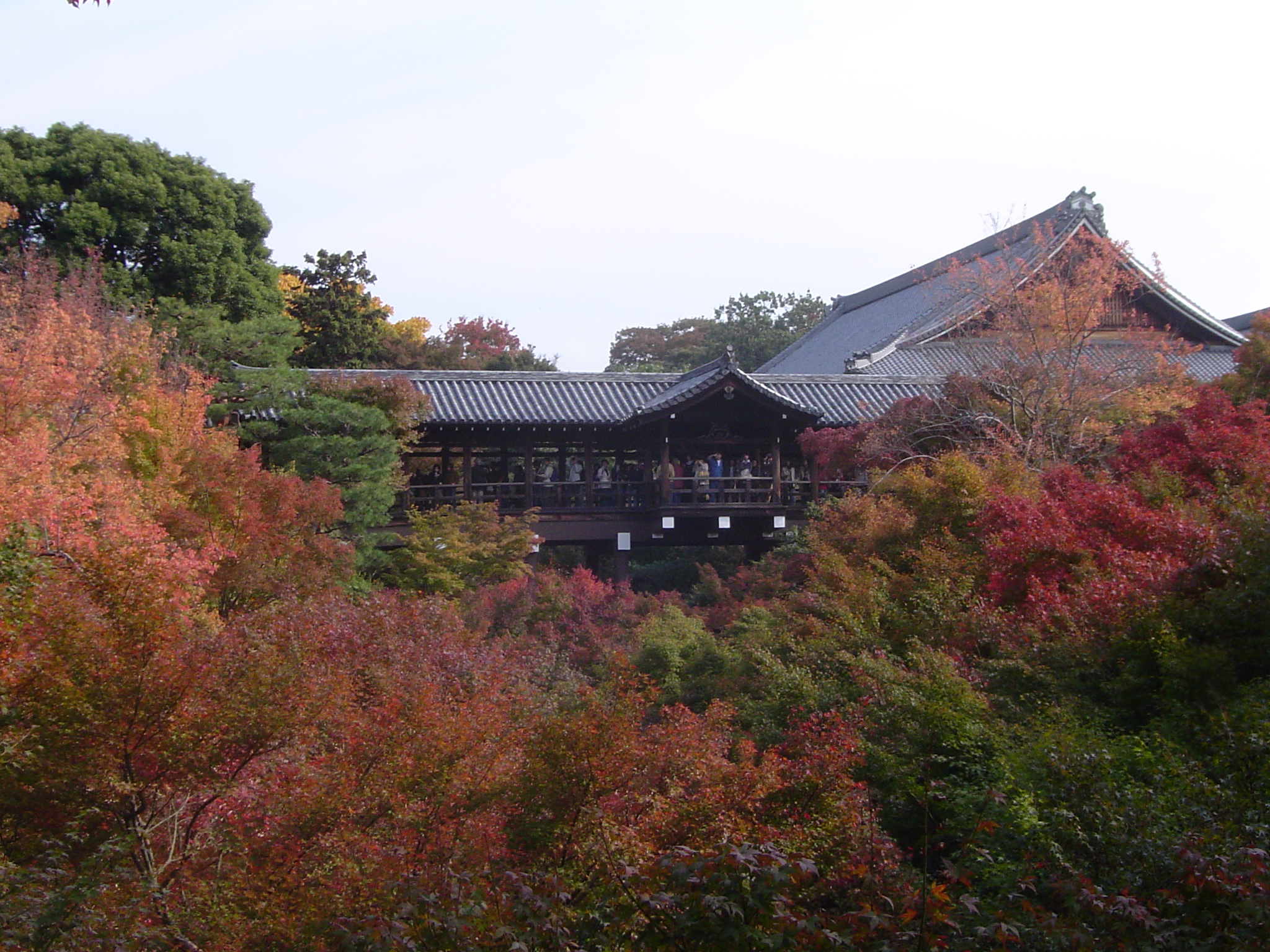
Every November, a sea of crimson maple leaves floods the valley beneath the Tsuten-kyo bridge at Tofuku-ji, drawing thousands of visitors who stand shoulder to shoulder on the wooden span, gazing down into what looks like a burning forest canopy. It is the most photographed autumn scene in Kyoto. But the temple that hosts this spectacle is far older and far stranger than its seasonal fame suggests -- a place where the oldest Zen gate in Japan stands alongside modernist gardens, where a massive painting of the dying Buddha is displayed only once every few years, and where a shipwreck discovered off the coast of Korea in 1975 traced its cargo back seven centuries to this very compound.
A Name Borrowed From Giants
Tofuku-ji was founded in 1236 by Kujo Michiie, the imperial chancellor, who wanted a temple grand enough to rival anything in Nara. He borrowed one character from Todai-ji and another from Kofuku-ji -- two of Nara's most powerful temples -- and combined them to create the name Tofuku-ji. To lead the new institution, Michiie appointed the monk Enni, who had studied Rinzai Zen Buddhism in China under the master Wuzhun Shifan. Enni brought back not just teachings but an aesthetic vision: Tofuku-ji was designed as a remarkable replica of the public monasteries of Zhejiang Province, transplanting Chinese Zen architecture onto Japanese soil. At its peak, the complex encompassed 53 sub-temples. Today 24 remain, still forming one of the largest Zen compounds in Kyoto.
The Gate That Outlasted Everything
Tofuku-ji's main gate, the sanmon, is the oldest of its kind in Japan and a designated National Treasure. Two stories high and five bays wide, its timber frame has stood since the Muromachi period while fires, earthquakes, and imperial decrees dismantled much of the temple around it. The Meiji-era Shinbutsu bunri decree -- which forced the separation of Buddhist and Shinto practices -- shrank Tofuku-ji from 70 buildings to 25. An 1881 fire destroyed the main hall, the abbot's quarters, and a statue of Sakyamuni Buddha. During the Russo-Japanese War, the temple grounds were requisitioned as a prisoner-of-war camp for Russian soldiers. Through all of this, the sanmon endured. The complex also preserves Japan's oldest communal toilet, built during the Muromachi period -- a structure mundane enough that it made international news in 2022 when a car accidentally crashed through its wooden doors.
Shigemori's Modern Zen
In the summer and autumn of 1939, the landscape architect Mirei Shigemori redesigned the gardens surrounding the abbot's quarters. Shigemori was a radical figure in Japanese garden design, convinced that the tradition had grown stagnant and needed to be shaken awake. His four gardens at Tofuku-ji became his manifesto. The most celebrated is the moss garden, where clumps of soft green moss are arranged in a checkerboard pattern against raked gravel, merging the organic and the geometric in a way that broke sharply from historical precedent. Shigemori called these 'concept gardens containing abstract expression.' The designs were controversial at the time but have since become emblematic of the renewal of Japanese gardening principles in the twentieth century, influencing landscape architects worldwide.
The Ship That Never Arrived
In 1319, fire devastated Tofuku-ji. To replace damaged Buddhist artifacts and obtain special construction materials, a merchant ship was dispatched to Yuan China in 1323. The vessel sailed from the port of Ningbo bound for Hakata, laden with roughly 200 tons of cargo including over 20,000 pieces of ceramic ware, 28 tons of Chinese coins, and lengths of red sandalwood. It never arrived. Caught in a storm, the ship sank near the Shinan Islands off the Korean coast. Its passengers -- including several Japanese Buddhist monks -- drifted ashore alive, and the Zen monk-poet Daichi Zenji later recorded the ordeal in his personal writings. The wreck lay undiscovered for nearly 700 years until 1975, when a Korean fishing boat hauled up ceramic fragments in its nets. Excavation took almost a decade. On the wooden cargo tags recovered from the seafloor, the characters for Tofuku-ji could still be clearly read.
The Bridge Over Burning Leaves
The Tsuten-kyo bridge connects the main temple precincts to the Founder's Hall, spanning a shallow valley dense with Japanese maple trees. In spring and summer the view from the bridge is a canopy of green. But from mid to late November, the maples ignite into shades of red, orange, and gold, and the bridge appears to float above a blazing cloud. The woodblock artist Hiroshige depicted this very scene in the nineteenth century, and visitors have been re-creating his perspective ever since. It is a tradition to view the autumn foliage specifically from this bridge, making Tofuku-ji one of the most sought-after destinations in Kyoto during the fall season -- a temple founded to replicate Chinese grandeur, now beloved for a spectacle that is entirely, unmistakably Japanese.
From the Air
Located at 34.977N, 135.774E in the Higashiyama ward of southeastern Kyoto, Japan. The temple complex is identifiable from the air by its large compound of traditional buildings and dense tree cover, situated between Kyoto Station to the west and the Higashiyama mountain range to the east. The nearby five-story pagoda of To-ji and the distinctive torii gates of Fushimi Inari Taisha (to the southeast) serve as excellent aerial landmarks. Nearest airports are Kansai International Airport (RJBB, approximately 80 km south) and Osaka Itami Airport (RJOO, approximately 30 km west). Best viewed at 2,000-4,000 feet AGL; in November, the autumn foliage around the Tsuten-kyo bridge valley is visible even from moderate altitude.