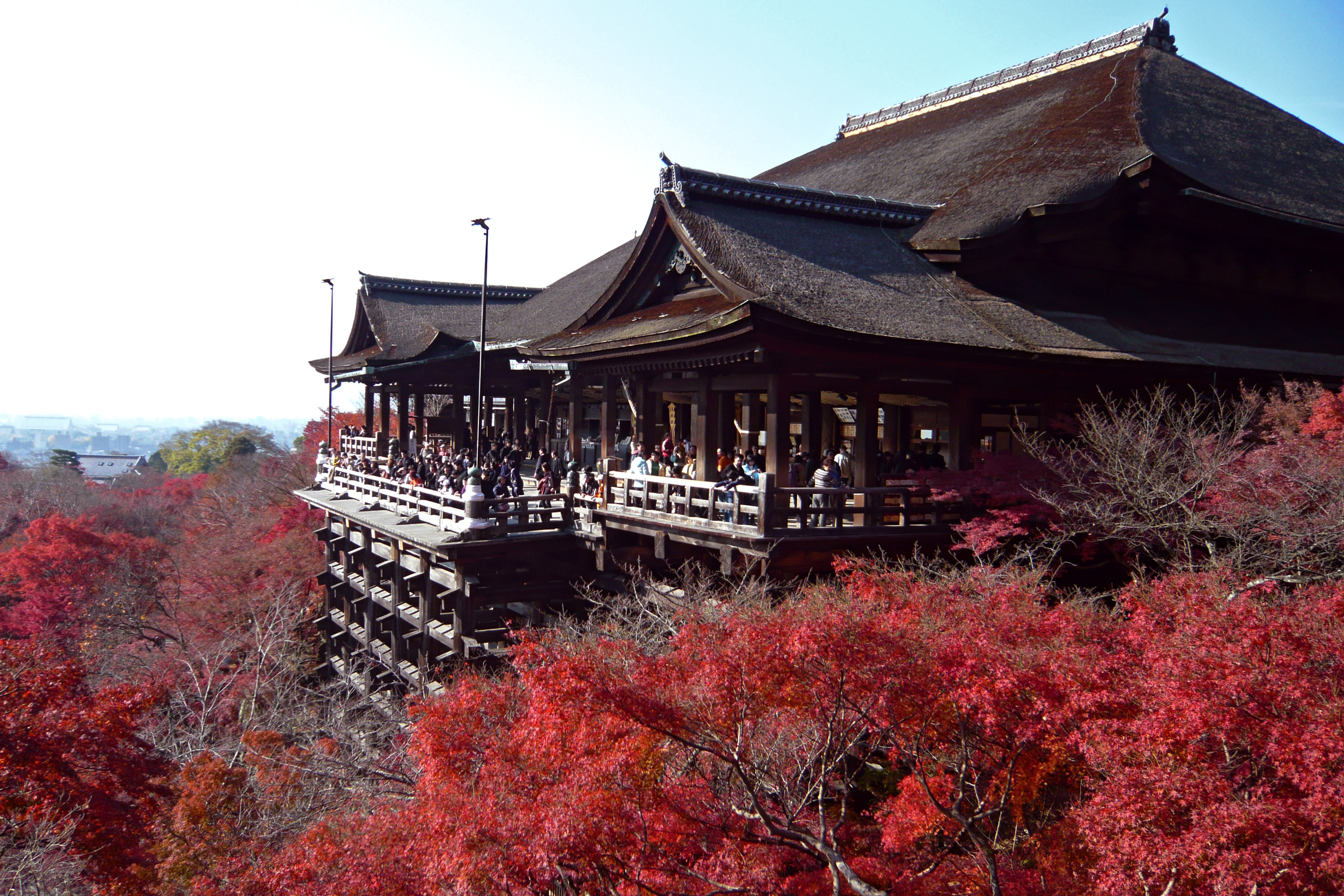
Tō-ji
When the imperial court moved Japan's capital to Heian-kyo in 794, they imposed a strict rule: only three Buddhist temples would be allowed within the city limits. Two flanked the Rashomon, the great southern gate. Tō-ji stood to the east, Sai-ji to the west. More than twelve centuries later, Sai-ji is a patch of grass in a small park. The Rashomon is a stone marker on a quiet street. But Tō-ji endures, its five-story pagoda rising 55 meters above the rooftops of Minami-ku, the tallest wooden tower in Japan and a silhouette so iconic it has become shorthand for Kyoto itself.
The Priest Who Claimed a Temple
For its first three decades, Tō-ji was an official state temple, a guardian shrine charged with protecting the nation. Then in 823, Emperor Saga handed control to a priest named Kukai, better known by his posthumous title Kobo Daishi. Kukai had spent two years studying esoteric Buddhism in Tang dynasty China and returned to Japan determined to establish Shingon, a school of Vajrayana Buddhism, as a major force. Tō-ji became his headquarters. He transformed it into the center of Shingon practice, filling its lecture hall with a mandala of 21 Buddhist statues arranged to express the religion's cosmology in three dimensions. The temple's principal image remains Yakushi Nyorai, the Medicine Buddha, whose statue in the Golden Hall dates to 1603. Kukai's residence became the Miedo hall, opened on the 21st of every month for memorial services that have continued, with interruptions, for nearly 1,200 years.
Destroyed and Reborn Four Times
The pagoda that defines Tō-ji today is not the original. Built first in the ninth century, it has burned down and been rebuilt four times. Lightning, warfare, and the 1586 Tensho earthquake each took their turn. The current structure dates to 1643, erected by order of the third Tokugawa shogun, Iemitsu. Its survival since then owes something to Kamakura-period engineering innovations that Japanese architects developed specifically to resist earthquakes: a central pillar suspended from the upper levels rather than anchored to the ground, allowing the entire structure to sway without snapping. At ground level, four Buddha statues face the cardinal directions. The interior, open to view but rarely entered, houses relics, sculptures, and paintings that compress a millennium of devotion into a single vertical space.
Five National Treasures Under One Roof
Few temple complexes anywhere in the world concentrate so many designated treasures in such a compact footprint. Five of Tō-ji's buildings hold National Treasure status: the Lotus Flower Gate, the Miedo Hall, the Golden Hall, the five-story pagoda, and the Kanchiin Guest Hall. The temple also houses documents and art spanning the Heian, Kamakura, Muromachi, Momoyama, and Edo periods, a timeline that covers nearly the entire arc of classical and medieval Japanese civilization. In 1994, UNESCO inscribed Tō-ji as part of the Historic Monuments of Ancient Kyoto, recognizing it alongside Kiyomizu-dera, Kinkaku-ji, and fourteen other sites. The architectural style known as Zenshuyo, visible in Tō-ji's linear layout, hinging panel doors, and cusped Katomado windows, represents a distinctly Japanese response to the challenge of building sacred spaces that could survive the archipelago's brutal seismic and climatic conditions.
A Legend of Rain and Rivalry
Tō-ji's vanished twin, Sai-ji, left behind more than ruins. A legend holds that during a great drought, Kukai and Shubin, the priest of Sai-ji, both prayed for rain. Kukai succeeded; Shubin did not. Consumed by jealousy, Shubin loosed an arrow at Kukai, but a Jizo statue appeared and took the blow in the priest's place. The Jizo, chipped where the arrow struck, still stands near the remains of the Rashomon gate. The story captures something essential about Tō-ji's survival: where Sai-ji fell to poor irrigation and neglected funding in the sixteenth century, Tō-ji kept drawing devotees, patrons, and protection. Today, a flea market fills the temple grounds on the 21st of every month, honoring Kukai's death anniversary. A Kyoto proverb links the temple to the weather itself: fair skies at Tō-ji market mean rain at Tenjin market. Even the clouds, it seems, still answer to Kukai.
From the Air
Tō-ji sits at 34.981N, 135.748E in Kyoto's Minami-ku ward, southwest of Kyoto Station. From the air, the 55-meter five-story pagoda is a prominent landmark, the tallest wooden structure visible in the Kyoto basin. Look for it just south of the rail yards near Kyoto Station, flanked by the temple's rectangular compound. The nearest major airport is Osaka Itami (RJOO), approximately 35 km southwest. Kansai International (RJBB) lies about 90 km to the south. At 2,000-3,000 feet AGL, the pagoda stands distinctly above the surrounding low-rise urban fabric, and the temple grounds are identifiable by their tree canopy and rectangular pond.