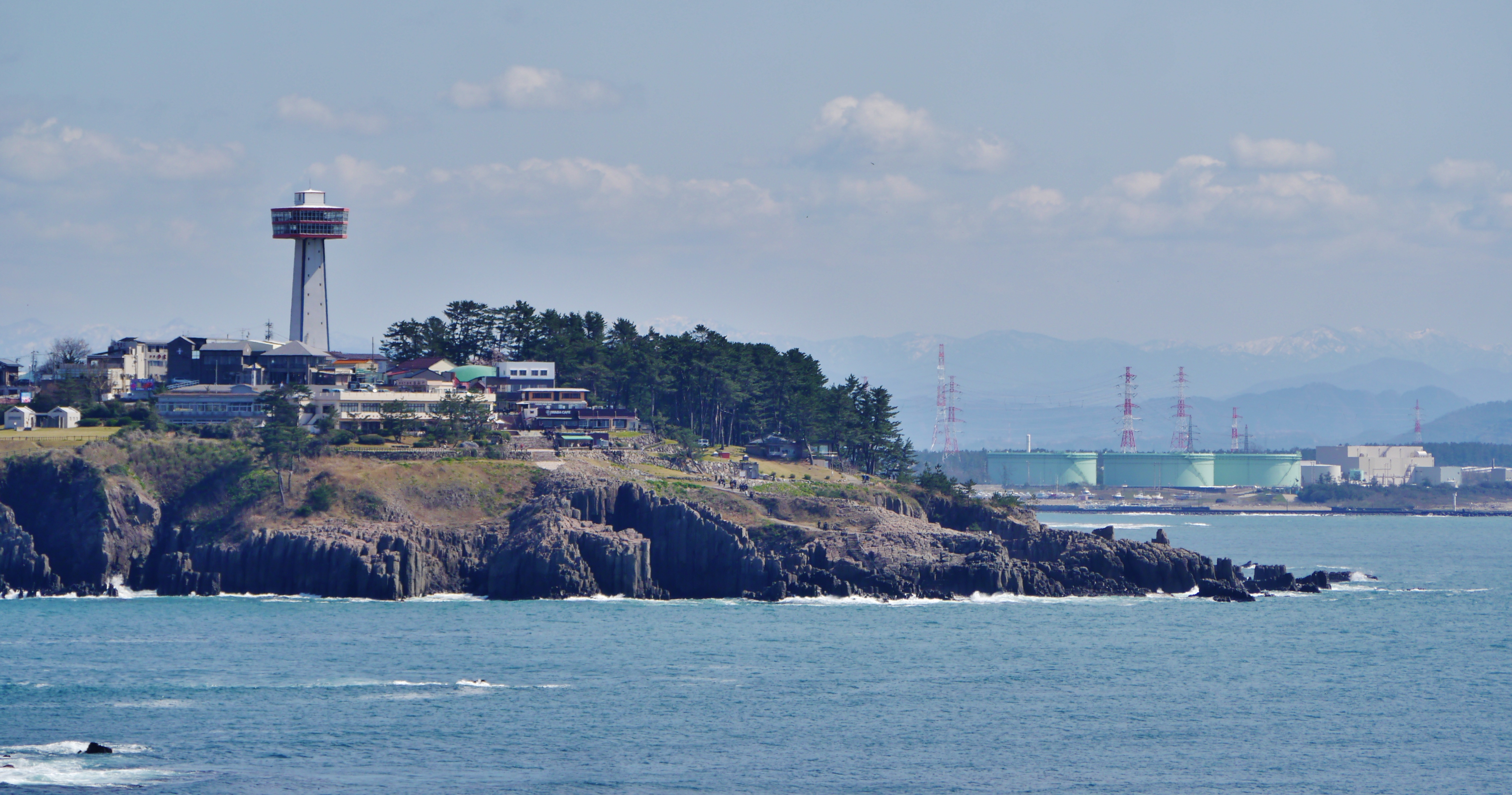
Tojinbo
The monk fell in love with a princess, and for that he was murdered. According to legend, a Buddhist monk named Tojinbo, despised by everyone around him, became infatuated with a beautiful princess called Aya. A rival suitor lured him to these cliffs and pushed him into the sea. For years afterward, violent storms lashed the coast at the same time each year, said to be the dead monk's rage given form. It took another wandering priest, one with enough compassion to hold a memorial service for the reviled Tojinbo, to finally quiet the storms. The cliffs kept his name. Today, the columnar rock formations that bear the monk's legacy rise up to 30 meters above the churning Sea of Japan along a kilometer of Fukui Prefecture's coastline, one of Japan's most striking geological spectacles and one of only three places in the world where columnar joints of this type exist at such scale.
Twelve Million Years in the Making
The rocks that form Tojinbo were born 12 to 13 million years ago during the Miocene Epoch, when volcanic activity along what is now the Sea of Japan coast forced magma up through layers of sedimentary rock. As the molten stone cooled, it contracted and cracked into columnar joints of pyroxene andesite, the same geological process that created Northern Ireland's Giant's Causeway and Korea's Jusangjeolli Cliffs. The columns at Tojinbo contain crystals of plagioclase, augite, and enstatite, arranged in pentagonal and hexagonal cross-sections. Millennia of wave erosion have done the sculpting, carving the columns into formations dramatic enough to earn their own names: the Sandan Rocks, stacked like enormous steps; the Rosoku Rocks, shaped like candles; the Byobu Rocks, standing flat and broad like folding screens; and the towering Oike, the tallest single cliff face. The Japanese government recognized the geological significance in 1935, designating the entire formation a Natural Monument.
Ghosts and Grudges
Two competing legends explain the name. In one version, a corrupt Buddhist priest from a local temple so outraged the surrounding community that they dragged him to the sea cliffs and hurled him to his death. In the more elaborate telling, Tojinbo was not corrupt but lovelorn, a monk universally disliked who made the fatal mistake of falling for Princess Aya. A jealous rival exploited his infatuation to lure him to the cliff's edge. Either way, the monk's vengeful spirit is said to haunt the rocks. The area sits within the Echizen-Kaga Kaigan Quasi-National Park, a protected stretch of coastline in the Mikuni-cho district of Sakai, where the dramatic geology has attracted pilgrims and tourists for centuries. Walking paths trace the cliff edge, and excursion boats take visitors along the base of the columns, where the scale of the formations and the violence of the surf become fully apparent.
The Watchman on the Cliffs
Tojinbo carries a darker modern reputation. The cliffs became one of Japan's most well-known locations for suicide, with as many as 25 people jumping each year, a number that rose and fell with the country's economic hardships and unemployment rates during the Lost Decades. In the 2000s, a retired police officer named Yukio Shige decided he had pulled enough bodies from the sea. Frustrated by what he saw as inaction by local authorities, Shige began patrolling the cliffs himself, watching for anyone who seemed to be lingering too long, approaching them, and simply asking if they were okay. He founded an NPO and recruited volunteers. By 2015, Shige and his team had intervened and saved more than 500 lives. His work drew international attention and became one of Japan's most recognized examples of community-based suicide prevention.
An Unlikely Savior
In an unexpected turn, the mobile game Pokemon Go may have contributed to a period of unusual safety at Tojinbo. Although 14 people died there in 2016, the cliffs saw no suicides for months during 2017. Shige attributed the change partly to the constant stream of players who came to the cliffs hunting for rare virtual creatures, their presence creating an unintentional surveillance network. The irony was not lost on observers: a phone game doing what years of official policy had not. Whether through Shige's patrols, the accidental crowds drawn by augmented reality, or broader shifts in public health awareness, the story of Tojinbo in the 21st century is as much about the living as the dead. The cliffs remain a place of staggering natural beauty, a geological formation millions of years in the making, named for a monk whose ghost may or may not still be angry, and watched over by a retired cop who refuses to look away.
From the Air
Tojinbo sits at 36.24°N, 136.13°E on the Sea of Japan coast in Fukui Prefecture. From the air, the columnar cliff formations are clearly visible as a jagged, dark-rock coastline jutting into blue water, distinct from the surrounding sandy beaches. The cliffs stretch about 1 km along the shore in the Mikuni-cho district. The nearest major airport is Komatsu Airport (RJNK), roughly 40 km northeast. Best viewed at 2,000-4,000 feet AGL on a clear day, when the contrast between white surf and dark andesite columns is most dramatic.