Toshodai-ji
He tried six times to cross the East China Sea. Storms destroyed his ships. Authorities arrested his companions. On the fifth attempt, a typhoon blew his vessel to Hainan Island, where he was stranded for months. His closest Japanese disciple died of illness. Jianzhen himself went blind. And still, in 753, at the age of sixty-five, the Tang dynasty monk finally stepped ashore in Japan. Six years later, on grounds granted by the imperial court, the blind priest founded Toshodai-ji, the temple where formal Buddhist ordination first took root in Japanese soil.
Twelve Years, Six Attempts, One Vow
In 742, two Japanese monks named Yoei and Fusho traveled to Tang dynasty China with a specific request: Japan needed a qualified monk to establish a proper system of Buddhist precepts. Jianzhen, a respected priest in Yangzhou, accepted the mission. He was fifty-five years old. His first attempt that year ended in betrayal when a disciple reported the Japanese monks as pirates, leading to arrests and four months of imprisonment. The second attempt in 744 was wrecked by a blizzard. Authorities forced Jianzhen back when he tried switching departure ports. The third and fourth attempts also failed. On the fifth attempt in 748, a superstorm drove the expedition to Hainan Island, where the party was stranded for nearly half a year. Yoei died from illness during the ordeal, and Jianzhen lost his sight. Undeterred, he tried once more. In 753, concealed aboard a Japanese diplomatic vessel, Jianzhen and five disciples finally made the crossing. He arrived on December 20th, blind but unbowed, carrying twelve centuries of Chinese Buddhist learning in his memory.
The Archetype of Classical Beauty
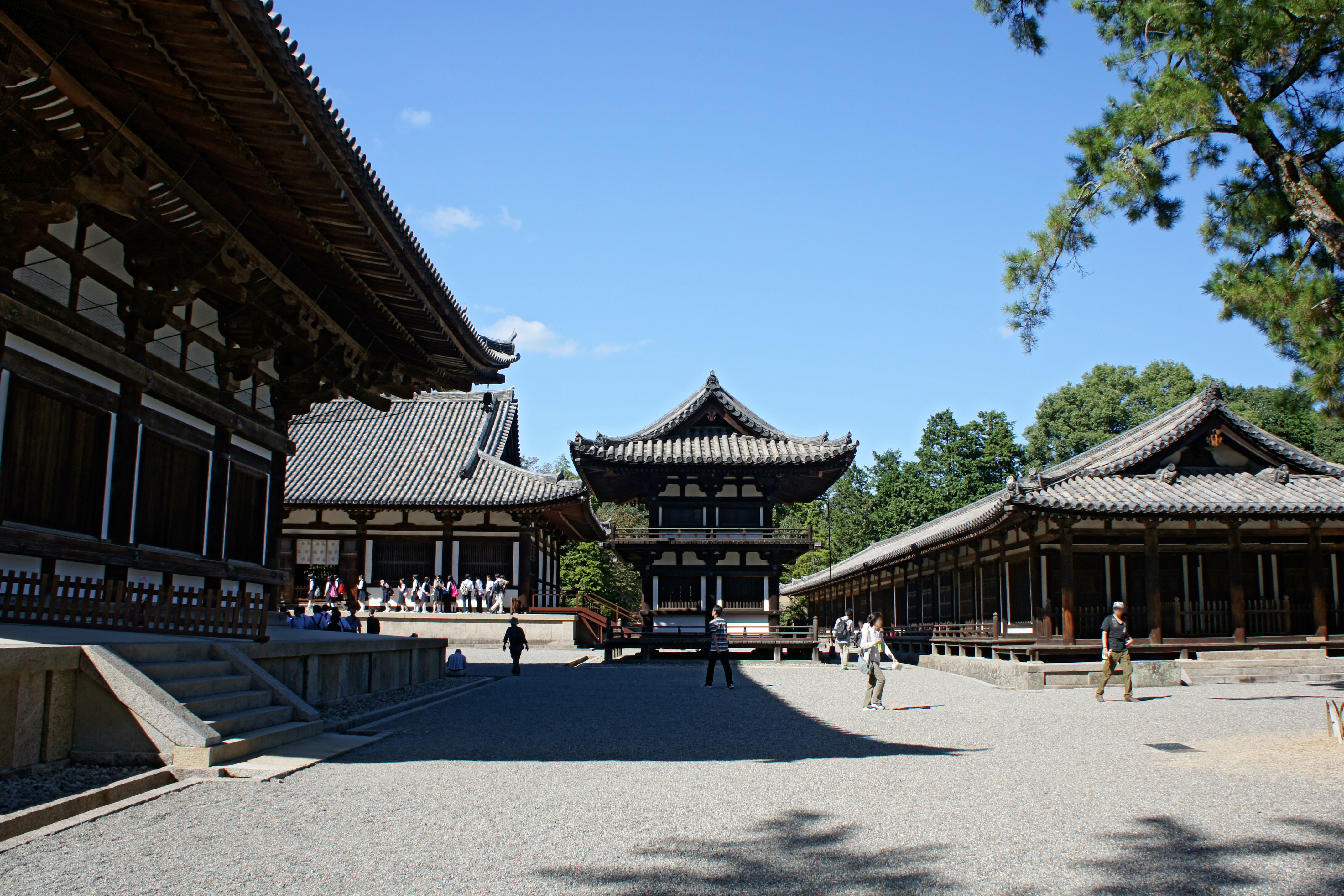
The Golden Hall, or Kondo, at Toshodai-ji is considered the archetype of classical Japanese temple architecture. Its single-story form, with a hipped tiled roof stretching across a seven-bay facade, has been called the greatest surviving structure of the Tenpyo era. Built during the Nara period in the 8th century, the hall embodies the aesthetic ideals that Jianzhen brought from Tang China, blending continental grandeur with Japanese refinement. The temple was established in 759 on the former residence of Prince Nitabe, granted by the imperial court in recognition of Jianzhen's extraordinary contributions. Today, the Kondo houses five National Treasures, and across the entire temple grounds, Toshodai-ji holds seventeen National Treasure designations and more than two hundred Important Cultural Properties. The Kodo, or Lecture Hall, is itself remarkable: originally an imperial government office building from the Nara-period capital, it was relocated to the temple grounds and repurposed for Buddhist assembly and teaching.
First Ordinations on Japanese Soil
Before Jianzhen's arrival, Japanese Buddhism lacked a formal system of ordination. Monks could study and practice, but without a qualified master to transmit the vinaya precepts, no one could be properly ordained. Jianzhen changed this permanently. Shortly after landing in Japan, he established a kaidan, an ordination platform, within the Great Buddha Hall at Todai-ji and conferred precepts upon 430 people, including Emperor Shomu and Empress Komyo themselves. The founding of Toshodai-ji gave this mission a permanent home. The temple became the headquarters of the Ritsu sect, the school of Buddhism devoted to monastic discipline and the vinaya tradition. Jianzhen spent his remaining years here, training monks and establishing the practices that would shape Japanese Buddhist institutions for centuries. He died at Toshodai-ji on May 6, 763, at the age of seventy-six. His disciples created a hollow-core dry-lacquer portrait statue of their master, now enshrined in the Mieido hall and considered one of the oldest portrait sculptures in Japan.
Living Bridges Between Cultures
Toshodai-ji has always been a place where China and Japan meet. The temple's two azekura-style wooden storehouses, the Hozo and the Kyozo, were built before the famous Shosoin at Todai-ji and once held sutras and treasures that traced the Silk Road from Central Asia through Tang China to Nara. The Koro, rebuilt in 1240, hosts the annual Uchiwamaki ceremony on May 19th, when fans are scattered from the upper story. In the modern era, Chinese writer Yan Wenjing composed a reflection on Sino-Japanese friendship after discovering lotus flowers imported from China growing around Jianzhen's portrait at the temple, a text that became an official passage on China's Putonghua Proficiency Test. In 1998, UNESCO designated Toshodai-ji as part of the Historic Monuments of Ancient Nara, recognizing not just its architecture but the cross-cultural exchange it has embodied since the day a blind monk from Yangzhou planted Buddhist law in foreign soil.
From the Air
Located at 34.676N, 135.785E in western Nara, about 4 km west-southwest of Todai-ji. Nearest airport is Osaka Itami (RJOO), approximately 30 km west. Kansai International (RJBB) lies about 75 km to the south. From the air, Toshodai-ji sits in a quieter area west of central Nara, near Yakushi-ji temple. The Kondo's distinctive hipped roof is the largest structure on the grounds. Look for the pair of temples (Toshodai-ji and Yakushi-ji) in the flat area between the Saho River and the wooded hills to the east. Best viewed at 2,000-3,000 feet AGL.