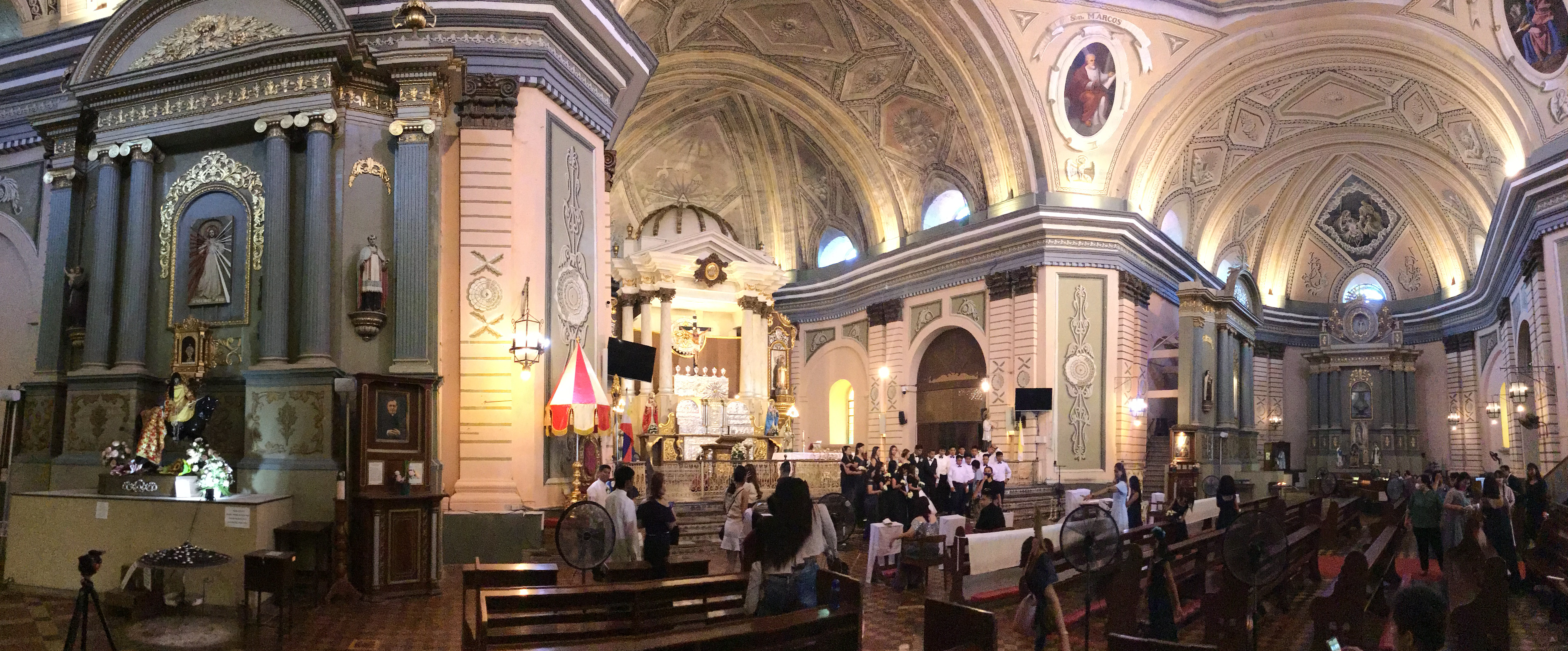
Taal Basilica
It should not be here. A church this immense -- 88.6 meters long, 48 meters wide, the largest in all of Asia -- belongs in a European capital, not a quiet town in Batangas province. Yet the Minor Basilica of Saint Martin of Tours stands in Taal, a municipality of modest streets and fishing boats, its silver-gray facade towering over the town plaza like a cathedral that wandered thousands of miles from its intended address. The explanation lies beneath the ground: an 1852 earthquake, centered near Taal Volcano just across the lake, destroyed the previous church and forced the entire town to relocate. What the people of Taal built in its place was not merely a replacement. It was a declaration.
Born from Rubble and Ambition
Construction began in 1856 under Marcos Anton, with Spanish architect Luciano Oliver commissioned to design a church that would surpass anything the Philippines had seen. Oliver drew on Italian Baroque traditions -- Ionic and Doric orders framing an elegant facade, a Latin cross plan anchored by a grand transept -- but scaled everything upward. The stone walls rose for nearly a decade before the unfinished church was inaugurated in 1865, its congregation worshipping beneath an incomplete ceiling. Agapito Aparicio finally completed the massive structure in 1878, adding a Doric altar that stretches 24 meters high and 10 meters wide. He also installed a baptistery tiled with materials imported from Europe, a detail that speaks to the ambition coursing through the project. This was not simply a parish church. It was the largest Augustinian church ever built, intended to project Spanish Catholic authority across the Philippine archipelago.
Stone Against the Shaking Earth
Living in the shadow of Taal Volcano means living with earthquakes, and the basilica has endured them repeatedly. A 1942 quake destroyed the large bell housed in a small tower on the left side of the facade. The old belfry was rebuilt in 1990 under supervision of the National Historical Institute, part of ongoing efforts to preserve a structure that nature keeps testing. The trompe l'oeil ceilings -- painted illusions of depth and grandeur that once dazzled parishioners looking upward -- faded over the decades. In 2011, a renovation under Alfredo Madlangbayan restored sections of the interior to match the original painted ceilings, returning the dome's depiction of the Ascension of Jesus and the Four Evangelists in the pendentives to something closer to their former brilliance. Each restoration adds another layer to a building that has been rebuilt, repainted, and rededicated for more than 170 years.
A Facade That Commands the Skyline
The numbers alone are staggering. The facade rises 28 meters, while the cupola reaches 44.5 meters above the ground. Inside, the 15.5-meter nave stretches between three aisles, the central one drawing the eye toward Aparicio's towering altar. The architectural intention was to echo the silver tones of other Augustinian churches rather than the brown stone typical of Philippine colonial buildings, giving the basilica an unusual luminosity under tropical light. From above, the cruciform layout is unmistakable -- the transept arms extending outward, the dome marking the crossing. The church dominates Taal not through any trick of geography or elevation but through sheer scale, its footprint so large that the surrounding town seems to have arranged itself around the building rather than the other way around.
Faith Measured in Centuries
Taal Basilica is not a museum. Mass is celebrated here regularly, and the pews fill with families from Taal and surrounding towns. The building earned its designation as a minor basilica from the Catholic Church and was declared a National Historical Landmark by the Philippine government, its historical marker installed in 1986. But designations only formalize what the community already knew: this church is the heart of Taal. Generations have been baptized in Aparicio's European-tiled baptistery, married beneath the painted dome, and mourned in the long nave. The basilica sits within the Archdiocese of Lipa, one parish among many, yet its physical presence is anything but ordinary. It remains a pilgrimage destination, drawing visitors who come for the architecture and stay for the quiet weight of a building that has outlasted earthquakes, wars, and the steady erosion of time.
From the Air
Located at 13.88N, 120.92E in the town of Taal, Batangas province, Philippines. The basilica's massive cruciform footprint is visible from low altitude, dominating the town center. Taal Lake and Taal Volcano are visible to the northeast. Nearest major airport is Ninoy Aquino International Airport (RPLL) approximately 80 km to the north. Recommended viewing altitude 2,000-3,000 ft for the church and surrounding town layout.