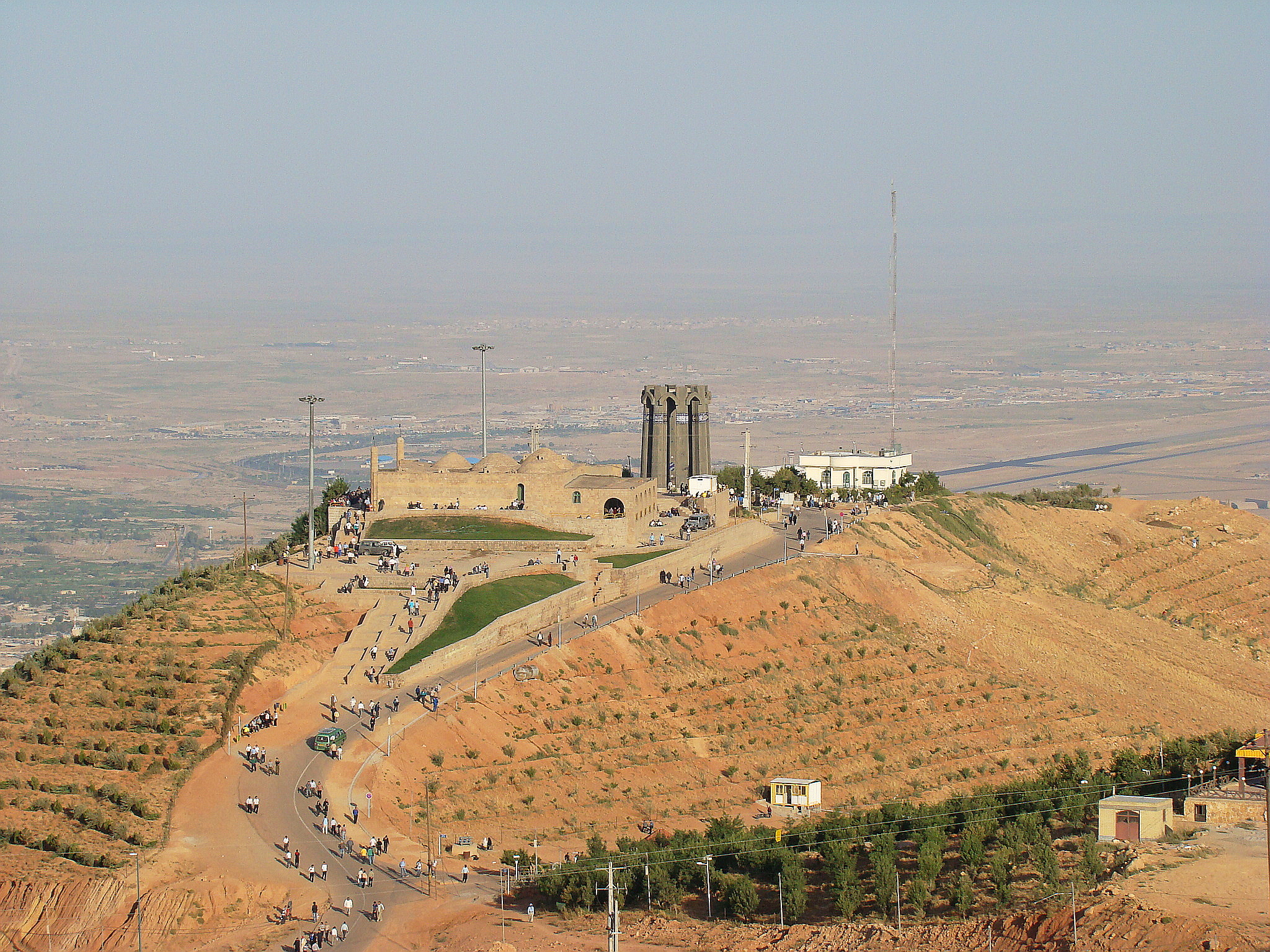
Tabriz
An earthquake leveled Tabriz in 858. The city rebuilt itself. Another earthquake killed more than 40,000 people in 1041. The city rebuilt itself again. Mongols conquered it, Tamerlane sacked it, Ottomans besieged it, Russians occupied it. Each time, Tabriz rose from its own rubble. Sitting at 1,340 meters in a valley north of Mount Sahand, this city in Iran's East Azerbaijan province has been trading, teaching, and defying destruction for at least 2,500 years. Its Grand Bazaar, inscribed as a UNESCO World Heritage Site in 2010, is the physical proof: a covered labyrinth of interconnected brick structures where merchants still sell carpets, dried fruits, and gold jewelry much as they did when Tabriz was a capital of the Mongol Ilkhanid dynasty in the 13th century.
The Bazaar That Survived Everything
The Tabriz Historic Bazaar Complex is not a market. It is a city within a city, a series of interconnected covered passages, caravanserais, and arcades built from brick that has absorbed centuries of footsteps. When Tabriz sat at the crossroads of the Silk Road, this bazaar was one of the most important commercial centers in the world. Traders from China, India, and Europe converged here, exchanging silk, spices, and the carpets for which Tabriz remains famous. The Mozzafarieh corridor, with its vaulted ceilings and light filtering through small openings, leads past carpet dealers whose families have occupied the same stalls for generations. Tabrizi carpets, known for their intricate patterns in pink, red, and cream, rank among the finest in the world. The bazaar endures because Tabriz endures, and because commerce is the thing that not even earthquakes can permanently stop.
Capital of Conquerors
The oldest known reference to Tabriz appears on a stone tablet of Sargon II, the Assyrian king, which mentions a place called Tauri Castle. By the 3rd century CE, the city served as capital of Azerbaijan. But its greatest era came under the Mongol Ilkhanids, who made Tabriz their capital from around 1295 until the dynasty dissolved in the 1330s. Under Ghazan Khan, the city reached the peak of its importance. Artists and philosophers traveled from across the known world to study here. Khajeh Rashid od-Din Fazlollah, Ghazan Khan's learned minister and historian, built the Rob'e Rashidi center, a complex for scholarship. Ibn Battuta, the great Berber explorer, visited during this period and recorded what he saw. When the Safavids later rose to power, Tabriz briefly became a national capital once more, until Shah Tahmasb moved the seat of government to Qazvin because Ottoman armies kept attacking. The city's position near the borders of three empires made it prestigious and perpetually vulnerable.
Shattered and Stubborn
Geography gave Tabriz everything and took it away repeatedly. The valley north of Mount Sahand provided fertile land and a natural crossroads. The same tectonic forces that built the mountains also generated the earthquakes that flattened the city with brutal regularity. The devastation of 858, the catastrophe of 1041, and the massive earthquake of 1780 that destroyed the Blue Mosque each erased generations of architecture. What remains today mostly dates to the Ilkhanid, Safavid, and Qajar periods. The Blue Mosque, originally completed in 1465 with cobalt and turquoise mosaic tiles that gave it its name, lost everything but its entrance hall in the 1780 quake. Reconstruction did not begin until 1973. The mosque stands as a metaphor for the city itself: beautiful, damaged, rebuilt, never quite the same but never gone.
Birthplace of Revolution
In 1908, Tabriz became the center of the Iranian Constitutional Revolution, a democratic uprising against the autocratic Mohammad Ali Shah. Two figures led the resistance: Sattar Khan and Baqer Khan, whose names still carry weight in the city. The revolt was eventually suppressed with the brutal intervention of Russian troops, but the constitutional movement it sparked reshaped Iranian politics. This was not Tabriz's first entanglement with larger powers. During the Russo-Persian wars of the 1820s, the city was occupied by the Tsar's army, returned to Iran only through the Turkmanchai Treaty of 1828. Russians occupied the city again during both world wars. Yet Tabriz retained its identity: Azerbaijani-speaking, fiercely independent, and suspicious of distant capitals making decisions on its behalf.
A City That Feeds You
Tabriz reveals itself through its food. Kufte Tabrizi, the enormous meatball that is the city's signature dish, arrives at the table the size of a fist. Tea flows constantly in the chaikhanehs, served strong and sweet. Confectioneries sell qurabiya cookies, pashmak cotton candy, and tabrizi luvuz nougat from family-owned shops with no chain-store equivalents. On summer evenings, food vendors at Shahgoli park sell roasted corn called makka and boiled eggs with potato wrapped in flatbread, a street snack known as yeralma yomurta. In winter, peddlers on street corners offer labou, hot boiled sweet beet, and pakhla, salty boiled fava beans, warming food for a city where winters are severe. Families gather in the big parks for picnic suppers. The ice cream shops guard their recipes across generations. Tabriz is a city that has always traded with the world but eats entirely like itself.
From the Air
Tabriz (38.07N, 46.30E) sits at 1,340m elevation in a valley north of Mount Sahand in northwestern Iran. Tabriz International Airport (OITT) lies east of the city center. The city is 60km east of Lake Urmia, which is visible as a large saline body from altitude. Mount Sahand (3,707m) rises to the south. The volcanic cone of Mount Sabalan (4,811m) is visible to the northeast in clear conditions. Terrain is mountainous with the city nestled in a broad valley. Continental climate with cold winters and warm summers. Visibility generally good except during dust events.