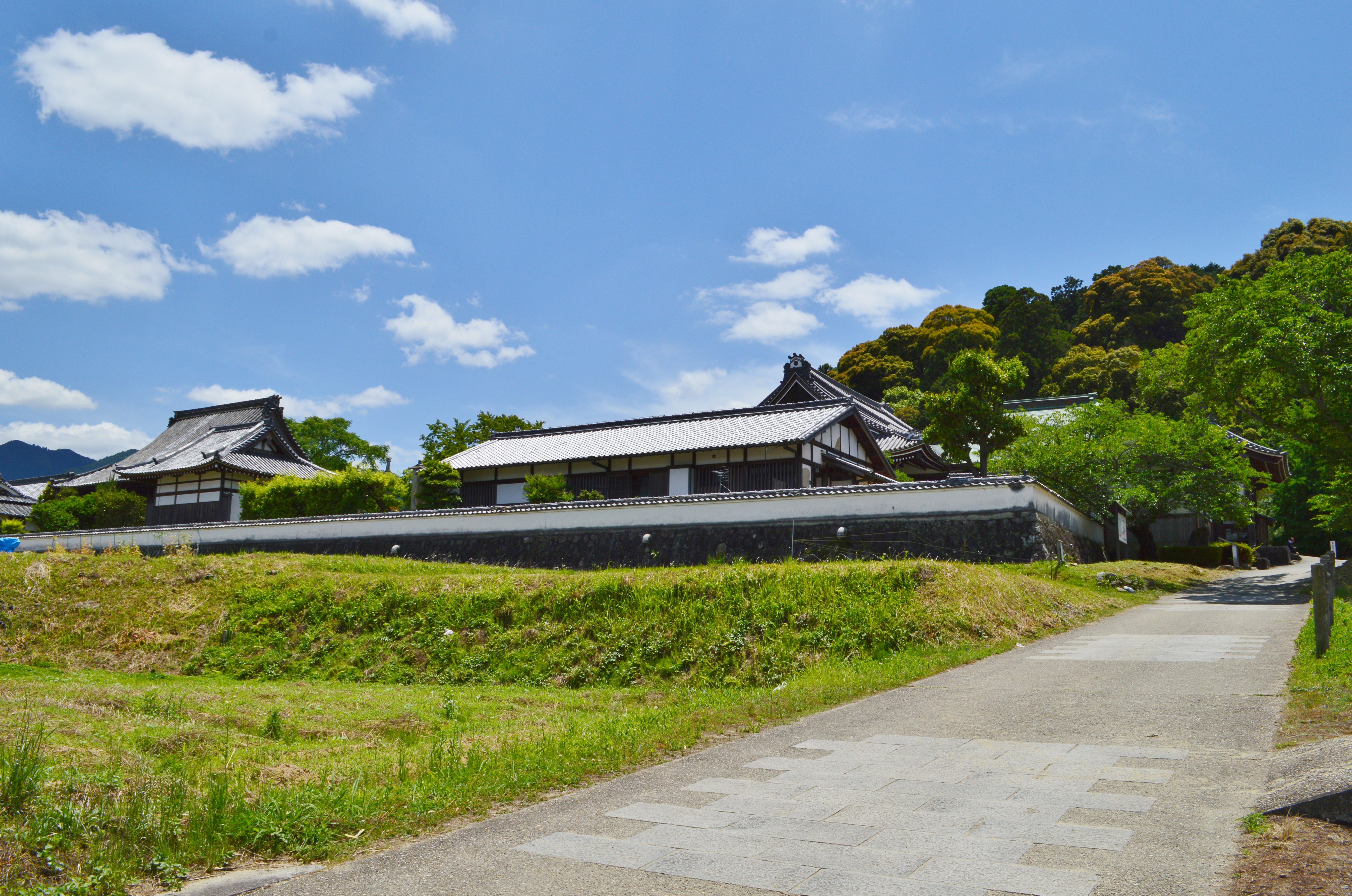
Tachibana-dera
The legend begins with a quest for immortality. During the reign of Emperor Suinin, the loyal courtier Tajimamori was dispatched to the mythical land of Tokoyo no kuni to retrieve the tachibana, a citrus fruit said to grant eternal life. He returned too late -- the emperor had already died -- but a sapling of that magical tree was planted on a hillside in the village of Asuka, in what is now Nara Prefecture. Centuries later, a temple rose on that very spot, taking the fruit's name as its own. Tachibana-dera has stood in some form on this ground since the early seventh century, a place where myth, imperial lineage, and Buddhist devotion intertwine beneath the gentle hills of Japan's spiritual heartland.
The Prince's Birthplace
Tachibana-dera occupies ground that carries deep significance in Japanese history. Tradition holds that Prince Shotoku -- the regent and culture hero who championed Buddhism's early spread across Japan -- was born near this very site. According to temple lore, the prince converted a branch palace of his father, Emperor Yomei, into a place of worship, making it one of the seven great temples attributed to his patronage. The temple belongs to the Tendai sect, and its principal image, or honzon, is a seated statue of Prince Shotoku himself. The temple's formal name is a mouthful that reveals its layered identity: Butsuzan Jogu Koin Bodaiji, each element linking the site to both Buddhist cosmology and imperial heritage.
Tiles and Timelines
The founding date of Tachibana-dera remains a matter of archaeological detective work rather than documented certainty. The oldest roof tiles recovered from the site -- round tiles bearing a multi-petaled lotus motif -- date to the first quarter of the seventh century, but so few survive from that era that scholars believe full-scale construction began only after the mid-600s. A revealing clue comes from neighboring Kawara-dera, a nationally sponsored temple just to the north. The roof tiles excavated at Tachibana-dera are identical to those from Kawara-dera, and the central axis of Kawara-dera's complex aligns precisely with Tachibana-dera's north gate. This architectural relationship suggests Tachibana-dera may have served as a convent -- an interpretation supported by its earliest historical mention, a 680 entry in the Nihon Shoki recording a fire at 'the nunnery of Tachibana-dera' that destroyed ten rooms.
Rise and Ruin
By the eighth century, Tachibana-dera had grown into a sprawling complex of 66 buildings, sustained by the patronage of the imperial family and aristocracy. Its original layout placed the main gate, pagoda, main hall, and lecture hall in a straight line from east to west, following either the Shitenno-ji or Yamada-dera architectural style. A five-story pagoda once anchored the skyline. Then came the fires. In 1148, lightning struck the pagoda and reduced it to ash. It was rebuilt during the Bunji era (1185-1189), but as a more modest three-story structure. The worst blow fell in 1506, when the armed monks of a neighboring temple, Myoraku-ji, torched Tachibana-dera in retaliation for an attack by a vassal of the shogunate's regent, Hosokawa Masamoto. The temple never recovered its former scale. What had been a grand complex dwindled to a small chapel, surviving the centuries largely on the strength of its association with Prince Shotoku.
What Remains
The current main hall dates to 1864, a relatively recent structure on ancient ground. But the temple's real treasures are the cultural properties that endured the centuries of fire and neglect. Among the designated National Important Cultural Properties are sculptures from the Heian and Kamakura periods, a stone lantern from 1515, and painted scrolls attributed to the Muromachi period artist Tosa Mitsunobu. The temple precincts themselves have been protected as a National Historic Site since 1966. Walking the grounds today, surrounded by the low hills of Asuka -- one of Japan's oldest settled landscapes -- it is easy to forget the centuries of destruction. The quiet is deceptive. Beneath the modern calm lie layers of ash, lotus-patterned tiles, and the roots of a mythical tree.
From the Air
Located at 34.47N, 135.82E in the Asuka village area of Nara Prefecture, Japan. The temple sits in the gently rolling Asuka plain, a historically dense area dotted with ancient burial mounds and temple ruins. Nearest major airport: Kansai International Airport (RJBB) approximately 30nm to the west-southwest. Osaka Itami (RJOO) lies approximately 25nm to the north-northwest. The Asuka area is visually identifiable from altitude by the patchwork of rice paddies and small wooded hillsides clustered along the Asuka River valley, south of the larger Yamato plain. Expect good visibility in clear conditions, with mountain terrain rising to the east and south.