The Boxer Who Built Silence
Before he ever poured a slab of concrete, Tadao Ando was a professional boxer. Born in 1941 in the Minato-ku ward of Osaka, separated from his twin brother at age two and raised by his great-grandmother, Ando followed an unlikely path to becoming one of the most celebrated architects of the twentieth century. He never attended architecture school. Instead, less than two years after finishing high school, he abandoned the boxing ring, began studying drawing at night, took correspondence courses in interior design, and then boarded planes to see the buildings of Le Corbusier, Mies van der Rohe, Frank Lloyd Wright, and Louis Kahn in person. By 1968, he was back in Osaka, founding Tadao Ando Architects and Associates. The firm operates from Kita-ku to this day, and the buildings it has produced span six continents.
The Haiku in Concrete
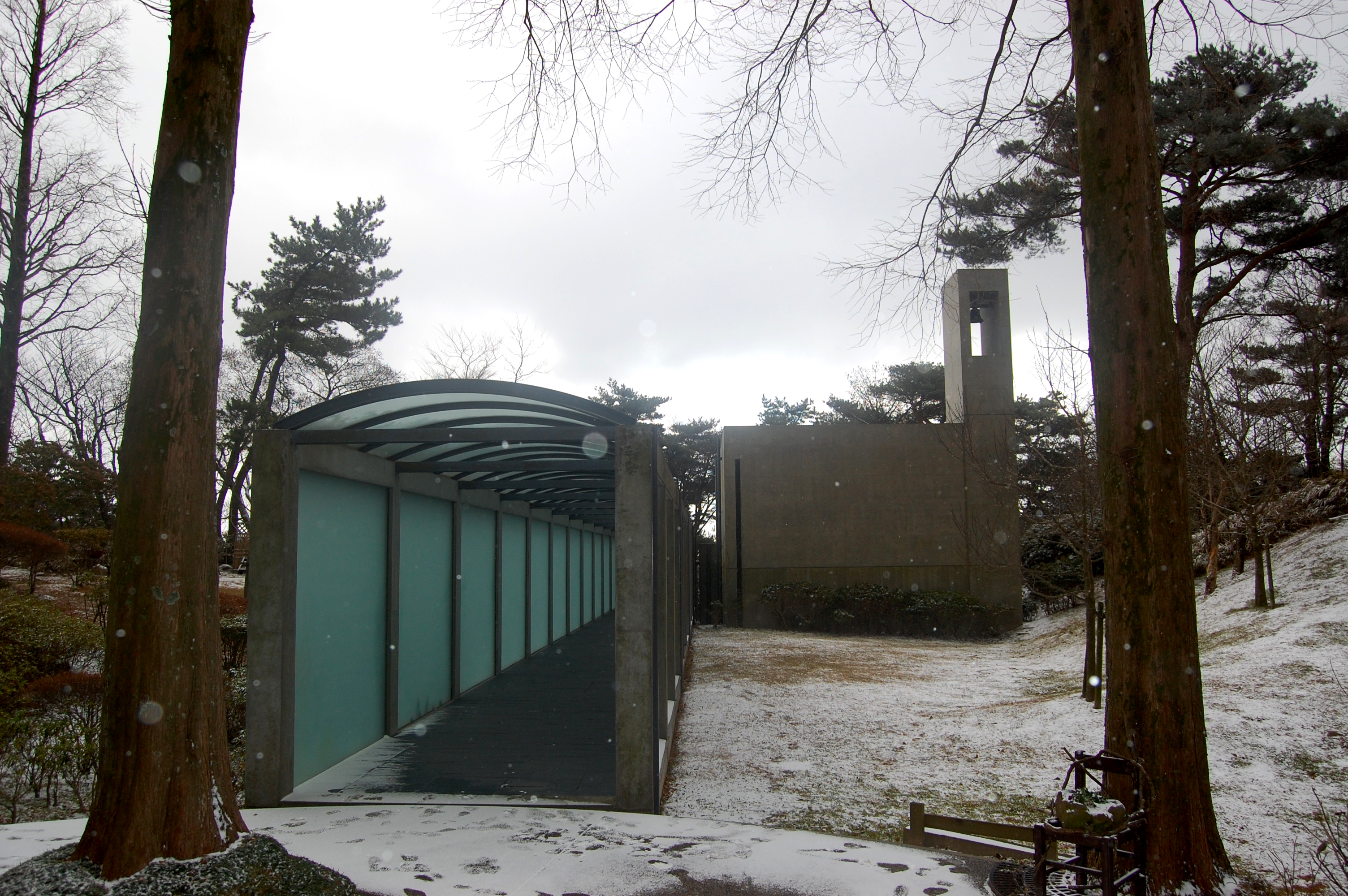
Ando's signature material is concrete -- specifically, smooth exposed concrete cast using meticulous formwork that leaves a faint memory of wood grain on every surface. His buildings achieve what critics call a 'haiku' effect: complex spatial circulation concealed behind the appearance of radical simplicity. Zen philosophy saturates the work. Nothingness and empty space become as important as any wall, and the interplay of light and shadow acts as a building material in its own right. His Church of the Light in Ibaraki, Osaka, completed in 1989, distills this idea into a single gesture: a cruciform slit carved through the sanctuary wall, letting sunlight blaze through in the shape of a cross. No stained glass, no ornamentation -- just light, concrete, and faith.
Houses That Reshape Cities
Ando believes that 'to change the dwelling is to change the city and to reform society.' His Row House in Sumiyoshi, a tiny two-story concrete dwelling completed in 1976, demonstrated the principle early. Three equal rectangular volumes -- two enclosed rooms separated by an open-air courtyard -- forced inhabitants to walk outside just to move between their own living spaces. Rain fell into the center of the house. The building was criticized for its inconvenience and praised for its poetry, and it announced a career-long conviction that architecture should challenge its occupants, not merely shelter them. His Rokko Housing complex outside Kobe pushed the idea further: a cascading warren of terraces, atriums, and shafts built into a steep hillside. When the devastating Great Hanshin earthquake struck in 1995, Rokko Housing survived undamaged -- a structural achievement as meaningful as any aesthetic one.
Sacred Ground, Sacred Light
For Ando, there is no difference between designing a house and designing a church. 'Dwelling in a house is not only a functional issue, but also a spiritual one,' he has written. 'The house is the locus of heart -- kokoro -- and the heart is the locus of god.' This philosophy produced some of his most transcendent work: the Church on the Water in Tomamu, Hokkaido, completed in 1988, where a glass wall opens onto a reflecting pool and the surrounding forest; the Water Temple on Awaji Island, where visitors descend through a lotus pond to enter a subterranean worship space; and the Hill of the Buddha in Sapporo, completed in 2015, where a massive stone Buddha sits inside a concrete rotunda open to the sky, visible only as a head peeking above a surrounding lavender field. Nature does not decorate these buildings. It completes them.
From Naoshima to the World
No place captures Ando's vision more fully than Naoshima, a small island in Japan's Inland Sea that he helped transform into one of the world's most remarkable art destinations. Starting with Benesse House in 1992, Ando designed a series of museums that blur the boundary between architecture, art, and landscape. The Chichu Art Museum, completed in 2004, is built almost entirely underground, using only natural light to illuminate works by Claude Monet, James Turrell, and Walter De Maria. Internationally, his portfolio spans the Pulitzer Arts Foundation in St. Louis, the Modern Art Museum of Fort Worth, Armani's headquarters in Milan, and the 21 21 Design Sight gallery in Tokyo. In Malibu, a concrete house he designed with WHY Architects sold for $200 million in 2023 -- the most expensive single-family home transaction in the United States that year. In 1995, the same year the Rokko complex withstood the earthquake, Ando received the Pritzker Prize, architecture's equivalent of the Nobel.
Art Beyond Architecture
In recent years, Ando has expanded into sculpture and conceptual art, carrying his themes of silence, emptiness, and sacred geometry into new forms. His Table of Pirosmani project features acrylic cubes filled with preserved blue roses -- the flower long used as a symbol of the impossible and the unattainable. A 2018 prototype, Blue Rose in the Cube Study 1, sold at Christie's in March 2025 for $114,400, nearly nine times its low estimate, outperforming works by David Hockney and Banksy at the same auction. For the former boxer from Osaka who never attended architecture school, the trajectory feels almost inevitable. Ando has spent a lifetime proving that the most powerful structures begin not with blueprints, but with the stubborn conviction that empty space can hold more meaning than anything built to fill it.
From the Air
Tadao Ando Architects and Associates is located in Kita-ku, Osaka at approximately 34.726°N, 135.228°E. The studio is not a visible landmark from the air, but many of Ando's most important works are concentrated across the Kansai region. Kobe Airport (RJBE) lies roughly 15 nautical miles to the southwest. Osaka Itami Airport (RJOO) is approximately 8 nautical miles to the north. Kansai International Airport (RJBB) is about 25 nautical miles to the south on its artificial island. Notable Ando buildings visible from the air include the Rokko Housing complex on the slopes of Mount Rokko (visible northwest of Kobe), the Church of the Light in Ibaraki (northeast of central Osaka), and the Hyogo Prefectural Museum of Art along Kobe's waterfront.
Sources
- Tadao Ando - Wikipedia
- Outside the Box: Architect Tadao Ando's Osaka Projects and Vision
- Tadao Ando - EBSCO Research
- Beyonce Jay-Z Malibu Mansion Purchase - Fox Business / Artnet
- Tadao Ando Blue Rose in the Cube Study 1 - Christie's / Newshub.ge
- Hill of the Buddha - Wikipedia / Dezeen
- Chichu Art Museum - Benesse Art Site Naoshima
- Row House in Sumiyoshi - METALOCUS / WikiArquitectura