Tadasu no Mori
Seventy percent of this forest burned on a single June day in 1470. The Onin War was tearing Kyoto apart, and the flames that consumed temples and palaces did not spare the sacred grove at the junction of the Kamo and Takano rivers. Yet Tadasu no Mori grew back. It always grows back. For over a thousand years, this slender strip of woodland in northeast Kyoto has persisted through revolt, inferno, and the relentless sprawl of one of Japan's greatest cities. Its name translates roughly as the "Forest of Correction" or "Forest of Purification," and walking beneath its canopy of ancient elms, the name feels earned. The air changes. The city recedes. You step into a world that Murasaki Shikibu described in The Tale of Genji and Sei Shonagon referenced in The Pillow Book, a world where 4,700 trees of forty distinct species still stand as guardians of Shimogamo Shrine.
Where Two Rivers Meet
Tadasu no Mori occupies a narrow wedge of land where the Takano River flows into the Kamo River, a geographic position that has shaped both its ecology and its spiritual significance. The forest stretches 12.4 hectares along a north-south corridor between the two waterways, an area more than double the size of Liberty Island in New York Harbor. Clear-water streams thread through the interior, feeding outward into the larger rivers, while dense riparian vegetation lines the forest edges. This confluence was considered a place of spiritual power long before the Kamo shrines were established. The Kamo-jinja, the paired complex of Shimogamo Shrine and Kamigamo Shrine, was built to protect Kyoto from malign influences, and the forest served as their sacred grove. Today, from above, it appears as a startling patch of deep green amid the gray urban grid of Sakyo Ward.
A Forest That Refuses to Die
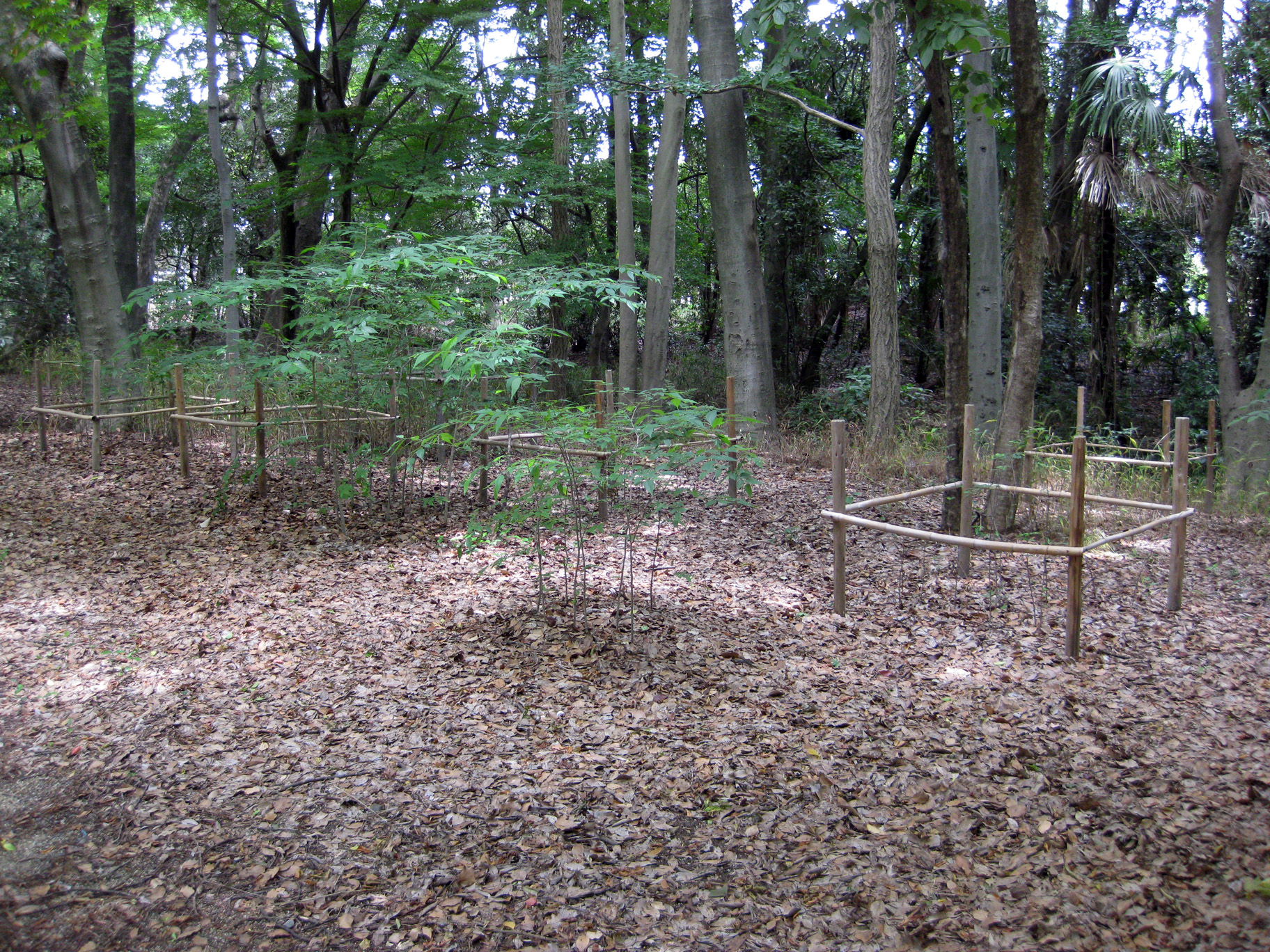
In ancient Kyoto, Tadasu no Mori sprawled across nearly 5 million square meters. War reduced it. The Onin War of 1467 to 1477 was the worst blow, with that devastating fire on June 14, 1470, destroying seventy percent of the canopy. But the forest rebounded. Then came the Meiji era, when land forfeit ordinances in 1871 stripped away more territory, compressing the forest to its present 124,500 square meters. Through all of this, the forest has never been planted or pruned. It grows in its natural state, regenerating on its own terms. A 1983 survey by Kyoto University's Research Institute for Mathematical Sciences found that 71.9 percent of the forest consists of Aphananthe oriental elm, with 15.9 percent Japanese zelkova, alongside hackberry, oak, camellia, laurel, and Chinese windmill palm. Some 600 of its trees are between 200 and 600 years old, their trunks wider than a person's reach.
The Quiet Work of Preservation
Tadasu no Mori is often called a virgin forest, but that label obscures a more interesting truth. Human hands have shaped its survival in subtle ways. After the Muroto Typhoon of 1934 sent floodwaters crashing through the grove and drowned much of the vegetation, camphor trees were planted to stabilize the recovering landscape. Red camellias were added later to complement the aesthetic of Shimogamo Shrine. Yet the overall character remains wild and deciduous, a bright forest compared to the dark, coniferous groves that surround many Japanese shrines. Winter nights at the northern edge of the Kyoto Basin drop cold enough to discourage conifers, so broad-leaf deciduous species dominate. The hollow cavities that form naturally in aging elm trunks have created habitat for the Brown Hawk-Owl, a migratory bird that nests here during summer before returning to Southeast Asia.
Heritage Among the Elms
Recognition came in layers. In 1983, Tadasu no Mori was designated a National Historic Site, placing it under formal ecological protection. Eleven years later, the stakes rose dramatically. In 1994, the entire Shimogamo Shrine complex, forest included, was inscribed by UNESCO as one of the Historic Monuments of Ancient Kyoto, alongside sixteen other sites across the Kyoto region. The designation acknowledged what the Kamo priests had known for centuries: this forest is not merely beautiful. It is a living archive. The elm canopy filters light onto paths that Heian-era courtiers once walked. The streams run along courses unchanged since before the city existed. And the forest continues to serve its original purpose, standing between Kyoto and whatever forces might threaten it, just as it has since the first shrine timbers were raised at the meeting of two rivers.
From the Air
Tadasu no Mori sits at 35.060N, 135.753E in northeast Kyoto, at the visible Y-shaped confluence of the Kamo and Takano rivers. From above, look for a distinct wedge of dark green forest amid the dense urban grid of Sakyo Ward. The nearest airport is Osaka Itami (RJOO), approximately 30 nm southwest. Kansai International (RJBB) is about 55 nm to the south. Best viewed at 2,000-3,000 feet AGL on a clear day when the forest canopy contrasts sharply with the surrounding cityscape. The twin rivers converging at the forest's southern tip are the most reliable visual landmark.