Tado Taisha
Every May, young men on horseback charge up a steep slope and attempt to clear a two-meter earthen wall at the top. The horses refuse, rear, scramble, and sometimes throw their riders. The crowd roars. Whether a horse clears the wall or not becomes a prophecy: a successful leap foretells a bountiful rice harvest; failure warns of lean times ahead. This is the Ageuma Shinji, the horse-jumping ritual at Tado Taisha, a Shinto grand shrine tucked into the forested hills of Kuwana in Mie Prefecture, Japan. The festival has been performed for over seven hundred years, dating to the Nanboku-cho period, and the shrine itself has stood here since the latter half of the fifth century, making it one of the oldest continuously active sacred sites in the region.
Five Centuries Before the Shoguns
Tado Taisha was founded in the late 400s, placing its origins in the Kofun period, when Japan was still consolidating under the Yamato court and massive keyhole-shaped burial mounds dotted the landscape. The shrine occupies the northernmost reach of the old province of Ise, a region whose spiritual significance to Shinto practice is unmatched -- the great Ise Grand Shrine lies to the south. Tado Taisha earned the rank of kokuhei taisha, a national shrine of the first rank, under the modern system of ranked Shinto shrines established during the Meiji era. That designation placed it among the most prestigious shrines in Japan, supported directly by offerings from the national treasury. Today, the shrine holds five nationally designated Important Cultural Properties and one additional property recognized at the prefectural level.
Horses Against the Wall
The Tado Festival, held on May 4 and 5, is the shrine's most dramatic event and was designated one of Mie Prefecture's Intangible Cultural Properties in 1978. The centerpiece is the Ageuma Shinji, where young riders from local neighborhoods guide their horses at speed toward a steep earthen embankment topped by a wall. The horses must charge uphill and leap over the barrier in a single explosive effort. Some horses clear it cleanly; others balk, stumble, or turn away. The outcomes are recorded and interpreted as agricultural divinations for the coming season. The spectacle is visceral and unpredictable -- these are not trained show horses performing rehearsed routines, but animals responding to genuine fear and adrenaline, urged forward by riders who have prepared for months. Crowds pack the hillside grounds, pressing close enough to feel the vibration of hooves on packed earth.
Fire and Rebirth
In 1571, the shrine was laid waste by fire, its wooden structures consumed in the chaos of the Sengoku period, when feudal lords warred across Japan. For decades, Tado Taisha existed in diminished form. Restoration came with the arrival of Tadakatsu Honda, the feudal lord of Kuwana and one of the most celebrated samurai commanders of the era. Honda had served Tokugawa Ieyasu through the wars of unification and was rewarded with the Kuwana domain. In 1606, Honda contributed resources to reconstruct the shrine and revive its annual festivals. The rebuilding under Honda's patronage marked the beginning of the shrine's Edo-period prosperity, an era when the Tado Festival grew into the major regional event it remains today.
Lanterns, Arrows, and the Turning Seasons
Beyond the May festival, Tado Taisha anchors the local calendar with two other significant annual events. In late July, the Chochin Festival fills the shrine grounds with the warm glow of hundreds of paper lanterns, their candlelight swaying in the humid summer air. The lanterns line the approach paths and hang from the shrine's eaves, transforming the precinct into a corridor of flickering amber light. Then in late autumn, on November 23, the Yabusame Festival brings mounted archers to the grounds. Yabusame is an ancient martial art dating to the Kamakura period, in which riders at full gallop draw and release arrows at wooden targets. The practice was originally training for mounted warfare; at Tado Taisha, it survives as a ritual offering to the kami, the spirits enshrined within. Together, the three festivals mark spring's promise, summer's abundance, and autumn's discipline.
A Shrine in the Hills
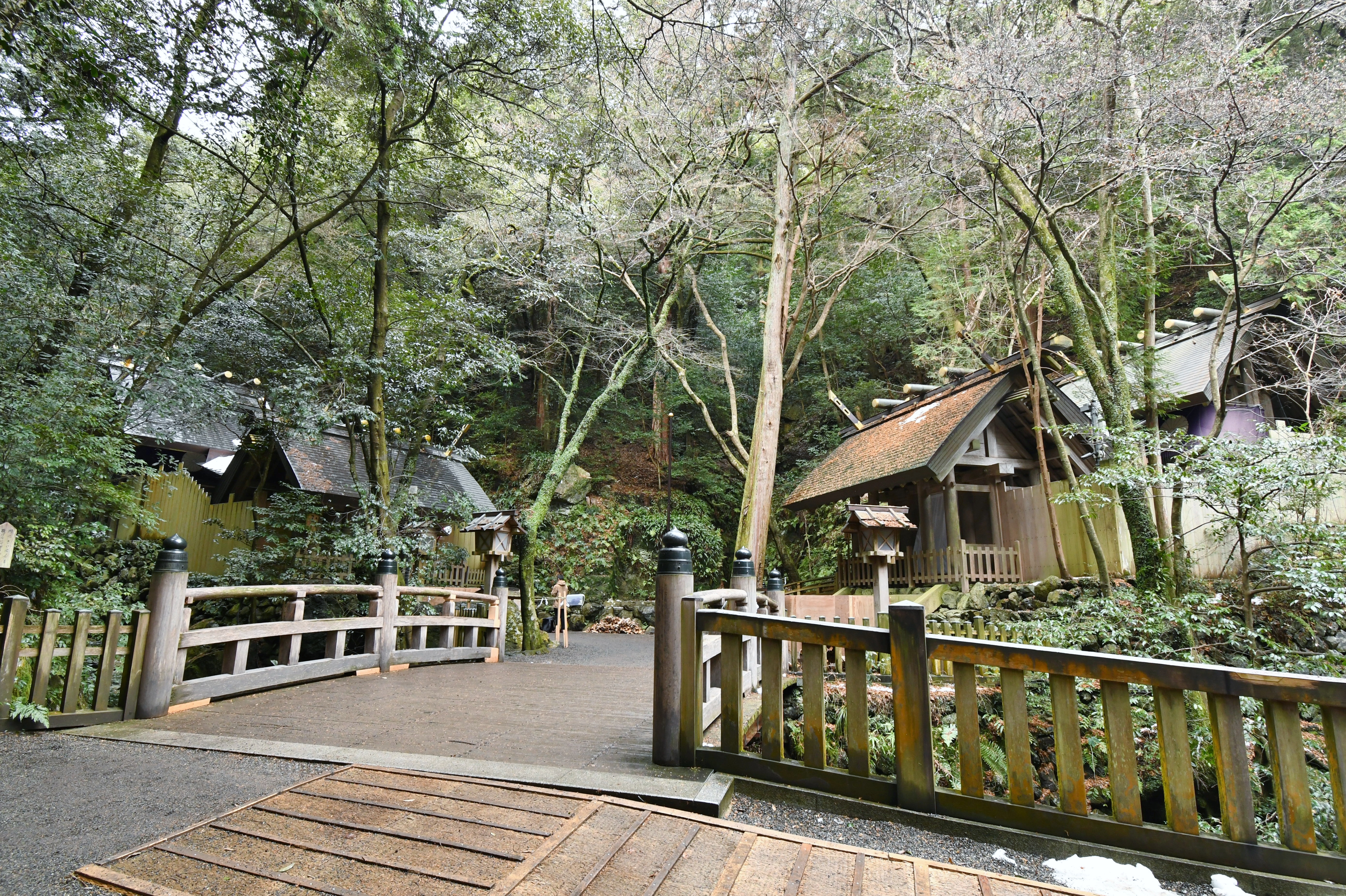
The shrine grounds sit at the base of Mount Tado, surrounded by dense forest that climbs the slopes of the Yoro Mountains along the border between Mie and Gifu Prefectures. The approach from Kuwana city passes through the quiet residential streets of Tado-cho before the torii gate announces the transition from ordinary space to sacred ground. Within the precinct, the architecture reflects successive periods of patronage and repair, from Edo-period structures to more recent conservation work. The setting is intimate rather than grand -- Tado Taisha lacks the monumental scale of Ise Grand Shrine or Meiji Shrine, but that modesty concentrates attention on the rituals themselves, where the relationship between community, nature, and the divine plays out in galloping horses and flickering lanterns.
From the Air
Located at 35.14°N, 136.62°E in the foothills of the Yoro Mountains near Kuwana, Mie Prefecture, Japan. The shrine is nestled in forest at the base of Mount Tado, making it difficult to spot directly from the air, but the town of Kuwana and the Yoro mountain ridgeline serve as reliable landmarks. Nearest major airport is Chubu Centrair International Airport (RJGG), approximately 40 km to the southeast across Ise Bay. Nagoya Airfield (RJNA) lies about 30 km to the northeast. Best viewed at 2,000-4,000 ft AGL following the Yoro mountain ridge south from Gifu.