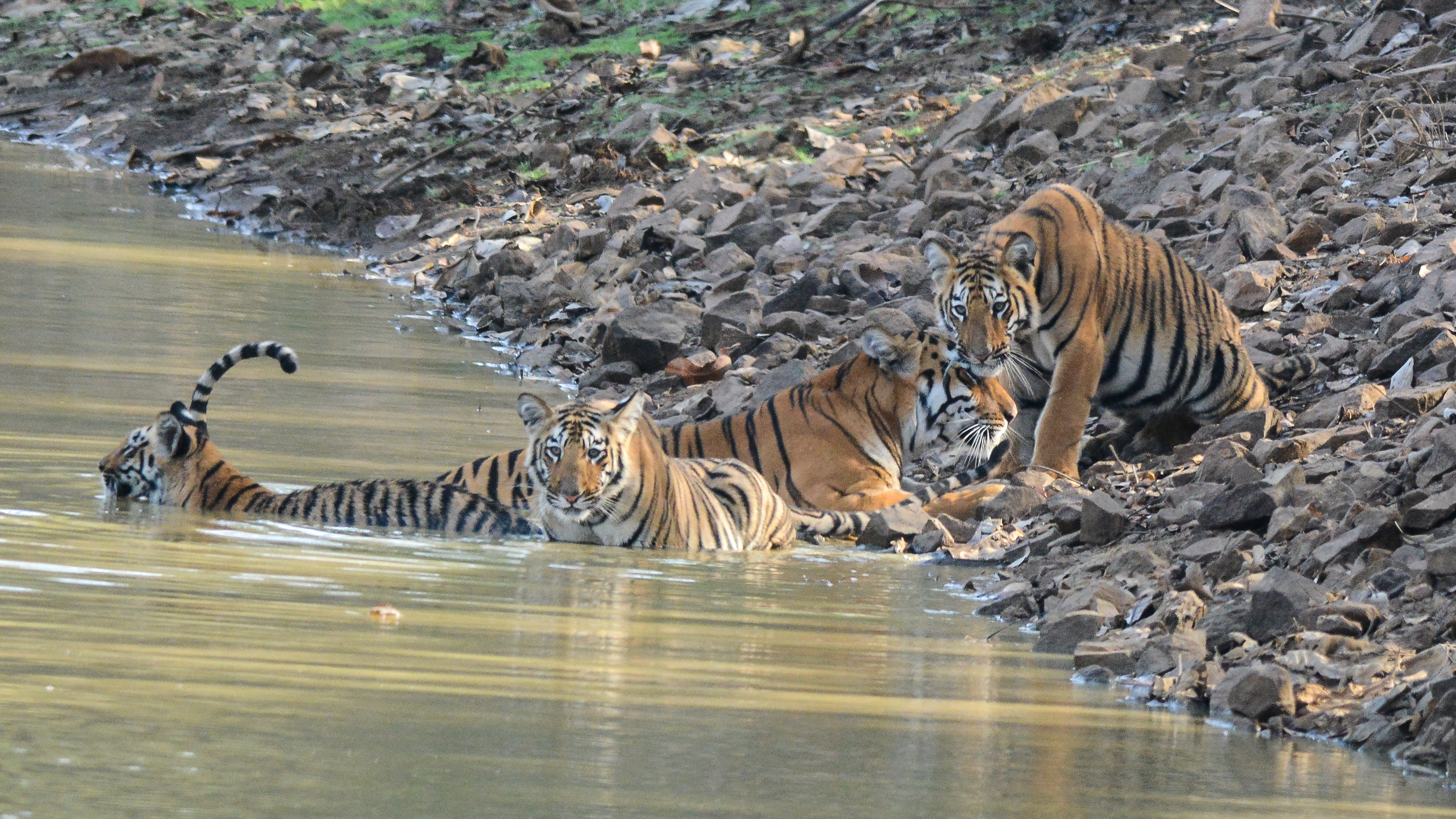
Tadoba Andhari Tiger Reserve
In May 2018, a Belgian diplomat photographed something that should not have been there: a black panther moving through the dry deciduous forest of Tadoba Andhari Tiger Reserve. Black panthers typically inhabit the evergreen jungles of India's Western Ghats, not the teak-dominated woodlands of central Maharashtra. Park officials called it a rare sight. Biologists called it remarkable. The photograph reminded everyone that Tadoba, despite being Maharashtra's oldest and most visited tiger reserve, still keeps secrets in the shadows beneath its canopy.
From Gondi Kingdom to Tiger Country
The Gondi people once ruled these forests in the Chimur Hills of Chandrapur district. Their kingdom gave way to colonial administration, and in 1935, hunting was banned across the area. Two decades later, in 1955, a portion of the forest was declared a national park - Tadoba. The Andhari Wildlife Sanctuary followed in 1986, carved from adjacent forests along the Andhari River. In 1995, the two were merged to create the present Tadoba Andhari Tiger Reserve, Maharashtra's largest protected area. The name carries both legacies: Tadoba from the Chimur Hill forests, Andhari from the river that threads through the eastern ranges. What began as a hunting ground became a sanctuary, and what was a sanctuary became the state's most important stronghold for the Bengal tiger.
A Landscape of Contrasts
The reserve sprawls across the Chimur Hills and the Moharli and Kolsa ranges. Densely forested hills form the northern and western boundaries, their elevation running between 200 and 350 meters. The terrain slopes from north to south, thick forest giving way to smooth meadows and deep valleys. Cliffs and caves punctuate the landscape, providing refuge for animals that have learned to use the topography.
To the southwest, Tadoba Lake acts as a natural buffer between forest and farmland, its perennial waters sustaining marsh crocodiles that were once common across Maharashtra but now survive in diminishing numbers. Kolsa Lake and the Andhari River complete the reserve's wetland network. Winters bring temperatures low enough for morning mist; summers push the mercury until the monsoon arrives between July and September with roughly 66 percent humidity and rain that transforms the dry forest into something briefly, startlingly green.
The Teak Cathedral
Teak dominates. About 87 percent of the reserve consists of Central Deccan Plateau dry deciduous forest, and teak is the presiding species, with crocodile bark, bija, dhauda, salai, semal, and tendu filling the understory. Bamboo thickets grow in abundance throughout the reserve. Among the more unexpected residents is kach kujali - the velvet bean, a climbing plant whose compounds are used in treating Parkinson's disease. Bheria leaves serve as insect repellent. Bija yields medicinal gum. Beheda provides traditional remedies.
Fire-resistant axlewood survives the dry season burns that char between two and sixteen percent of the park each year. Forest fires remain a persistent threat, but they have also shaped the ecosystem: the species that thrive here are the ones that learned to endure them.
Predators and Prey
Bengal tigers are the headline species, but Tadoba's cast is deep. Indian leopards, sloth bears, gaur, nilgai, and dhole patrol the same territory. Jungle cats, sambar, barking deer, chital, and the four-horned antelope - the chausingha - round out the mammal roster, along with the rarely seen honey badger. The lakes draw grey-headed fish eagles, crested serpent eagles, and changeable hawk-eagles, and 195 bird species have been recorded in total, including three endangered ones. Seventy-four species of butterflies have been documented, from pansies and monarchs to swordtails and mormons.
The reserve harbors endangered Indian pythons and common Indian monitors. Indian star tortoises share the ground with cobras and Russell's vipers. During monsoon, signature spiders and giant wood spiders spin webs between the trees. It is an ecosystem where nearly every ecological niche is occupied.
Living on the Edge
Forty-one thousand people live in and around the reserve across fifty-nine villages, five of them inside the core zone. Rehabilitation is ongoing - the village of Navegaon was recently relocated, its former site expected to revert to grassland. More than 41,000 cattle graze within the core and buffer zones, and though core-zone grazing is prohibited, animals from peripheral villages regularly wander in. The human-wildlife boundary here is not a line but a contested gradient.
In 2013 alone, leopards, tigers, and sloth bears killed at least four people and between thirty and fifty cattle in neighboring villages. The economic toll on local communities creates resentment toward the reserve's management. Tadoba's challenge is the oldest conservation dilemma: how to protect a wilderness that exists alongside the people who have lived in it for generations.
From the Air
Tadoba Andhari Tiger Reserve is located at 20.27N, 79.43E in the Chandrapur district of Maharashtra. The reserve is visible from altitude as a large expanse of dense forest amid agricultural land, with Tadoba Lake glinting to the southwest. The Chimur Hills form the northern boundary. The nearest airport is Nagpur (VANP/NAG), approximately 150 km to the northwest. Chandrapur town lies to the southeast. Elevation ranges from 200m to 350m. Best viewed at 3,000-5,000 feet in clear weather to distinguish the forest boundaries and lake systems. Monsoon season (July-September) brings cloud cover that can obscure the reserve.