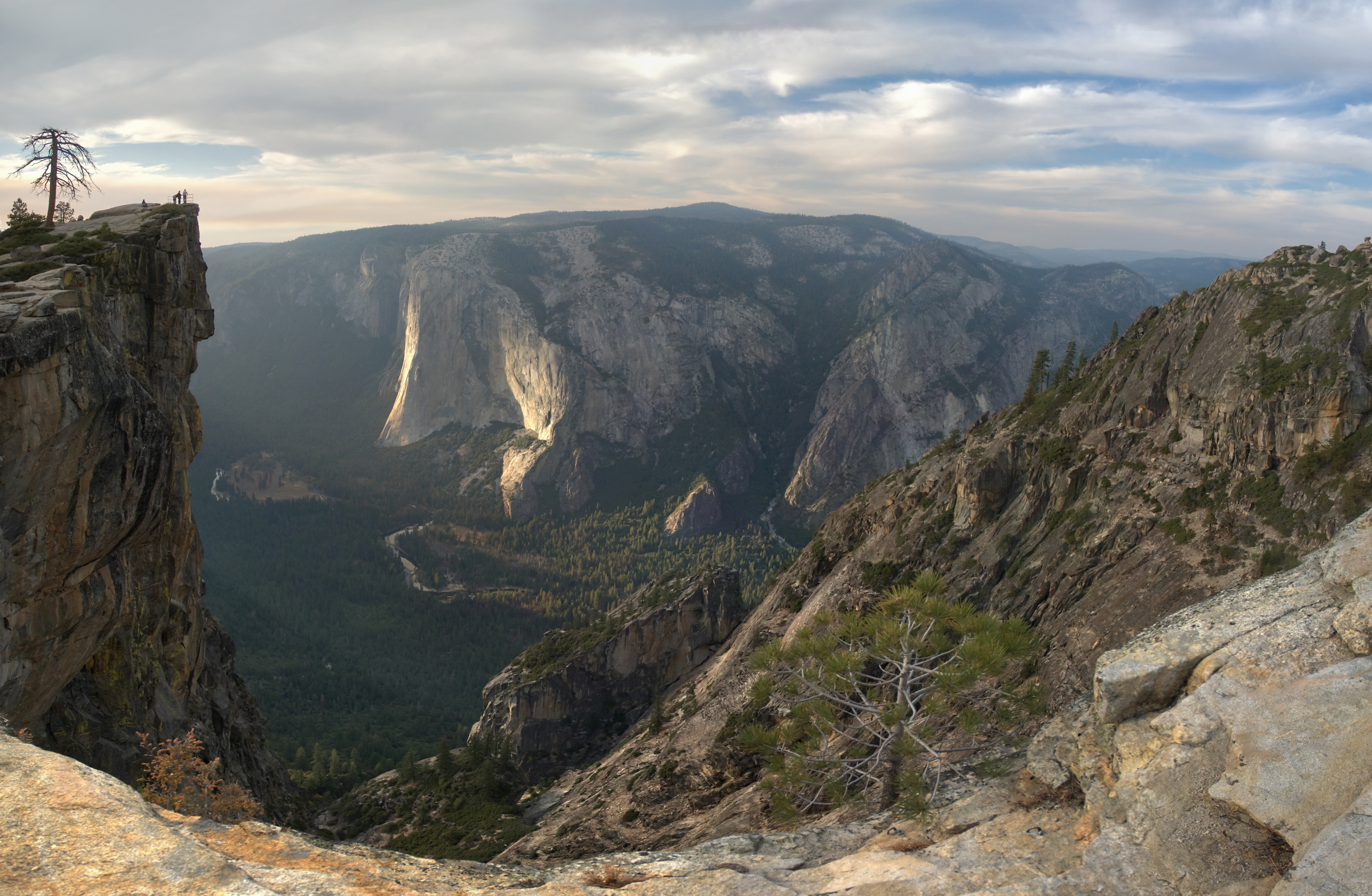
Taft Point
The horses were too small. When William Howard Taft - the 27th president, a man who carried more than 300 pounds on his frame - arrived at Yosemite in October 1909 for a three-day visit hosted by John Muir, his staff had planned a horseback trip from Glacier Point down to the valley floor. But not a single horse in the park could bear his weight. So the president hiked instead, sweat-drenched and game, sustained by a luncheon of fried chicken that his staff served on a flat granite ledge overlooking the valley. That ledge, or one very near it, became Taft Point. The president wrote afterward with characteristic understatement: "While I am tired from the open air exercise, I feel greatly the better for it." Today, Taft Point offers wide views of Yosemite Valley, Yosemite Falls, and El Capitan, but its true attraction lies underfoot. Giant fissures split the mile-high granite, narrow cracks that drop without interruption to the valley floor thousands of feet below.
Cracks in the Earth
The fissures at Taft Point are not gentle erosion features or shallow crevices. They are vertical fractures in the granite, some wide enough to peer into, all deep enough that objects dropped into them vanish without a sound of impact. The first fissure drops approximately 1,000 feet from its edge. There are no guardrails, no fences, no barriers between the visitor and the void. The rock is bare, polished by wind and ice, and the fissures appear suddenly - cracks in a seemingly solid surface that open into sheer vertical space. The effect is disorienting. The human brain expects solid ground to remain solid, and the fissures violate that expectation with a completeness that makes the stomach lurch. Standing near the edge of Taft Point, with El Capitan's massive face across the valley and Yosemite Falls threading white down the far wall, the exposure is both thrilling and deeply unsettling.
The Walk Through the Meadow
Getting to Taft Point is deceptively gentle. The trailhead sits along Glacier Point Road, about five minutes before the road's terminus, and the hike is just one mile each way. The first half crosses open terrain with little shade, but the trail soon transitions into a flat, shaded walkway through a green alpine meadow - the kind of pleasant woodland stroll that gives no hint of what waits at the end. The final approach tilts slightly downhill over rocky ground, and then the trees thin, the granite opens up, and the world drops away. The whole trip from trailhead to edge takes 20 to 30 minutes. Taft Point is fairly remote and unpopulated compared to Yosemite's busier overlooks like Glacier Point itself, which means visitors often find themselves alone on the ledge. Nearby destinations include Sentinel Dome, Glacier Point, and the Ostrander Lake trailhead, making the area a hub for hikers seeking the valley's southern rim.
The Last Flight
On May 16, 2015, Dean Potter and Graham Hunt launched from the edge of Taft Point wearing wingsuits, attempting a proximity flight through a narrow notch in a neighboring cliff formation known as Lost Brother. Wingsuit BASE jumping demands precision measured in feet: the flyer must thread through gaps in the rock at high speed, relying on body position and aerodynamic control to clear obstacles that pass in fractions of a second. Hunt struck the far wall of the notch. Potter cleared it but hit rocks immediately beyond. Both were killed on impact. Potter was one of the most accomplished and controversial climbers of his generation - a free soloist, slackliner, and BASE jumper who had pushed boundaries in Yosemite for years. His death, and Hunt's, cast a shadow over Taft Point that coexists uneasily with the place's beauty. The ledge where a president once ate fried chicken and the cliff where two men took their final flight are separated by a few hundred yards of granite and more than a century of changed expectations about what humans come to Yosemite to do.
From the Air
Located at 37.71°N, 119.61°W on the south rim of Yosemite Valley, west of Glacier Point. The point juts out from the valley rim at approximately 7,500 ft elevation, offering views north across the valley to El Capitan and Yosemite Falls. Best viewed from 8,000-10,000 ft MSL approaching from the north. Nearest airports: Mariposa-Yosemite (KMPI) approximately 30 nm southwest, Merced Regional (KMCE) about 55 nm west. Note: BASE jumping is illegal in national parks. Valley winds and thermals can be strong in the afternoon.