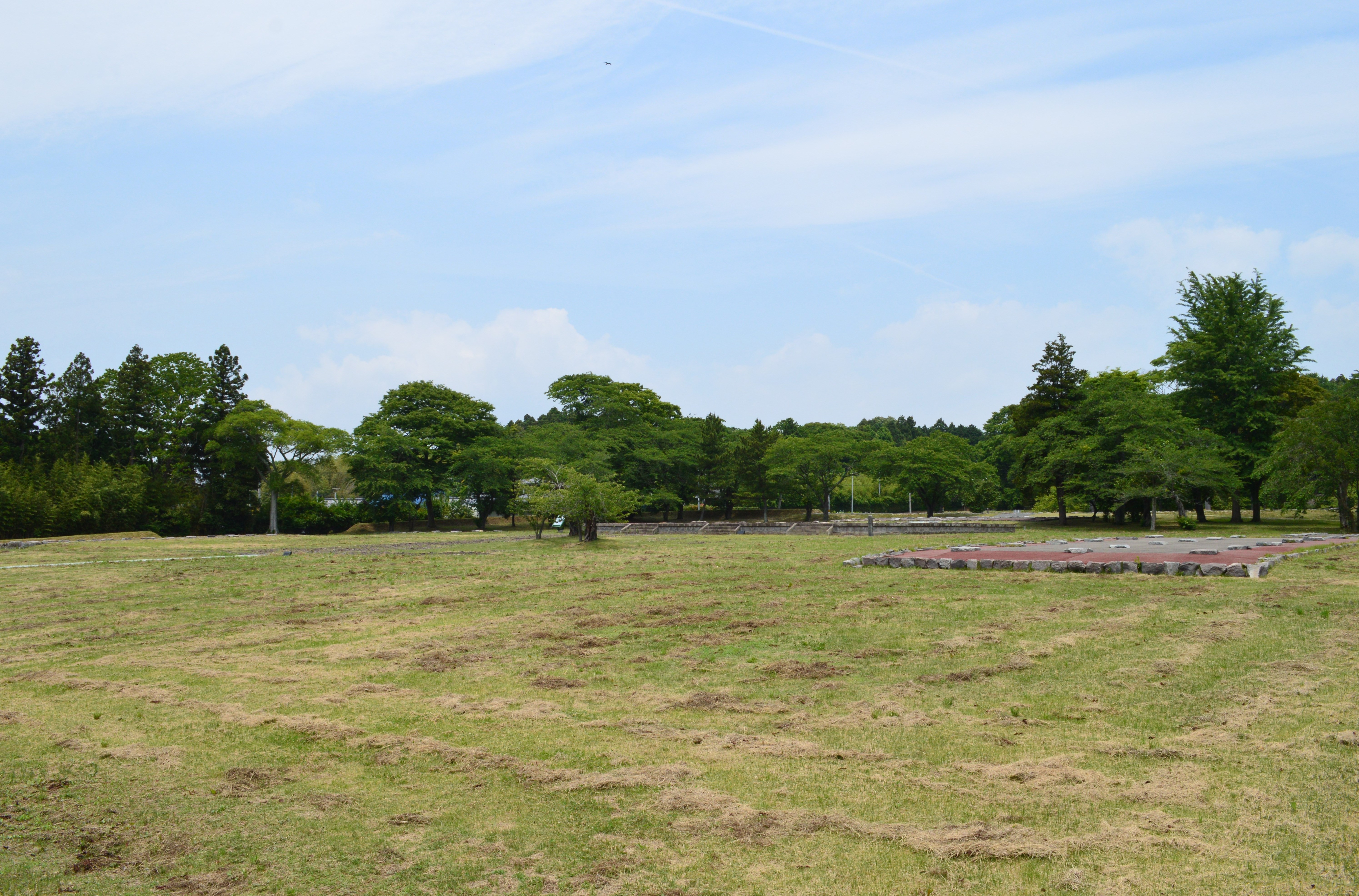
Taga Castle
In 1689, the wandering poet Matsuo Basho stood before a weathered stone monument on a windswept plateau northeast of Sendai and wept. The inscription carved into its face confirmed what chronicles had recorded for nearly a thousand years: that in 724 AD, a man named Ono Azumahito had raised a fortress here at the very edge of the known world. 'There are seldom any certain vestiges of what has been,' Basho wrote, 'yet in this place there are wholly trustworthy memorials of events a millennium ago.' That monument still stands. And the fortress it commemorates, Taga Castle, remains one of the most important archaeological sites in Japan, a place where the expanding Yamato state met the unconquered north.
The Empire's Northern Edge
Taga Castle was never a castle in the feudal sense. It was a fortified administrative city, the seat of imperial power in a contested frontier. Founded in 724 AD during the Nara period, it served as the provisional capital of Mutsu Province, the vast and loosely controlled territory stretching across northern Honshu. Together with Akita Castle and Okachi Fort in neighboring Dewa Province, it formed the backbone of the Yamato court's campaign to bring the indigenous Emishi people under centralized rule. The commander stationed here held the title of Chinju-fu Shogun, the northern counterpart to the military governor of Kyushu, underscoring how seriously the court took this distant frontier. The castle was substantially renovated in 762 AD by Fujiwara Asakari, but the Emishi were far from subdued. In 780, they sacked and burned the fortress entirely.
A Fortified City on a Plateau
Rebuilt after the Emishi assault, Taga Castle occupied a naturally defensible plateau ten kilometers northeast of modern Sendai, near the port of Shiogama. Marshes and rivers guarded its flanks. The fortification itself was immense: a square enclosure approximately 3.4 kilometers in perimeter, ringed by five-meter-high earthen ramparts topped with a wooden palisade and fronted by a dry moat three to four meters wide. A broad main road, over twenty meters across, ran from the fortified south gate to an inner compound one hundred meters square. The outer zone housed barracks, administrative offices, and officers' quarters, while the inner enclosure held the highest government buildings, workshops, and storehouses. It was less a military stronghold than a transplanted capital, a statement of imperial intent stamped into the northern landscape.
Decline and Rediscovery
Success brought obsolescence. After the campaigns of Sakanoue no Tamuramaro pushed the frontier further north around 802 AD, and the construction of Isawa Castle shifted military operations to more distant outposts, Taga Castle settled into a quieter administrative role. The devastating Jogan tsunami of 869 damaged it severely. By the tenth century, the collapse of centralized rule and the rise of local samurai clans rendered it irrelevant. The fortress that had once represented the reach of the Yamato state gradually crumbled into grassy fields. Kitabatake Chikafusa briefly occupied the ruins during the Nanboku-cho civil wars of the fourteenth century, but the site was soon abandoned for good. It lay undisturbed until archaeologists began systematic excavations in 1955, with more extensive work following in 1976.
The Stone That Made a Poet Weep
The site's most celebrated artifact is a granite sandstone monument standing near the south gate of the outer ruins. Carved with 140 kanji characters across eleven lines, it records the castle's founding by Ono Azumahito in 724 and its renovation by Fujiwara no Nakamaro in 762. Discovered during the Edo period between 1661 and 1671, the stone's authenticity was debated for centuries. But archaeological work since 1969 has confirmed that the inscription's claims about the castle's date, scale, and structure align perfectly with the physical evidence. The calligraphy itself matches documents preserved in the Shosoin imperial repository. In 1998, the monument was designated an Important Cultural Property. In 2024, that status was elevated to National Treasure. The ruins and their companion temple, Tagajo Haiji, have been a designated Special Historic Site since 1922.
From the Air
Located at 38.31N, 140.99E on a plateau northeast of Sendai. The ruins are subtle from the air, appearing as geometric earthwork outlines amid residential areas. Look for the rectangular perimeter traces approximately 3.4 km in circumference. Sendai Airport (RJSS) lies 20 km to the south. Matsushima Air Base (RJST) is approximately 8 km to the northeast. Best viewed at 3,000-5,000 feet AGL. The nearby coast and port of Shiogama provide visual reference points.