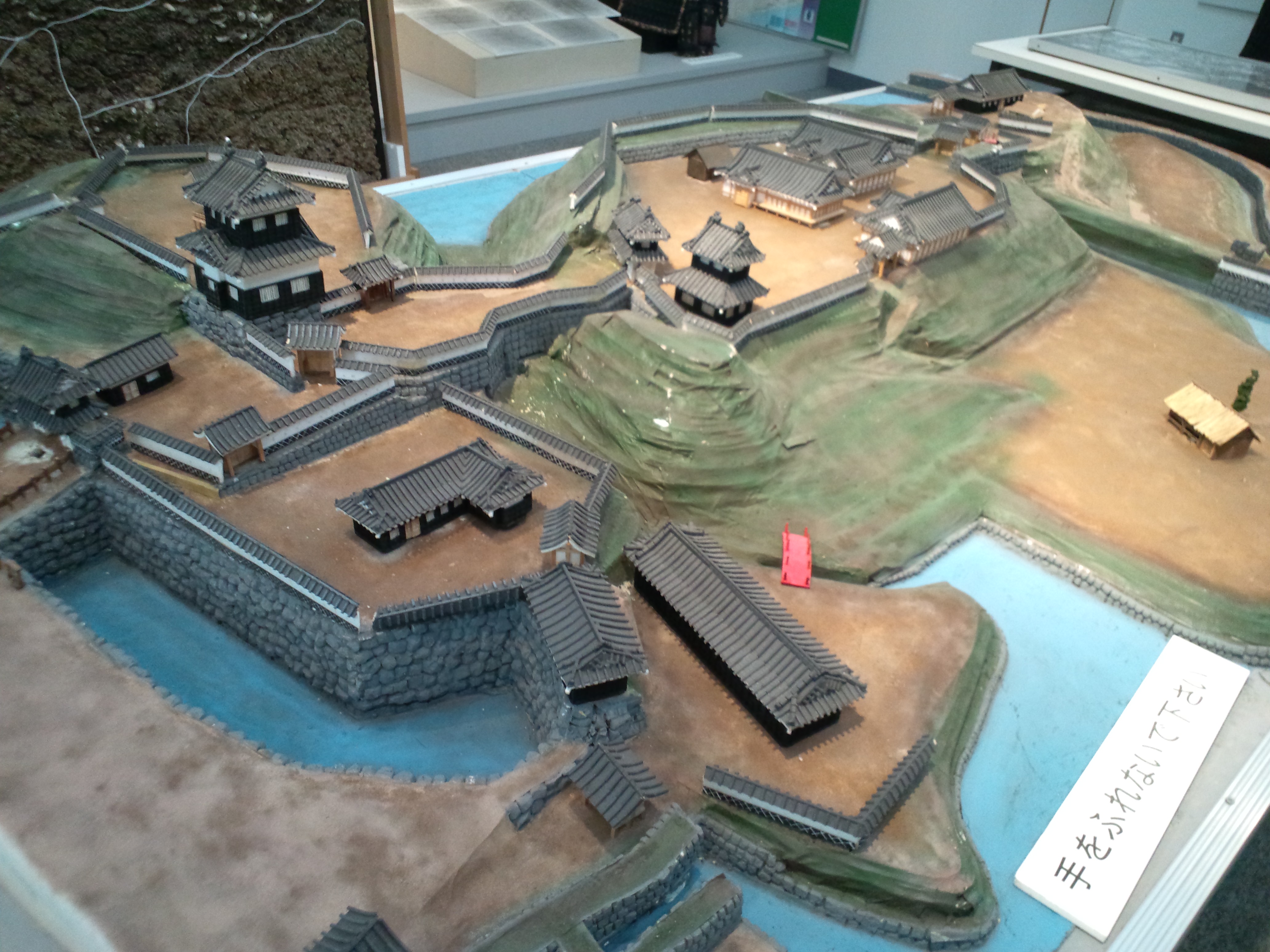
Tahara Castle
The Toda clan made a spectacular miscalculation in the 1540s. Entrusted with escorting the young son of Matsudaira Hirotada to Sunpu Castle as a hostage to the Imagawa clan, they instead sold the boy to Oda Nobunaga in exchange for a cash payment. That boy was the future Tokugawa Ieyasu -- the warlord who would unify Japan and found a dynasty that ruled for 265 years. The Toda's home base was Tahara Castle, a fortification perched on a small hill near the root of the Atsumi Peninsula, surrounded by the tidal inlets of Mikawa Bay. The castle's story is inseparable from the feudal power struggles of central Japan, a saga of clans rising and falling with each shift in military fortune.
A Warlord's Perch Above the Bay
Toda Munemitsu built the first fortification on this site in 1480, during the chaos of the Sengoku Period. The location was well chosen. The hill commanded views across Mikawa Bay, and the surrounding tidal inlets created natural moats that made direct assault costly. From this position, the Toda controlled shipping lanes along the Atsumi Peninsula and maintained a degree of independence that few minor lords could manage in an era when larger clans swallowed smaller ones whole. The peninsula itself -- a narrow finger of land extending into the bay -- gave the Toda strategic depth. Any army approaching overland had to funnel through a narrow corridor, while the castle's seaward faces were protected by water. It was a classic defensive position for a clan that needed to punch above its weight.
The Hostage and the Double-Cross
The Toda's fatal error came during the turbulent 1540s, when the Matsudaira clan to the north found itself squeezed between the Imagawa to the east and the Oda to the west. Matsudaira Hirotada, seeking protection from the Imagawa, agreed to send his young son as a hostage to Sunpu -- a common practice among feudal lords to guarantee loyalty. He asked the Toda to escort the boy. Instead, the Toda diverted the child to Oda Nobunaga, reportedly in exchange for a monetary reward. The Imagawa were furious. In 1550, they attacked and captured Tahara Castle, ejecting the Toda and seizing control of the peninsula. The boy, meanwhile, survived his captivity with the Oda and eventually returned to his family's domain. He grew up to become Tokugawa Ieyasu, the most consequential figure in Japanese history. The Toda's betrayal had planted a seed that would reshape the entire nation.
Changing Hands, Changing Fortunes
After the Imagawa's catastrophic defeat at the Battle of Okehazama in 1560, Tahara Castle passed to the Tokugawa, who used it as a subsidiary fortification to Toyohashi Castle. Honda Hirotaka and Honda Yasushige served as castellans from 1565 to 1595, administering the peninsula on behalf of their Tokugawa overlords. Then came the political earthquake of 1590: Toyotomi Hideyoshi, having defeated the Hojo clan at the Battle of Odawara, reassigned the entire Kanto region to Tokugawa Ieyasu. The Toda lost their ancestral holdings, which Hideyoshi handed to his own vassal, Igi Tadatsugu. Igi rebuilt the moats and stonework, modernizing the castle's defenses. But the Tokugawa victory at Sekigahara in 1600 reshuffled the deck once more. When the Tokugawa shogunate was established, Toda Katatsugu -- descendant of the clan that had once betrayed young Ieyasu -- was raised back to the status of daimyo with a 10,000 koku domain and allowed to return to Tahara Castle in 1601.
The Miyake Era and the Scholar's Legacy
In 1664, the Toda were transferred to Amakusa Domain in Bungo Province, and Tahara was reassigned to the Miyake clan. The Miyake would prove to be the castle's longest and final lords, remaining in residence for over two centuries until the Meiji Restoration swept away the feudal system. Their tenure produced Tahara's most celebrated figure: Watanabe Kazan, a scholar, painter, and reformist official of the late Edo period who served the Miyake lords. Kazan advocated for the study of Western knowledge at a time when the shogunate enforced strict isolationist policies. His progressive views led to his arrest in 1839 during the Bansha no goku crackdown on pro-Western scholars. Sentenced to house arrest, he eventually took his own life in 1841 to spare his lord from further political embarrassment. Today, a Shinto shrine within the castle grounds honors his memory alongside one dedicated to the Miyake ancestors.
Stones and Memory
The Meiji government ordered the destruction of Japan's feudal castles in 1872, and Tahara was no exception. All buildings were demolished, leaving only the stone foundations and portions of the moats -- the bones of a fortress stripped of its flesh. For over a century, the hilltop stood largely bare. Then, in 1990, when the Tahara City Museum was reconstructed on the site, a replica yagura watchtower and gate were built to suggest the castle's former profile. The reconstructions are acknowledged faux -- no one pretends they are original -- but they give visitors a sense of scale and form that the bare stonework alone cannot convey. The museum inside focuses on local history, including the castle's tangled feudal narrative and Watanabe Kazan's legacy. The moats still trace their original lines, and the hilltop still commands its view of Mikawa Bay, just as it did when the Toda first looked out from this spot in 1480 and decided this was a hill worth fortifying.
From the Air
Located at 34.673N, 137.270E at the base of the Atsumi Peninsula, where it connects to the mainland along Mikawa Bay. The castle hilltop is in central Tahara city and is identifiable from the air by the reconstructed yagura tower and the park-like grounds surrounded by moats. The Atsumi Peninsula extends to the southwest like a narrow finger, with Mikawa Bay to the north and the Pacific Ocean to the south. Nearest airports: Chubu Centrair International Airport (RJGG) approximately 30nm northwest across Mikawa Bay, Nagoya Airfield / Komaki (RJNA) approximately 50nm north. Best viewed at 2,000-3,000 feet AGL. The surrounding terrain is flat coastal plain with agricultural fields and the small urban core of Tahara city.