Tahquamenon Falls
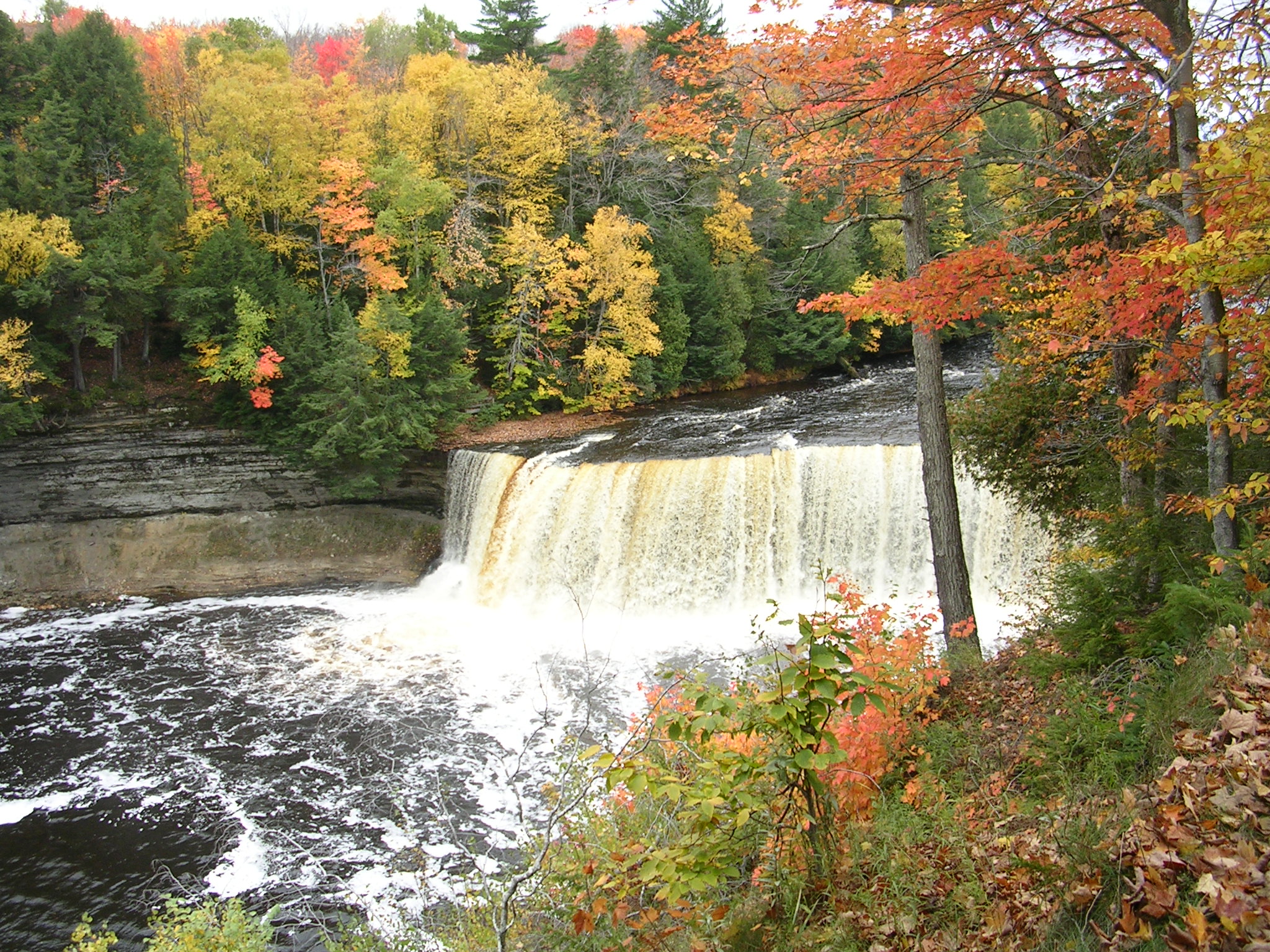
The water looks wrong. That is the first thing visitors notice as the Tahquamenon River heaves itself over a nearly 50-foot ledge and crashes 200 feet wide into the gorge below. The cascade is not the crystalline white of postcard waterfalls but a deep, foaming amber, the color of root beer poured from a great height. The tannins leached from miles of cedar swamps upstream stain every gallon, and at peak spring runoff more than 50,000 gallons per second pour over the brink, making this the third most voluminous waterfall east of the Mississippi. Henry Wadsworth Longfellow wrote the Tahquamenon into American literature in 1855 when he placed his Hiawatha here, building a birch-bark canoe "by the rushing Taquamenaw." The poem was fiction, but the river it described was real, and the Ojibwe people who inspired the legend had fished, hunted, and lived along these banks for centuries before any poet took notice.
The River That Stains Itself
The Tahquamenon River drains a vast watershed of boreal forest and cedar swamp in Michigan's Upper Peninsula, and the organic compounds dissolved in that journey give the water its signature amber hue. Tannins from decaying leaves, bark, and roots seep continuously into the flow, turning the river into something that looks brewed rather than born. Locals and visitors alike call this the Root Beer Falls, and the comparison is uncannily accurate. When the Upper Falls catches full sunlight, the spray glows a warm golden brown against the dark green of surrounding hemlock and white pine. The foam churned up at the base collects in thick, cream-colored rafts that drift downstream, completing the illusion of a freshly poured drink on a planetary scale. This natural chemistry is not merely scenic; it signals an entire ecosystem at work, the slow decomposition of boreal forest feeding the river's character mile after mile.
Hiawatha's Country
Long before the Upper Peninsula became a destination for tourists, this stretch of river belonged to the Ojibwe. They called it the Tahquamenaw, a name thought to mean "dark water river," and regarded the land as part of a territory rich with fish, game, and wild rice. The Ojibwe fished for whitefish and walleye, trapped beaver and mink, and built seasonal camps along the river corridor. When Henry Wadsworth Longfellow published The Song of Hiawatha in 1855, he wove the Tahquamenon into his verse, borrowing liberally from Ojibwe oral traditions to create a narrative poem that captivated 19th-century readers. Longfellow never visited the falls himself. He drew from the published accounts of ethnographer Henry Rowe Schoolcraft, who had spent years among the Ojibwe documenting their stories. The poem made the river famous in parlors from Boston to London, even as the people whose culture inspired it continued their quieter, more enduring relationship with the land.
A Logger's Gift
In the 1800s, timber interests pushed deep into the Upper Peninsula, and logging camps lined both banks of the Tahquamenon. The old-growth white pine that once blanketed this region fell to crosscut saws and river drives, transformed into the lumber that built Midwestern cities. One logging operator accumulated vast holdings around the falls, including land on both sides of the Upper and Lower cascades. When he eventually donated the property to the State of Michigan in the early 1900s, he attached stipulations designed to prevent overdevelopment, a remarkable act of foresight in an era when conservation was still a radical idea. Those conditions shaped the park that exists today: nearly 50,000 acres of undeveloped woodland where roads, power lines, and commercial structures remain scarce. The brewery and pub that sits near the Upper Falls parking area is operated by descendants of the original donor family, built in the style of the logging camps that once dotted this forest, serving whitefish and house-brewed beer to hikers who have just walked the viewing platforms above the cascade.
Two Falls, Five Faces
The Upper Falls commands the attention, but four miles downstream the river splits around a small island and tumbles over five separate cascades known collectively as the Lower Falls. These are gentler, more intimate, and reachable by rowboat. For a few dollars visitors can row across and circle the island on foot, watching the amber water spill over ledges from every angle. In summer, sandhill cranes nest in the marshes nearby while moose browse the shallows at dawn. Black bears, coyotes, bald eagles, and otters share the park with spruce grouse, pileated woodpeckers, and migrating waterfowl. In winter the falls transform entirely: the cascade freezes into enormous blue-white ice formations, the spray crystallizes into sculptural columns along the gorge walls, and miles of marked trails open for snowshoeing and cross-country skiing. Photographers prize both seasons equally, but it is winter that makes Tahquamenon feel most like the wilderness Longfellow imagined, silent except for the muffled roar of water still moving beneath the ice.
From the Air
Tahquamenon Falls is located at 46.574N, 85.256W in the eastern Upper Peninsula of Michigan. From the air, the amber-colored river is visible winding through dense boreal forest; the Upper Falls appear as a wide brown crescent where the river drops into a gorge. Look for the clearing and parking area near the falls. The nearest airports include Newberry Airport (Y98) approximately 23 miles south, and Chippewa County International Airport (KCIU) near Sault Ste. Marie about 55 miles east. Best viewed at 2,000-3,000 feet AGL in clear conditions. The area is remote with very few landmarks besides M-123 cutting through the forest.