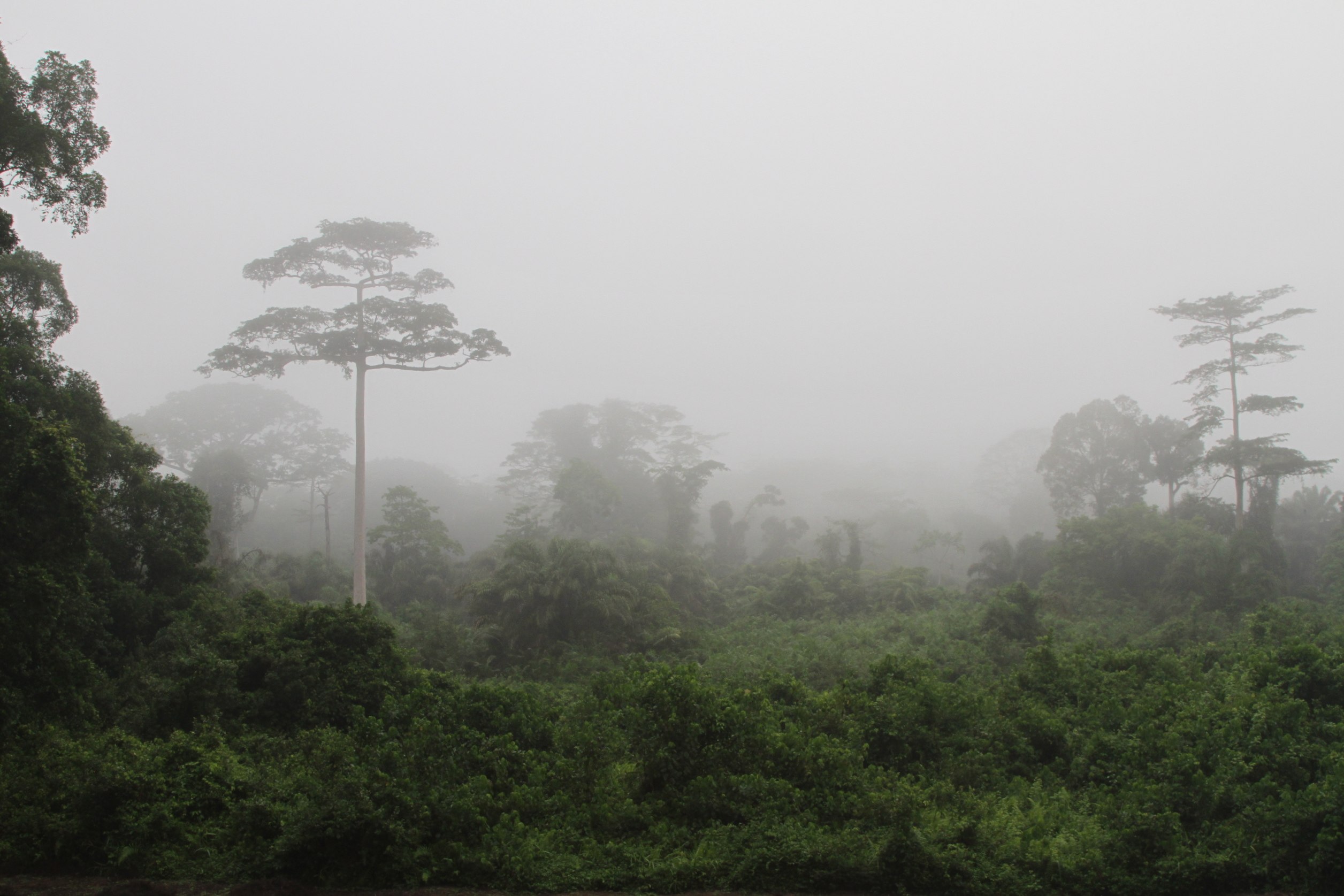
Tai National Park
In 1979, primatologists watching chimpanzees in the forests of southwestern Ivory Coast documented something that had never been systematically recorded before: the apes were selecting specific stones, carrying them to nut-bearing trees, and using them as hammers and anvils to crack open wild nuts. This was not random smashing. The chimpanzees chose their tools deliberately, preferred certain rock types, and taught the technique to their young. The Tai Chimpanzee Project, launched that year, has been running ever since -- one of the longest continuous studies of wild chimpanzee behavior anywhere on Earth. The forest where these observations continue is Tai National Park, 3,300 square kilometers of primary tropical rainforest that represents the largest and best-preserved remnant of the Upper Guinea forest bloc, a biome separated from Central Africa's rainforests by the arid Dahomey Gap.
The Last Great Forest
West Africa's Upper Guinea rainforests once stretched in an unbroken band from Guinea to Ghana. Today, most of that forest is gone -- cleared for cocoa, logged for timber, fragmented by roads and settlements. Tai National Park is what remains: 3,300 square kilometers of tropical evergreen forest in Ivory Coast's southwestern corner, bordered by Liberia to the west and hemmed in by the Cavalla and Sassandra rivers. The park sits on a Precambrian granite peneplain that slopes gently from the drier north to the wetter, more deeply dissected south, where annual rainfall exceeds 2,200 millimeters. Altitudes range from 80 meters to 396 meters at the summit of Mont Nienokoue. The Tai Forest reserve was first established in 1926 under French colonial rule, upgraded to national park status in 1972, recognized as a UNESCO biosphere reserve in 1978, and inscribed as a World Heritage Site in 1982.
Toolmakers in the Canopy
The chimpanzees of Tai have become famous far beyond primatology. Television footage of them hunting red colobus monkeys cooperatively -- coordinating roles like beaters and ambushers -- challenged assumptions about the cognitive limits of non-human primates. Their nut-cracking behavior, passed down through generations, is considered a form of culture: different chimpanzee communities in the same forest use different techniques, and juveniles spend years learning by observation before mastering the skill. But the chimpanzees share the forest with four other mammal species on the IUCN Red List: the pygmy hippopotamus, a secretive, largely nocturnal animal that wades through the park's streams; the olive colobus monkey; the leopard, which hunts the colobus in turn; and Jentink's duiker, one of the rarest antelopes in the world, restricted almost entirely to this corner of West Africa.
An Uneasy Reservoir
Tai's scientific significance extends beyond primates into virology, and the connection is unsettling. The forest is a natural reservoir of the Ebola virus. In 1994, a Swiss researcher contracted Ebola after performing a necropsy on a dead chimpanzee found in the park -- one of the first confirmed cases of Ebola in a non-Central African setting. The World Health Organization has since flagged the proximity of this viral reservoir to Abidjan, Ivory Coast's largest city, where Felix-Houphouet-Boigny International Airport handles international traffic daily. The park supports more than 1,300 species of higher plants and 47 of the 54 large mammal species known from the Upper Guinea forests, making it an irreplaceable genetic archive. But it also serves as a reminder that tropical forests are complex systems where human, animal, and microbial worlds intersect in ways that are not always benign.
Canopy and Consequence
From the air, Tai National Park appears as a solid block of green in a landscape increasingly fragmented by agriculture. The contrast is stark: the park's boundaries are visible as sharp lines where unbroken canopy gives way to cleared farmland. Inside, the forest is layered -- emergent trees reaching 50 meters or more above the ground, a dense mid-canopy, and a shaded understory where light barely penetrates. Eleven species of primates share this vertical space, from the Diana monkey in the upper canopy to the sooty mangabey foraging on the forest floor. The park's 140 recorded mammal species include forest elephants, bongo antelopes, and forest buffalo. Whether this biodiversity survives the next century depends on whether the park's boundaries hold against the pressures of population growth, cocoa farming, and climate change that press in from every side.
From the Air
Tai National Park is located at approximately 5.75N, 7.15W in southwestern Ivory Coast. The park is visible from altitude as a large, unbroken block of dense tropical rainforest, sharply contrasting with surrounding cleared agricultural land. Elevations within the park range from 80 to 396 meters. Nearest airports include San Pedro Airport (DISP) approximately 100 km east, and Tabou Airport to the southwest. The park lies between the Cavalla River (Liberian border) to the west and the Sassandra River to the east. Best viewed at 5,000-10,000 feet AGL. Expect cloud buildup in the afternoon, especially during the wet season (May-October).