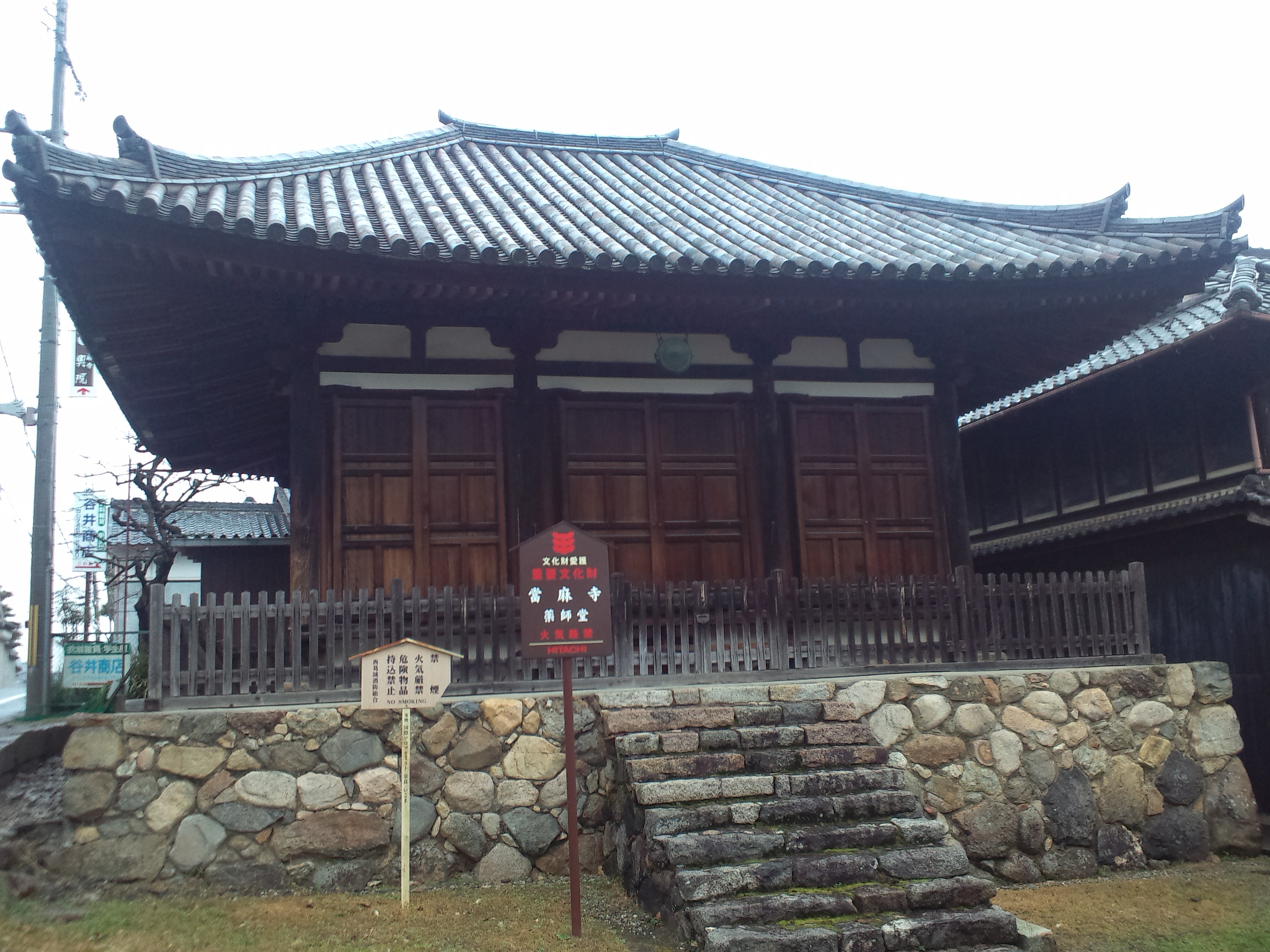
Taima-dera: The Temple Between Two Worlds
The setting sun drops between the twin peaks of Mount Nijo and vanishes. For the ancient Japanese, this was not just a sunset -- it was a doorway. Mount Nijo, standing at the western edge of the Nara Basin, was believed to be the entrance to the Western Paradise, the destination of departed souls. At the mountain's foot, the Taima clan built their temple on the very ground where they buried their ancestors, creating a place that has straddled the boundary between this world and the next for nearly fourteen centuries. Taima-dera remains one of Japan's most layered sacred sites: a temple that belongs simultaneously to two Buddhist sects, houses three National Treasures, preserves a mandala that draws Pure Land pilgrims from across the country, and somehow still keeps its twin pagodas standing after more than 1,300 years.
A Clan Temple on Ancestral Bones
The origins of Taima-dera are tangled in competing histories. One tradition says Prince Maroko, the half-brother of the revered Prince Shotoku, founded the temple in 612. Another account dates its establishment to the reign of Emperor Tenmu in the late 7th century. Archaeological evidence supports the later date: the Maitreya Bodhisattva and Four Heavenly Kings statues in the main hall, the temple bell, the stone lanterns, and excavated brick Buddhas all show a style consistent with the Tenmu era. What is clear is that the temple was built as the clan temple of the Taima clan, a branch of the powerful Katsuragi clan that controlled this area. An ancient tomb discovered beneath the main hall confirmed that the temple sits on ancestral burial grounds. The site was strategic as well as sacred -- the Taima area straddled the Yokooji road, the main east-west route connecting Yamato Province with Kawachi Province, the corridor through which cultural artifacts from Tang China and the Korean peninsula traveled from the port of Osaka to the capital.
The Mandala and the Princess
Taima-dera's fame rests on the Taima Mandala, a large textile depicting the Pure Land of Amida Buddha, said to have been created in 763. Legend attributes its making to Princess Chujo, a noblewoman who renounced the world and wove the mandala in a single night using lotus threads, guided by a manifestation of Amida Buddha himself. The story was popularized through Noh plays, Joruri puppet theater, and Kabuki, making the temple a pilgrimage destination that has drawn the faithful for centuries. The mandala is housed in a five-meter-tall shrine within the Mandala Hall, designated a National Treasure. In 1223, the Jodo sect monk Shoku wrote a commentary on the mandala and created over a dozen copies, distributing them across provinces and spreading devotion to the Pure Land teachings that the image represents. The princess legend gave Taima-dera a human story to anchor its theology, and it endures today in the Neri-Kuyo Eshiki, an annual procession where twenty-five priests wearing Bodhisattva masks walk across a long bridge symbolizing the passage from this world to paradise.
Twin Pagodas, Thirteen Centuries Apart
Taima-dera is the only temple in Japan to preserve both of its original twin pagodas, and the two towers are fascinatingly different. The East Pagoda, a National Treasure standing 24.4 meters tall, dates to the end of the Nara period, around 710 AD. It is full of architectural anomalies: the upper stories have two bays instead of the standard three, its spire carries eight rings rather than the usual nine, and its water-smoke finial features an unprecedented fishbone-shaped design found nowhere else in Japanese architecture. The West Pagoda stands slightly taller at 25.2 meters and was built in the early Heian period, though evidence suggests it replaced an even earlier Asuka-period tower. During repairs between 1911 and 1914, workers discovered a reliquary of three nested containers -- gold, silver, and gilt bronze -- enshrined at the top of the central pillar rather than beneath it, an extremely rare placement. The East Pagoda is built of hinoki cypress; the West Pagoda uses zelkova, another unusual choice for pre-Heian architecture. Together they stand on a plateau six to seven meters above the main temple buildings, slightly asymmetrical, as though each century left its own subtle signature.
Layers of Destruction and Renewal
On January 15, 1181, during the Genpei War, the warrior Taira no Shigehira set fire to Taima-dera. The twin pagodas survived; nearly everything else burned. The Kodo lecture hall still shows a layer of burnt soil beneath its floor from that day. The Kondo's main image bears scorch marks. Rebuilding continued for centuries -- the Kondo was reconstructed around 1184, the Mandala Hall took its current form by 1262, the Kodo was rebuilt in 1303. Dismantling the Mandala Hall for repair between 1957 and 1960 revealed that its timbers had been reused across at least three building phases stretching from the Nara period through the late Heian period. Workers also found dozens of wooden haloes for Buddhist statues cached in the attic, dating from the 9th to 11th centuries, but the statues they belonged to were never located -- a mystery that remains unsolved. The stone lantern before the Kondo, dating to the Asuka period, is the oldest known stone lantern in Japan.
The Garden of the Pure Land
At the western edge of the temple grounds, the Oku-no-in inner temple contains the Jodo Garden, the largest garden in Japan designed to represent the paradise depicted in the Taima Mandala. Peonies bloom in spring, maples burn in autumn, and the garden maintains color through the year. This sub-temple was founded in 1370, when the 12th abbot of Chion-in in Kyoto relocated a statue of the Pure Land patriarch Honen to this site. Since then, Taima-dera has served as a place of study for both the Shingon and Jodo sects -- an unusual dual affiliation reflecting the temple's own journey from its original Sanron sect roots, through Kukai's visit in 823 that brought Shingon Buddhism, to the Pure Land devotion that drew pilgrims during the spread of Mappo ideology. By the Edo period, 31 sub-temples occupied the grounds. Thirteen survive, including the Naka-no-bo, designated a National Historic Site with gardens recognized as a National Place of Scenic Beauty.
From the Air
Located at 34.516N, 135.695E at the western edge of the Nara Basin in Katsuragi city, Nara Prefecture. The temple sits at the base of Mount Nijo, whose distinctive twin peaks are a prominent landmark from the air. Look for the forested hillside where the Nara plain meets the mountains along the border with Osaka Prefecture. The twin pagodas on their elevated plateau may be visible at lower altitudes. Kansai International Airport (RJBB) lies approximately 30 nautical miles to the west-southwest. Osaka Itami Airport (RJOO) is about 20 nautical miles to the north-northwest. Nara is approximately 15 nautical miles to the northeast. Best viewed at 3,000-4,000 feet AGL approaching from the east to see how the temple occupies the transition zone between the flat basin and the rising mountains.