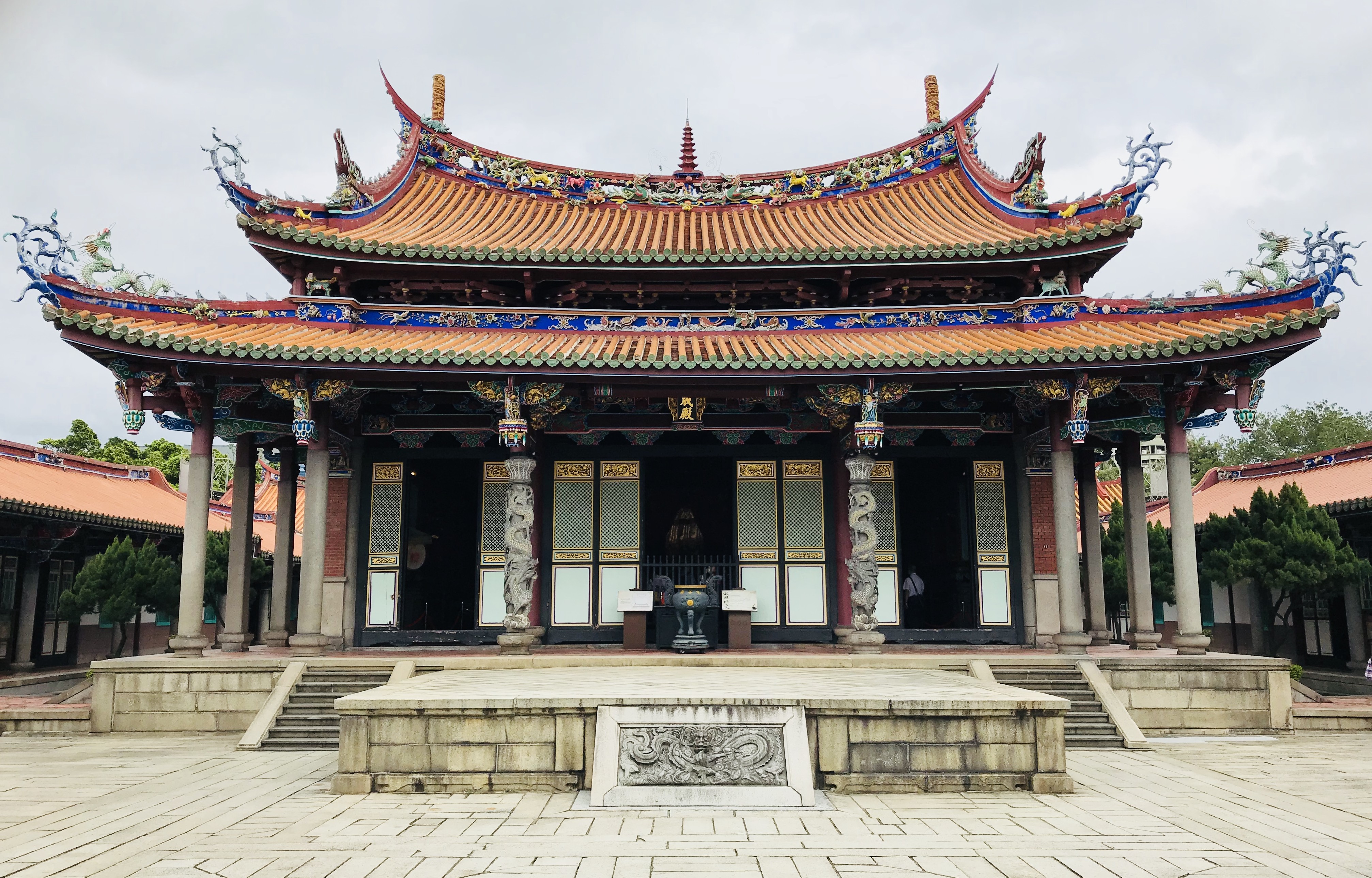
Taipei Confucius Temple
Every September 28 at dawn, musicians at the Taipei Confucius Temple perform a ritual that has been refined over centuries. The instruments are ancient -- stone chimes, bronze bells, wooden clappers. The dancers move through thirty-six precisely choreographed positions. The ceremony honors Confucius on what Taiwan recognizes as his birthday, and it unfolds in a courtyard where incense smoke mingles with the subtropical air of Datong District. The temple itself has been destroyed and rebuilt, its location shifted, its purpose contested by colonial powers -- yet the music has never stopped for long.
Built, Demolished, Rebuilt
The original Taipei Confucius Temple was constructed in 1879, four years after the establishment of Taipeh Prefecture under the Qing Dynasty. It stood on the site now occupied by Taipei First Girls' High School -- a detail that captures the casual erasure colonial transitions could impose on sacred spaces. When Japan took control of Taiwan in 1895, the temple's role shifted. Two years after the invasion, the Japanese held a ceremony at the temple, grafting their own administrative rituals onto a Confucian framework. The temple endured through the decades of Japanese rule, then passed into the hands of the Republic of China government after 1945. Today's structure, rebuilt and relocated to Datong District, carries forward a tradition that predates every modern institution in its neighborhood.
Fujian Rooftops in a Taipei Sky
Among the dozens of Confucius temples scattered across Taiwan, the Taipei temple holds one architectural distinction: it is the only one adorned with southern Fujian-style ceramic ornaments. These are the jiaozhi ceramics -- intricate, multicolored figures of dragons, phoenixes, and mythological scenes that crown the roof ridges and eaves. The temple's overall design is modeled after the original Temple of Confucius in Qufu, Shandong province, the sage's birthplace. But the Fujian ceramics mark it as distinctly Taiwanese, reflecting the southern Chinese heritage of the island's majority Hoklo population. The effect is striking: a building that looks simultaneously ancient and regional, honoring a universal Chinese tradition through a specifically local craft.
The Students' Pilgrimage
Before Taiwan's grueling college entrance examinations each year, the temple fills with a different kind of worshiper. Students arrive with their parents, burn incense, and pray to Confucius for success -- a ritual that blends genuine spiritual seeking with pragmatic anxiety. Confucius, revered across East Asia as the patron of scholarship and learning, is asked here to do something he might have appreciated: help young people pass a test. The tradition is not unique to Taipei, but the scale of the annual pilgrimage here reflects both the temple's prominence and the intense pressure of Taiwan's education system. Exam season turns the temple into a gathering place for families united by hope and nervousness in equal measure.
A Neighborhood of Temples
The Confucius Temple sits in Datong District, one of Taipei's oldest neighborhoods, within walking distance of Yuanshan metro station. Just next door stands the Dalongdong Baoan Temple, a lavishly decorated Taoist temple dedicated to the deity Baosheng Dadi. The two temples, side by side, represent distinct but overlapping traditions -- Confucian reverence for learning and social order alongside Taoist folk religion with its colorful rituals and spirit mediums. Together they anchor a stretch of Taipei that has been sacred ground since long before the metro arrived. The neighborhood around them is dense, noisy, and thoroughly modern, but the temple courtyards remain islands of deliberate quiet, their stone pavements worn smooth by generations of feet.
From the Air
Located at 25.073°N, 121.517°E in Datong District, northern Taipei. The temple complex is adjacent to the Dalongdong Baoan Temple, making the pair of traditional rooftops distinctive from the air against the surrounding urban fabric. Best viewed below 2,500 feet. Nearest airport: Taipei Songshan (RCSS), approximately 4 km east-southeast. Taoyuan International (RCTP) is 35 km to the west.