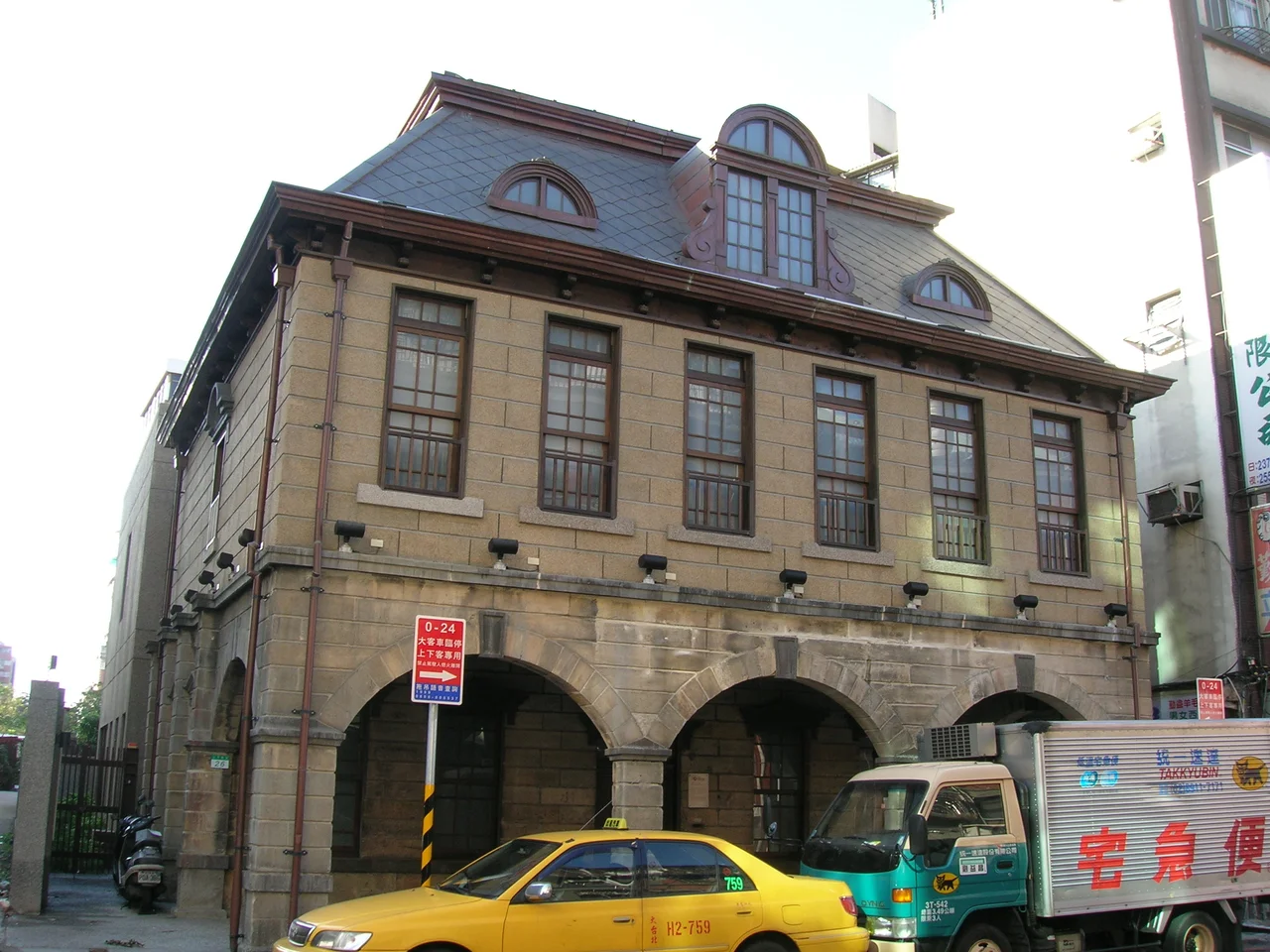

Taipei Futai Street Mansion
Most of colonial Taipei was swept away — by bombs, by redevelopment, by the relentless appetite of a modernizing city. The Futai Street Mansion was not. Sitting at Yanping South Road No. 26 in the Zhongzheng District, this modest two-story building from 1910 has watched empires rise and fall from the same address, its steep mansard roof unchanged, its stone arcade still casting the same shadows it did when Taiwan was a Japanese colony and the building served as the headquarters of a construction company called Takaishi Gumi.
Stone, Columns, and a Borrowed Style
Takaishi Gumi, a construction firm founded in 1901, commissioned the mansion in 1910 during the early decades of Japanese rule. The company chose a style that was fashionable across colonial Asia at the time: European Baroque classicism, filtered through a Japanese imperial sensibility. The ground-floor arcade and columns were built from kizingan stone — a volcanic material quarried from the Qilian'an area of Taipei — giving the building a particular weight and texture, a roughness that contrasts with the restrained elegance of the design above. The second floor is where the building announces itself most boldly: a steep, angular mansard roof punctuated by dormers, a French-derived form that Baroque architects had used since the seventeenth century and that Japanese colonial planners adopted enthusiastically for prestige buildings across Taiwan. The result is a small building that punches above its scale.
The Last One Standing
What makes the Futai Street Mansion remarkable is not just what it is, but what it is alone. Of all the historical commercial buildings that once lined central Taipei's streets during the Japanese colonial period, this is the only one that survives intact. The rest are gone — replaced by concrete towers, cleared for infrastructure, or lost to time and neglect. The mansion's survival owes something to its ownership: the Ministry of National Defense of the Republic of China has held the property, and institutional ownership, however bureaucratic, can be a form of preservation. The building also sits within the Bo'ai Special Zone, a designated area near the Presidential Office Building that contains several other heritage structures, its significance recognized within a broader protected landscape.
Between Two Worlds
To stand in front of the Futai Street Mansion is to feel the particular strangeness of Taiwanese colonial history. The building looks neither fully Japanese nor fully European, but like the hybrid it was always meant to be: a Japanese company, building in European style, in a Chinese city under Japanese rule. The North Gate — one of Taipei's original Qing Dynasty gates — stands nearby, making this corner of the city an unusually dense archaeological layer cake. Qing-era fortifications, Japanese Baroque commercial buildings, and the avenues of the modern Republic of China exist within a short walk of each other. The mansion connects those eras in a single structure, a thread running through Taipei's complicated twentieth century.
A Building That Keeps Its Secrets
The mansion's Facebook page carries the handle @futai1910 — a neat compression of its identity as a heritage site that has learned to speak the present's language while remaining rooted in its own past. Visitors who come expecting grandeur may find the building's scale surprising; it is not imposing. What it offers instead is intimacy and rarity. This is what a working commercial headquarters looked like at the start of colonial Taiwan's most ambitious building boom. It is what has been lost everywhere else. The arcade columns, the dormered roof, the kizingan stone façade: all of it is a record of a city that no longer exists, preserved in the one spot where someone, somehow, let it stand.
From the Air
The Futai Street Mansion sits at 25.0467°N, 121.511°E in central Taipei's Zhongzheng District, near the North Gate (Beimen). Approaching from the air, look for the cluster of older government buildings northwest of Taipei Main Station. The North Gate's circular form and the Presidential Office Building's distinctive cross-shaped footprint serve as orientation landmarks. Taipei Songshan Airport (RCSS) is approximately 5 km northeast; the international gateway Taoyuan (RCTP) lies about 40 km to the southwest. Recommended viewing altitude for the historic district is 2,000–3,000 feet in clear conditions.
Nearby Stories
- Dapu Incident 9.3 km away
- Shuanglianpi Wetland 18 km away
- Toufen 41 km away
- North Jiangsu Main Irrigation Canal 980 km away
- General Cliff Rock Paintings 1050 km away
- Sinking of MV Sewol 1061 km away
- Yellow Sea 1111 km away
- Twin Forts of Romblon 1358 km away