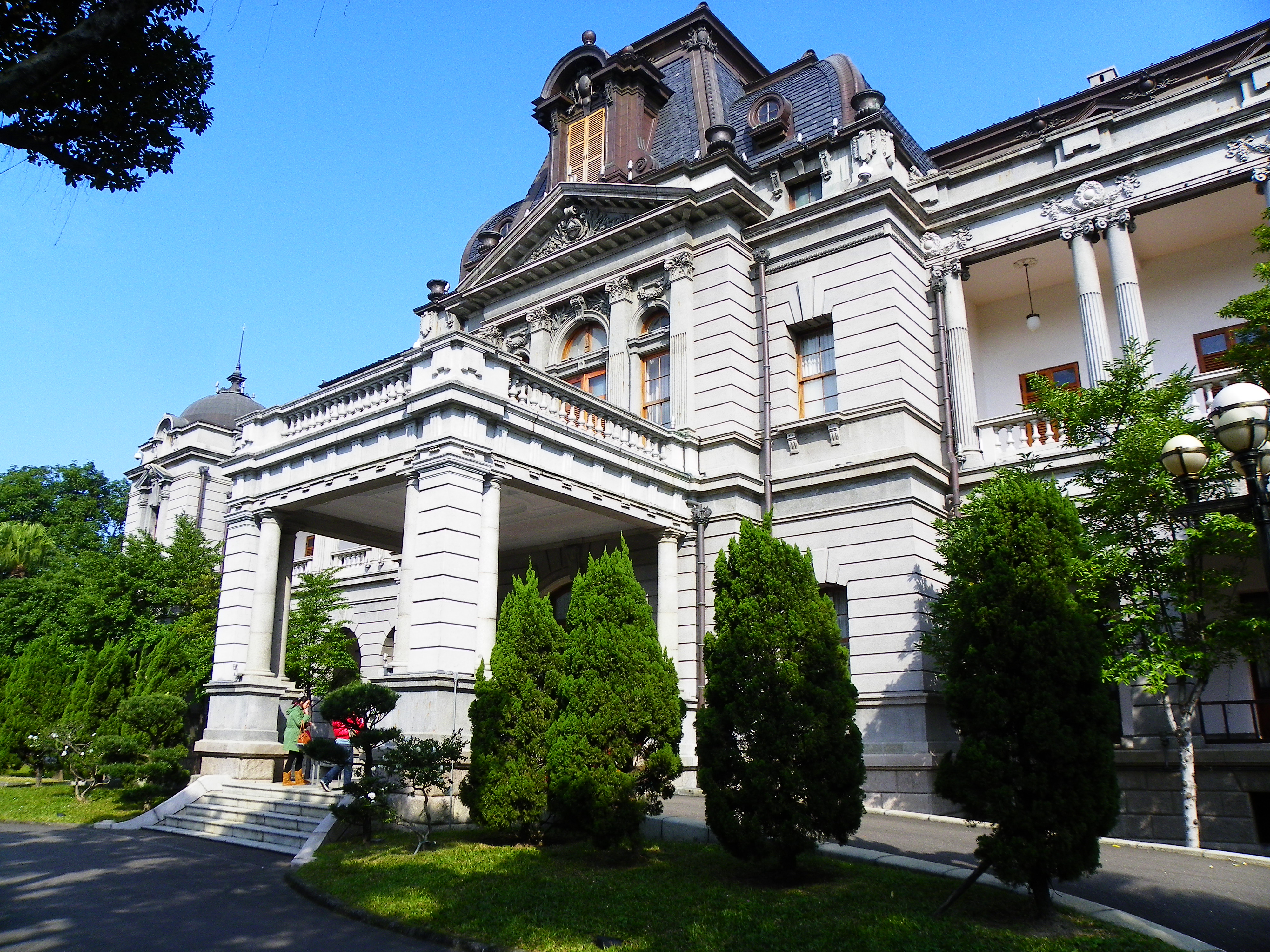
Taipei Guest House
The budget scandal came first, then the palace. When Goto Shinpei, the powerful chief civil administrator of Japanese-ruled Taiwan, was building what is now the Taipei Guest House at the turn of the 20th century, rumors reached Tokyo that funds earmarked for the Taiwan Grand Shrine were being diverted to this extravagant residence instead. Goto was recalled to Japan to explain himself before members of the National Diet. He survived the inquiry, and the building was completed -- a French Second Empire mansion with Mansard roofs and Roman pillars, planted 100 meters from the Governor-General's office in the administrative heart of colonial Taipei.
A Residence for Governors and a Crown Prince
Built between 1899 and 1901 by Japanese architects, then substantially rebuilt in 1911, the Taipei Guest House served as the official residence of the Governor-General of Taiwan during the Japanese colonial period. Its location on what is now Ketagalan Boulevard, in the Bo'ai Special Zone of Zhongzheng District, placed it at the epicenter of colonial power -- steps from the Governor-General's office, which today serves as Taiwan's Presidential Building. Imperial visitors stayed here, including Crown Prince Hirohito, the future Emperor Showa, during his 1923 tour of Taiwan. The building was not merely a residence; it was a statement of permanence, a signal that Japan intended to govern Taiwan in style and at length. The architecture made the message unmistakable: this was a European palace transplanted to the subtropics.
The Treaty That Ended a War
After Japan's defeat in 1945 and the transfer of Taiwan to the Republic of China, the building took on a new diplomatic role. On April 28, 1952, ROC Minister of Foreign Affairs George Yeh and Japanese Minister of Foreign Affairs Katsuo Okazaki sat down in this building to sign the Treaty of Taipei, formally ending the state of war between Japan and the Republic of China. The treaty was a companion document to the San Francisco Peace Treaty signed the previous year, and its signing at the Taipei Guest House gave the building a place in the legal architecture of postwar Asia. What had been a colonial governor's home became the setting where Taiwan and Japan negotiated their transition from occupier and occupied to sovereign neighbors.
Baroque Grandeur Behind the Gates
The building's architecture is a deliberate collision of European formality and Japanese precision. The Mansard roof -- that distinctive double-sloped form associated with Napoleon III's Paris -- crowns a structure supported by high Roman pillars. Inside, crystal chandeliers hang from baroque ceilings decorated with gold leaf flowers and foliage. Outside, a traditional Japanese garden provides a counterpoint: manicured trees, stone pathways, the carefully controlled wildness that Japanese landscape design uses to evoke nature without surrendering to it. The building has been called the most graceful baroque residence in Taiwan, and while superlatives are easy to overuse, the description is hard to argue with. Designated a national monument in 1998, it is administered by the Ministry of Foreign Affairs and still used to receive visiting heads of state and host diplomatic functions.
Six Sundays a Year
For most of its existence, the Taipei Guest House was invisible to ordinary Taiwanese citizens -- a building glimpsed through gates, used by officials, closed to the public. That changed on June 4, 2006, when the government began opening the grounds on the first Sunday of every even-numbered month. Six days a year, visitors can walk the Japanese garden, stand in the rooms where the Treaty of Taipei was signed, and see the crystal chandeliers that once lit colonial dinner parties. The limited access makes each opening something of an event, drawing crowds who line up along Ketagalan Boulevard for a few hours inside a building that has witnessed every transition in modern Taiwanese history -- from Japanese colonial rule to postwar diplomacy to democratic governance.
From the Air
Located at 25.040°N, 121.517°E on Ketagalan Boulevard in Zhongzheng District, directly south of the Presidential Office Building. The Mansard-roofed structure with its surrounding Japanese garden is visible from the air as a distinctive low-rise complex amid taller government buildings. Best viewed below 2,000 feet. Nearest airport: Taipei Songshan (RCSS), approximately 4 km northeast. Taoyuan International (RCTP) is 35 km west.