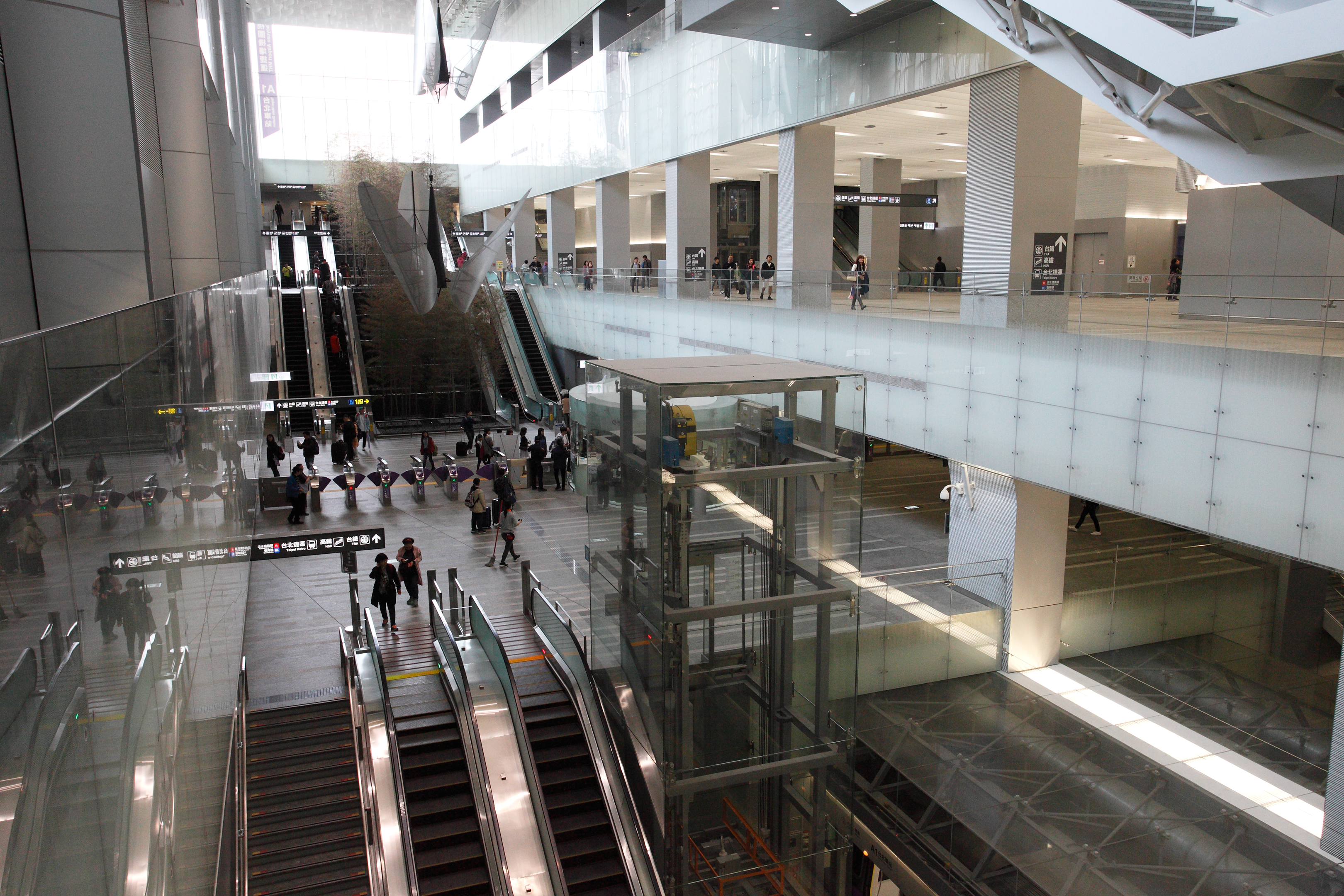
Taipei Main Station
Somewhere inside Taipei Main Station, there is a plaque marking the height that floodwater reached during Typhoon Nari in 2001. The storm dumped so much rain on the capital that water poured down the station's escalators and filled the underground platforms, submerging the metro tunnels and knocking out the entire system for months. The station survived, was drained, cleaned, and reopened. It has been surviving things since 1891, when the first rail station in Taipei was completed in the neighborhood of Twatutia under Qing Dynasty rule. That wooden station is long gone. So is the Japanese-era replacement, and the temporary structure that followed. The current building -- 149 meters long, 110 meters wide, six floors above ground, four below -- is the latest iteration of a place that has been Taipei's central node for more than a century.
Four Stations in One Spot
The first Taipei rail station opened in 1891, when the Qing government completed its railway from Keelung to what was then called Twatutia. A permanent station was built in 1897 during the early years of Japanese rule, then relocated slightly east in 1901, then rebuilt entirely in 1940 to handle the growing passenger traffic of a colonial capital. By the 1980s, the railroad crossings slicing through downtown Taipei had become an intolerable source of congestion. The solution was radical: bury the tracks. The Taipei Railway Underground Project created a tunnel between Huashan and Wanhua, and on September 2, 1989, railway service shifted to the current building. The old station was demolished, and an era ended. Taipei had moved its central transit artery underground, and the city above could finally breathe.
An Underground City
The station today is less a building than a subterranean district. At street level, a grand hall with a skylight serves as the main concourse, surrounded by ticketing counters and exits in every direction. Below, the complexity multiplies. Level B1 holds turnstiles for Taiwan Railways and the High Speed Rail, plus entrances to four separate underground shopping malls -- Zhongshan Metro Mall, Taipei City Mall, Station Front Metro Mall, and Qsquare -- that stretch in tunnels toward other metro stations. Level B2 has the conventional and high-speed rail platforms, each with two island platforms. The Taipei Metro's Bannan line enters at B2 and descends to platforms at B3. The Tamsui-Xinyi line dives deeper still, with entrances at B3 and platforms at B4. The Taoyuan Airport MRT connects via underground passageways to its own station nearby. Navigating the complex is notoriously disorienting; a 3D map was eventually published to help passengers find their way.
Hub of a High-Speed Island
When the Taiwan High Speed Rail began service in 2007, Taipei Main Station became its northern anchor. Nearly every HSR train calls here, connecting the capital to Taichung in under an hour and to Kaohsiung in about ninety minutes. The first southbound departures each morning -- Service 803, which stops at all stations, and Service 203, which runs express to major cities -- leave just four minutes apart, a scheduling choreography that lets commuters choose between speed and coverage. Combined with the conventional Taiwan Railway system, the metro, the airport MRT, and the intercity bus station connected by underground passageways, Taipei Main Station processes more passengers daily than any other transit node in Taiwan. It is the place where the island's transportation networks converge into a single point.
The Station That Keeps Changing
Renovation has been more or less constant since 2005. Japanese architect Fumihiko Maki -- a Pritzker Prize laureate -- was chosen to design two skyscrapers flanking the station: one of 76 stories, one of 56, to be built on empty parcels above the Taoyuan Airport MRT station. The station interior was overhauled between February and October 2011, replacing flooring, removing the old ticket office, adding retail space, and improving fire safety. Solar panels were planned for the roof. The ambition is to transform the station precinct from a transit facility into a mixed-use urban center modeled, in part, on the great train station districts of Tokyo and Osaka. Whether the skyscrapers will materialize as designed remains to be seen, but the direction is clear: Taipei Main Station is not finished evolving.
From the Air
Located at 25.048°N, 121.517°E in Zhongzheng District, central Taipei. The station's large rectangular roof is visible from the air as a prominent civic structure between the historic North Gate area and the Shin Kong Mitsukoshi tower. Best viewed below 3,000 feet. Nearest airport: Taipei Songshan (RCSS), approximately 4 km east. Taoyuan International (RCTP) is 35 km west, directly connected to the station by the Airport MRT line.