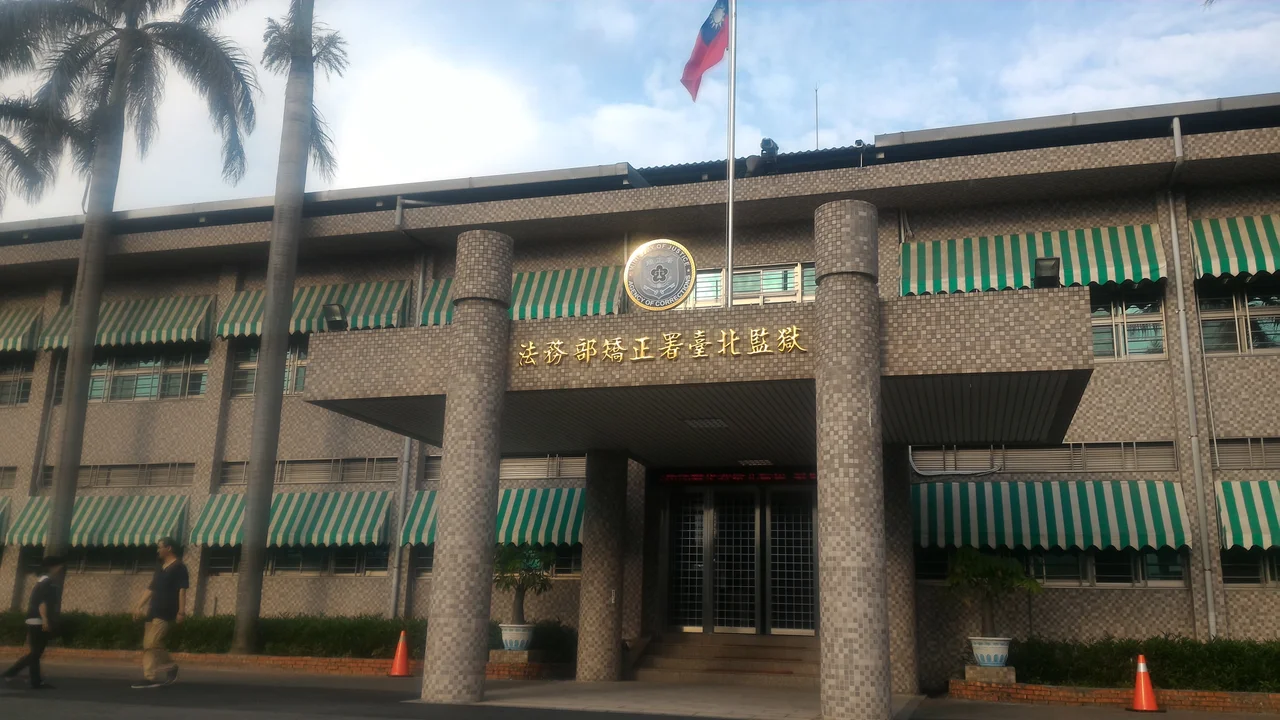

Taipei Prison
On 19 June 1945, in the early morning hours at Taihoku Prison, fourteen US Army and Navy airmen were executed. They had been found guilty by Japanese military tribunal of what the charge sheet called 'indiscriminate bombing' of Taiwan's civilian population. Their remains were cremated. Their ashes were placed at a local shrine. The war would end less than two months later. That morning, and those fourteen men, belong to the long and layered history of the place now known as Taipei Prison — an institution that began under the Qing Dynasty, expanded under Japanese colonial rule, and has continued under the Republic of China into the present day.
Origins Under Two Empires
The institution that would become Taipei Prison was established in 1895 as the Taihoku Penalty Institute. The name Taihoku was the Japanese rendering of Taipei; the year marks the beginning of Japanese colonial rule following the Treaty of Shimonoseki, which ceded Taiwan from China to Japan. The facility inherited and remodeled infrastructure from the preceding Qing Dynasty administration — an early example of the way Japan's colonial project in Taiwan built on existing foundations even as it transformed the island's institutions. By 1902, the prison had been rebuilt on a new site southeast of Taihoku City, in the area now known as Aiguo East Road. The original structure was gone, but the institution persisted, growing to serve the expanding colonial capital.
The Weight of June 1945
The executions of fourteen Allied airmen at Taihoku Prison in June 1945 represent one of the most specific and documented episodes in the facility's wartime history. These were men from US Army Air Forces and naval aviation units who had been shot down over or near Taiwan during the American air campaign against Japanese military and industrial targets. Tried by military tribunal and convicted on charges of bombing civilians, they were executed weeks before the war's end. Their deaths were part of a broader pattern of Allied POW mistreatment across Japanese-occupied Asia during the final, desperate months of the Pacific War. The men deserve to be remembered as individuals whose lives ended far from home, caught in the machinery of a conflict they had not started. Their ashes, placed at a local shrine, were a small human gesture in circumstances that allowed for very few.
From Colony to Republic
When Imperial Japan surrendered in August 1945, the Republic of China took administrative control of Taiwan. The prison received its current name — Taiwan Taipei Prison — in October of that year, a renaming that marked the transfer of authority without interrupting the institution's operation. The postwar years were turbulent. Taiwan's political situation remained fraught, and the prison population swelled as the island passed through the upheavals of the late 1940s and the decades of martial law that followed. By the late 1950s, the old facility was inadequate and overcrowded. The Ministry of Judicial Administration acquired land in Guishan District and began planning a new complex. Groundbreaking took place on October 11, 1961; the new facility was completed by the end of December 1962.
Guishan: The Prison in the Present
The current Taipei Prison sits in Guishan District, Taoyuan City — outside Taipei proper but still considered the city's primary detention facility for the north of the island. It can hold up to 2,705 people and houses those convicted of serious crimes and sentenced to at least ten years, as well as foreign nationals serving sentences in Taiwan. Three affiliated detention centers — the Taipei Detention Center, the Shilin Detention Center, and the Sindian Detention Center — handle shorter sentences. Among its most prominent recent residents was former President Chen Shui-bian, who served time at Taipei Prison as Inmate 1020 following his corruption conviction. The institution has been, across more than a century, a place where Taiwan's political and social history has been played out at close quarters — sometimes in ways that make history, sometimes in ways that history prefers not to examine too closely.
From the Air
The current Taipei Prison is located in Guishan District, Taoyuan City, at approximately 24.995°N, 121.338°E — roughly 40 km southwest of central Taipei, close to Taiwan Taoyuan International Airport (RCTP). The historical Taihoku Prison site near Aiguo East Road in central Taipei (approximately 25.03°N, 121.52°E) is now part of the urban fabric around Zhongzheng District. For the greater Taipei region, Taipei Songshan Airport (RCSS) is the in-city option, about 5 km northeast of the old city center. Approach at 3,000–5,000 feet for a broad view of the Taipei Basin and the surrounding mountains.
Nearby Stories
- Dapu Incident 9.3 km away
- Shuanglianpi Wetland 18 km away
- Toufen 41 km away
- North Jiangsu Main Irrigation Canal 980 km away
- General Cliff Rock Paintings 1050 km away
- Sinking of MV Sewol 1061 km away
- Yellow Sea 1111 km away
- Twin Forts of Romblon 1358 km away