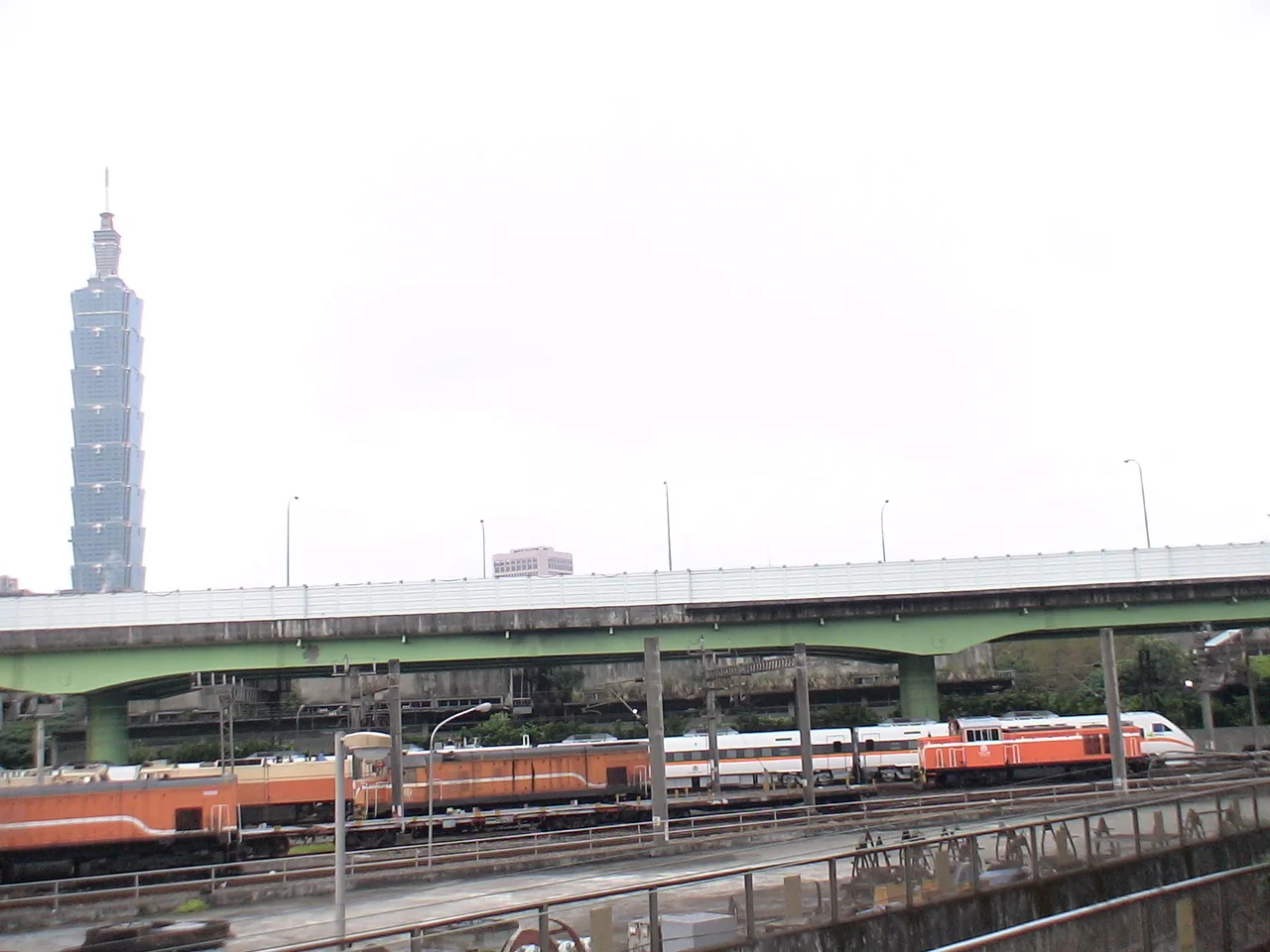

Taipei Railway Workshop
The assembly shed stretched 168 meters — longer than a city block, long enough that the far end disappeared into shadow when the doors were open and light fell in at a low angle. Inside, for decades, the locomotives and rail cars that moved people and freight across Taiwan were built, repaired, and sent back into service. The Taipei Railway Workshop was not a glamorous place. It was a working place, and it worked hard. When it finally went quiet in 2012, after more than seven decades of operation, it left behind a 16.82-hectare industrial monument on Civic Boulevard that the government has since designated a national historic site.
A Fortieth Anniversary Gift to an Empire
The workshop that stands today was established in 1935, replacing an earlier facility that had grown too small for the demands of a rapidly expanding rail network. The Governor-General of Taiwan framed the new workshop's opening as a celebration: the fortieth anniversary of Japanese colonial rule over the island. It was a deliberate symbolism. A workshop of this scale — the largest ever built in Taiwan — was an expression of industrial confidence, a statement that Japan's investment in Taiwan's infrastructure was permanent and serious. The site on Civic Boulevard was chosen for its size and its access to rail lines, and what was built there reflected the ambitions of colonial planners at the height of their power.
The Work of Making Trains Run
What happened inside the workshop for most of the twentieth century was unglamorous, essential labor. Mechanics, machinists, and engineers kept Taiwan's rail network running through the Japanese colonial period, through World War II, through the establishment of the Republic of China, through the island's postwar economic boom. The workshop manufactured new rolling stock and maintained existing vehicles across the network's narrow gauge — three feet six inches — lines that connected Taipei to the rest of the island. At its peak the complex employed hundreds of workers and contained specialized facilities for every aspect of rail vehicle production and repair. A bathhouse served the workforce, a detail that speaks to the scale of the operation and the culture of collective labor that sustained it.
Silence Falls on Civic Boulevard
The workshop closed in 2012. Its operations were transferred to the TRA Fugang Vehicle Depot, a modern facility better suited to contemporary rolling stock. The closure left a vast, quiet complex in the middle of one of Taipei's most accessible neighborhoods — a place that filmmakers noticed before historians did. The 2013 Jay Chou film The Rooftop and the 2014 Luc Besson film Lucy both made use of the workshop's atmospheric spaces, finding in the empty sheds and rusting tracks something that contemporary Taipei no longer offers: industrial scale, age, and the particular beauty of a place designed for work rather than appearance.
From Workshop to Museum
In 2015, the government of Taiwan recognized the Taipei Railway Workshop as an official national historic site. The designation was hard-won; for years, preservationists fought proposals to redevelop the land, and there were serious suggestions that the site might become an annex for a nearby cultural institution. The preservation movement prevailed. Plans to transform the complex into a railway museum have been discussed since the closure, and the 16.82-hectare site — the largest and oldest of its kind on the island — represents an extraordinary opportunity to tell the story of Taiwan's rail history in the place where so much of that history was made. Sun Yat-sen Memorial Hall Station and Nanjing Sanmin Station on the Taipei Metro both provide easy access to the site.
From the Air
The Taipei Railway Workshop occupies a large site at approximately 25.047°N, 121.565°E on Civic Boulevard in eastern Taipei. From the air, the complex is identifiable by its long industrial sheds and distinctive rectangular footprint east of the city center. Taipei 101 — the island's tallest tower — is visible to the south-southeast and provides a reliable orientation point. Taipei Songshan Airport (RCSS) is approximately 3 km northeast; approach the area at 2,000–3,000 feet for a clear view of the workshop's extent. Taiwan Taoyuan International Airport (RCTP) lies about 45 km to the southwest.
Nearby Stories
- Dapu Incident 9.3 km away
- Shuanglianpi Wetland 18 km away
- Toufen 41 km away
- North Jiangsu Main Irrigation Canal 980 km away
- General Cliff Rock Paintings 1050 km away
- Sinking of MV Sewol 1061 km away
- Yellow Sea 1111 km away
- Twin Forts of Romblon 1358 km away