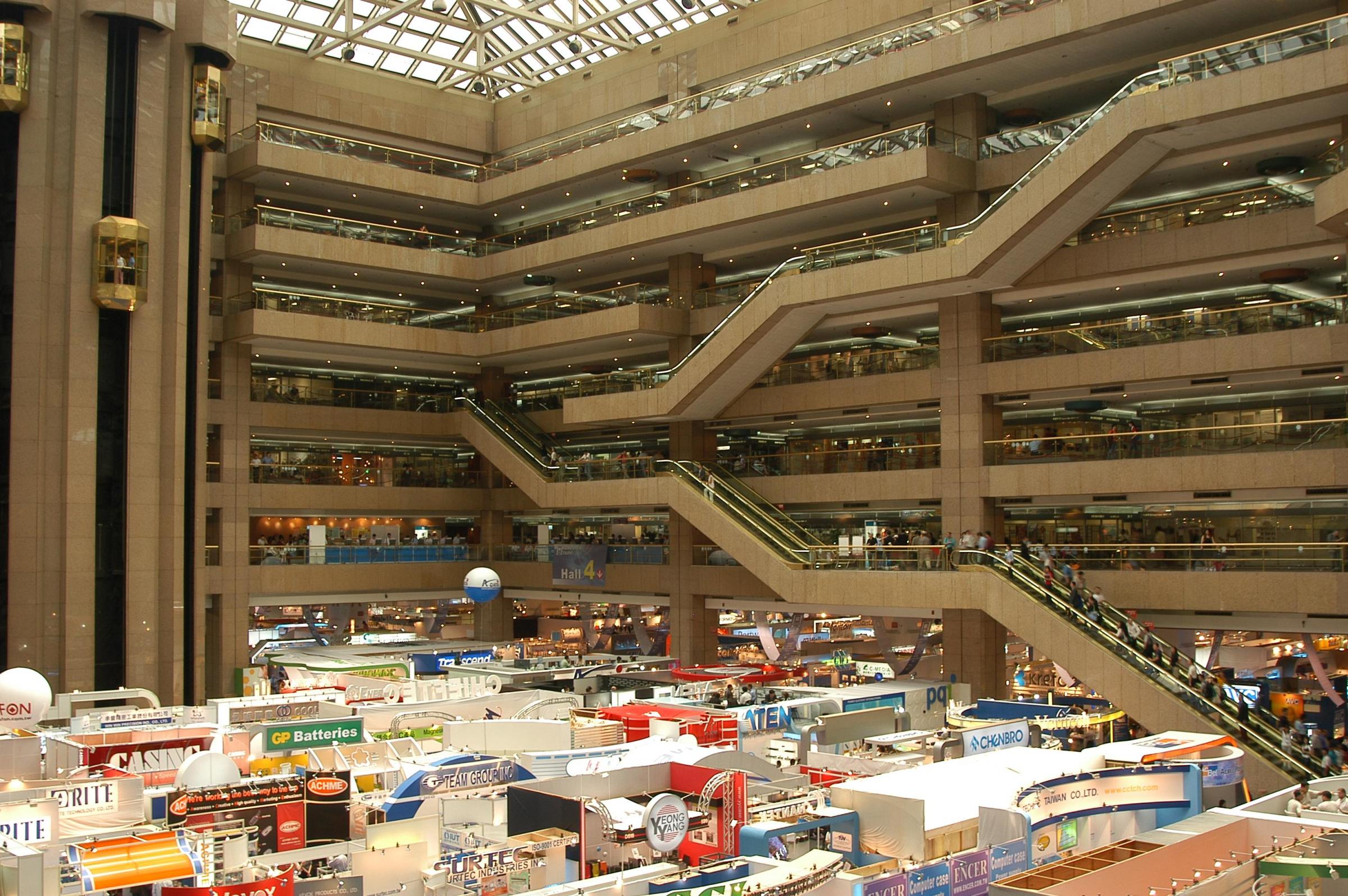
Taipei World Trade Center
The first Taipei Trade Show was held in a hotel ballroom. In March 1974, the Taiwan External Trade Development Council had no exhibition space of its own, so it borrowed the Taipei Grand Hotel for the Taiwan Export Clothings Exhibition. The irony was hard to miss: one of the fastest-growing economies in Asia, a nation that would soon be counted among the Four Asian Tigers, was showcasing its export goods in a borrowed dining hall. Within a decade, TAITRA would build the largest integrated trade complex in the country, and the Xinyi District would never be the same.
From Ballroom to Exhibition Floor
After outgrowing the Grand Hotel, TAITRA set up an exhibition hall at Taipei Songshan Airport, but Taiwan's economic acceleration during the 1970s overwhelmed that space too. The government launched an international design competition in 1982. Hellmuth, Obata and Kassabaum, William Tao & Associates, and T.Y. Lin & Associates, all American firms, were selected for the master plan and schematic design. Detailed design fell to Haigo Shen & Associates in Taipei, with Bechtel managing construction. On December 31, 1985, the Exhibition Hall opened with an IT Month expo. The International Tourist Hotel followed in 1987, later rebranded as the Grand Hyatt Taipei. The International Trade Building came in 1988, and the International Convention Center completed the four-building complex in 1989.
The Engine Room of Asian Tech
The World Trade Center's exhibition hall became the stage for events that shaped the global technology industry. COMPUTEX, one of the world's largest computer and technology trade shows, has called the TWTC home since its early years. IT Month, the Taipei International Book Exhibition, and the Taipei International Travel Fair rotate through the same floors. Hall 1 alone spans 23,450 square meters and accommodates 1,304 display booths divided into four quadrants. A second-floor area known as Area H adds another 4,789 square meters, connected to Taipei 101 by an aerial bridge. Exhibition Hall 3, opened in September 2003, provides 7,481 square meters more. On show days, the complex buzzes with buyers, engineers, and executives from every continent.
Four Buildings, One Purpose
The genius of the TWTC was integration. Rather than scattering trade functions across the city, the complex concentrated exhibition space, conference facilities, office towers, and a luxury hotel within walking distance of each other. The International Convention Center, now known as TICC, handles delegations and summit-level meetings. The Trade Building houses the Export Market on floors two through six and an Import Market on the seventh floor, with over 1,052 permanent product displays. The Grand Hyatt Taipei provides lodging steps from the exhibition halls. Since January 1, 1986, TAITRA has managed the Exhibition Hall and TICC under commission from the Ministry of Economic Affairs, ensuring continuity of purpose across four decades.
An Anchor in a Changing Skyline
The Xinyi District that surrounds the TWTC today bears little resemblance to the landscape of the mid-1980s. Taipei 101 now towers overhead, and the Taipei Metro's Taipei 101-World Trade Center Station delivers visitors directly to the complex's doorstep. Newer exhibition venues, including the Taipei Nangang Exhibition Center, have absorbed some of the overflow. But the World Trade Center remains the district's original anchor, the building that drew international commerce to this corner of Taipei before the skyscrapers followed. Its blocky, functional architecture may lack the flair of its newer neighbors, but the trade shows that fill its halls every month are a reminder that the building was never designed to impress from the outside. It was designed to work.
From the Air
Located at 25.0339°N, 121.562°E in Taipei's Xinyi District, immediately adjacent to Taipei 101. The complex's low-rise exhibition halls contrast visibly with the surrounding skyscrapers. Nearest airport is Taipei Songshan (RCSS), approximately 4 km north. Taoyuan International (RCTP) is 30 km southwest. Visible from 3,000-5,000 feet as a broad, flat-roofed structure at the base of the Xinyi tower cluster.