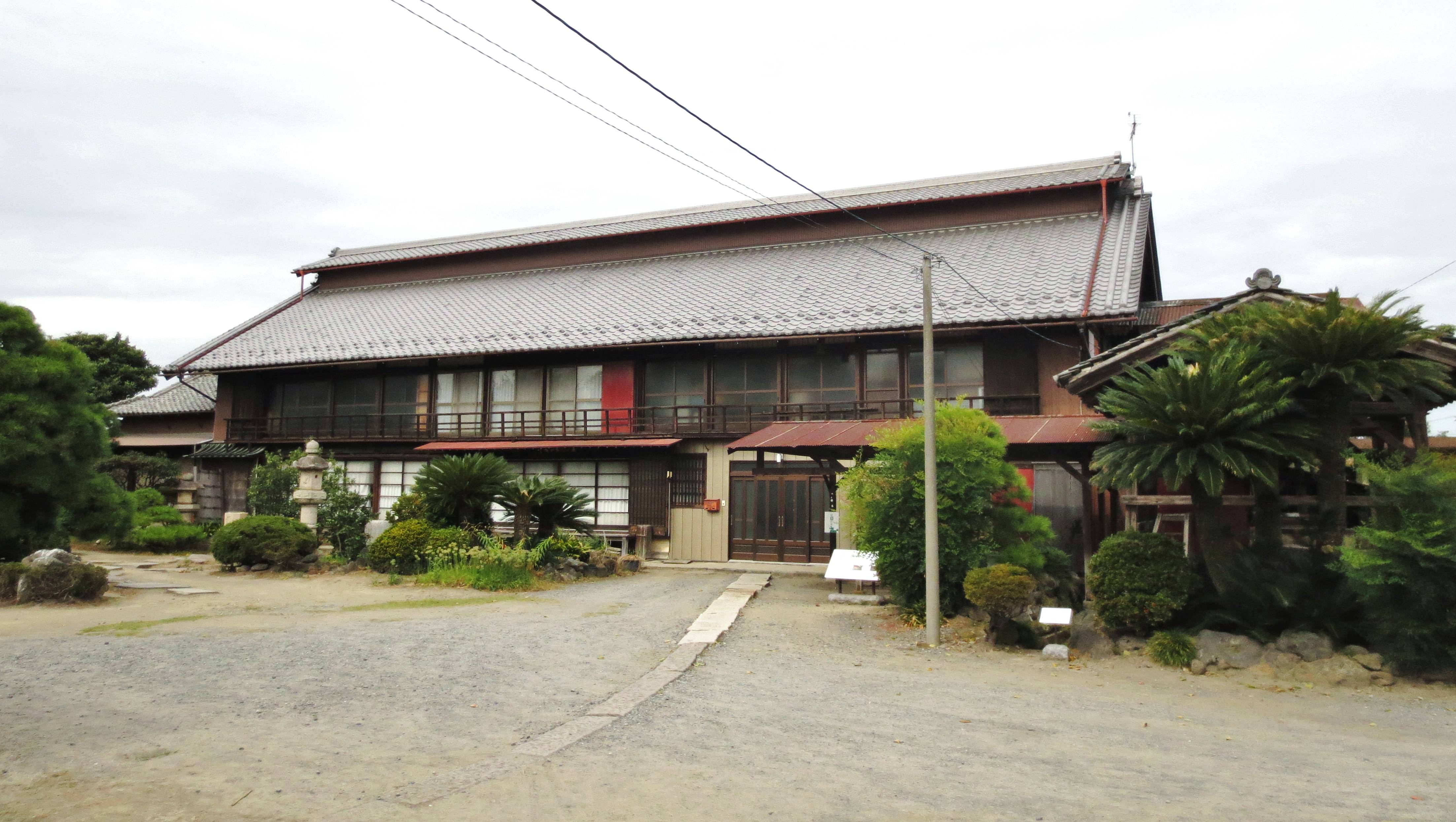
Tajima Yahei Sericulture Farm
The raised roof gives it away. Along the entire length of the two-story tile-roofed farmhouse in Isesaki, a distinctive ridge of windows -- called yagura -- pierces the roofline, letting air flow through the building in carefully controlled currents. This is not decoration. It is the physical expression of a theory that changed an industry. Tajima Yahei, a silk farmer born in 1822, spent years experimenting with how air and temperature affected silkworm cultivation. By 1863, he had rebuilt his own home to prove his ideas worked. The building still stands, preserved in its 1863 configuration, and in 2014 it became part of the Tomioka Silk Mill and Related Industrial Heritage UNESCO World Heritage Site -- one of only four associated sites that together tell the story of how Japan transformed raw silk into the economic engine of its modernization.
Trial, Error, and Open Windows
During the final years of the Tokugawa shogunate -- the turbulent Bakumatsu period -- Tajima Yahei was not fighting or plotting. He was watching silkworms. His initial approach relied on natural ventilation, the traditional method of raising silkworms in the breezy interiors of rural farmhouses. But he grew dissatisfied with its unpredictability and began experimenting with artificial temperature control. Neither method alone produced reliable results. Through persistent trial and error, he developed a hybrid technique he called Seiryo-iku, which combined natural airflow with controlled heating. To test the method at scale, he converted his barn into a two-level silkworm farm. After the first harvest revealed problems with air circulation, he installed yagura windows in the roof. The improvement was immediate. He added a third level, refined the ventilation further, and in 1863 rebuilt his main residence with a single raised roof spanning the entire length of the building -- the first silkworm farm in Japan to use this design.
Silk and the Birth of Modern Japan
The timing was extraordinary. In 1864, the Tokugawa shogunate lifted its ban on raw silk exports, and the number of silk producers in Kozuke Province -- modern Gunma Prefecture -- exploded. Many adopted Tajima's yagura architectural style for their own farms. Then came the Meiji Restoration of 1868, and the new government identified silk as the critical export commodity for earning the foreign capital Japan desperately needed to industrialize. In 1869, the Italian minister plenipotentiary to Japan, Conte Vittorio Sallier De La Tour, and Francis Ottiwell Adams, secretary to the British ambassador, inspected the silk-producing regions and praised both Tajima's methods and the quality of his silk. His techniques spread across the country. Tajima published his findings formally in 1872 as New Theories on Sericulture, followed by Additional New Theories on Sericulture in 1879, cementing his methods in print for future generations of producers.
Superseded but Not Forgotten
By the middle of the Meiji period, Tajima's Seiryo-iku method was overtaken by the onshitsu-iku method developed by Takayama Chogoro, which added humidity control to temperature and ventilation management. Yet the yagura roofline that Tajima pioneered persisted long after his specific cultivation technique fell out of favor. The distinctive raised windows became the architectural signature of Japanese silk farms, adopted even by operations using newer methods. In 1875, silk farms built at the Matsugaoka Land Reclamation Area used Tajima's farmhouse as their direct model. Tajima himself died in 1898, having witnessed the transformation of Japan from a feudal society into an industrial power -- a transformation his silkworms had helped finance.
A Farmhouse on the World Stage
The main residence survives in its 1863 state, a two-story building with the tile roof and full-length yagura that made it famous. A mulberry leaf warehouse built in 1896 also remains on the property. Part of the main residence was removed in 1952, but the landscape has otherwise remained unchanged. A historiographical study conducted between 1986 and 1988 documented the site's significance, and in 2006 Gunma Prefecture and the city of Tomioka submitted the farm as part of a World Heritage application. The final dossier, submitted in January 2013, included the Tajima Yahei Sericulture Farm as one of four sites associated with the Tomioka Silk Mill. UNESCO inscribed the entire group in 2014. The farm had already been designated a National Historic Site of Japan in 2012. Today the building stands in the Sakaishima neighborhood of Isesaki, a quiet monument to the idea that revolution can begin with something as simple as opening a window.
From the Air
Located at 36.25N, 139.24E in the flat agricultural landscape of Gunma Prefecture, Japan. The farm is a small historic structure in the Sakaishima neighborhood of Isesaki city and is not individually distinguishable from altitude, but the surrounding landscape of the Kanto plain -- with its patchwork of rice paddies and mulberry fields -- reflects the agricultural heritage. Nearest major airports: Tokyo Narita International (RJAA) approximately 75nm southeast, Haneda (RJTT) approximately 60nm south. The Tomioka Silk Mill, the primary UNESCO site, lies approximately 25km to the west.