Takada Castle: Built in Four Months, Blooming for Four Centuries
Thirteen daimyo houses, thousands of laborers, four months. That is all it took to raise Takada Castle in 1614, an 800-by-400-meter fortress of earthen ramparts and water moats in the flatlands of Echigo Province. The rush was deliberate. Tokugawa Ieyasu needed a strategic counterweight to the powerful Maeda clan in neighboring Kanazawa, and the approaching war with Toyotomi Hideyori's supporters in Osaka meant there was no time for stone walls or an ornate tenshu keep. What the castle lacked in elegance, it compensated for in sheer scale -- and in the strange, melancholy story of the man who commissioned it, only to lose everything within a year of moving in.
The Unwanted Son's Domain
Matsudaira Tadateru was Tokugawa Ieyasu's sixth son, born to a concubine and sent away to be raised by retainers almost immediately after birth. His father showed him no warmth. Shuffled between minor domains -- Fukaya in 1599, Sakura in 1602, Kawanakajima in 1603 -- Tadateru finally received Takada Domain with a staggering kokudaka of 750,000 koku, making it the second-largest domain in Japan. The appointment was strategic rather than sentimental: Ieyasu needed a loyal presence near the tozama Maeda clan in Kanazawa. Tadateru found the existing Fukushima Castle near the port of Naoetsu too small for his forces and prone to flooding. In 1614, he decided to build from scratch at an inland site where the Seki and Yashiro rivers curved together, providing natural moats and control over the main route between the Sea of Japan and the Kanto region.
A Castle Raised Against the Clock
With the Siege of Osaka looming, the Tokugawa shogunate could spare neither the time nor the money for a conventional castle. The solution was collective labor on an extraordinary scale. Date Masamune -- who was also Tadateru's father-in-law -- organized the construction, and thirteen daimyo houses contributed manpower and resources. Among them was Maeda Toshitsune from Kanazawa Domain and, remarkably, Uesugi Kagekatsu, the former warlord of Echigo who now governed from distant Yonezawa. Construction began on March 15, 1614, and the castle was essentially finished by midsummer. To meet the deadline, the builders used only earthen ramparts with no stone facing and skipped the tenshu entirely. The completed inner bailey measured 220 by 230 meters, protected by moats and clay walls with two masugata-style gates and a three-story yagura watchtower in the southwestern corner serving as the de facto donjon.
Exile, Earthquakes, and Fire
Tadateru's time in his new castle lasted barely a year. During the Siege of Osaka in 1615, he fell out with his elder brother, Shogun Tokugawa Hidetada, who saw the younger man as a potential rival. Ieyasu's longstanding coldness toward his sixth son provided no protection. In 1616, Tadateru was stripped of his domain and confined to Takashima Castle in Shinano Province, where he spent the next fifty years until his death. Takada Domain was reduced in size and handed to a succession of fudai daimyo, many of whom treated the posting as a stepping stone. The Sakakibara clan took control in 1741 and held on until the Meiji Restoration. The castle itself suffered repeated blows: earthquakes in 1665 and 1751, a devastating fire in 1802 that consumed everything except the gates and corner towers, and another fire in 1870 that destroyed the reconstructed palace and yagura.
From Army Base to Blossom Park
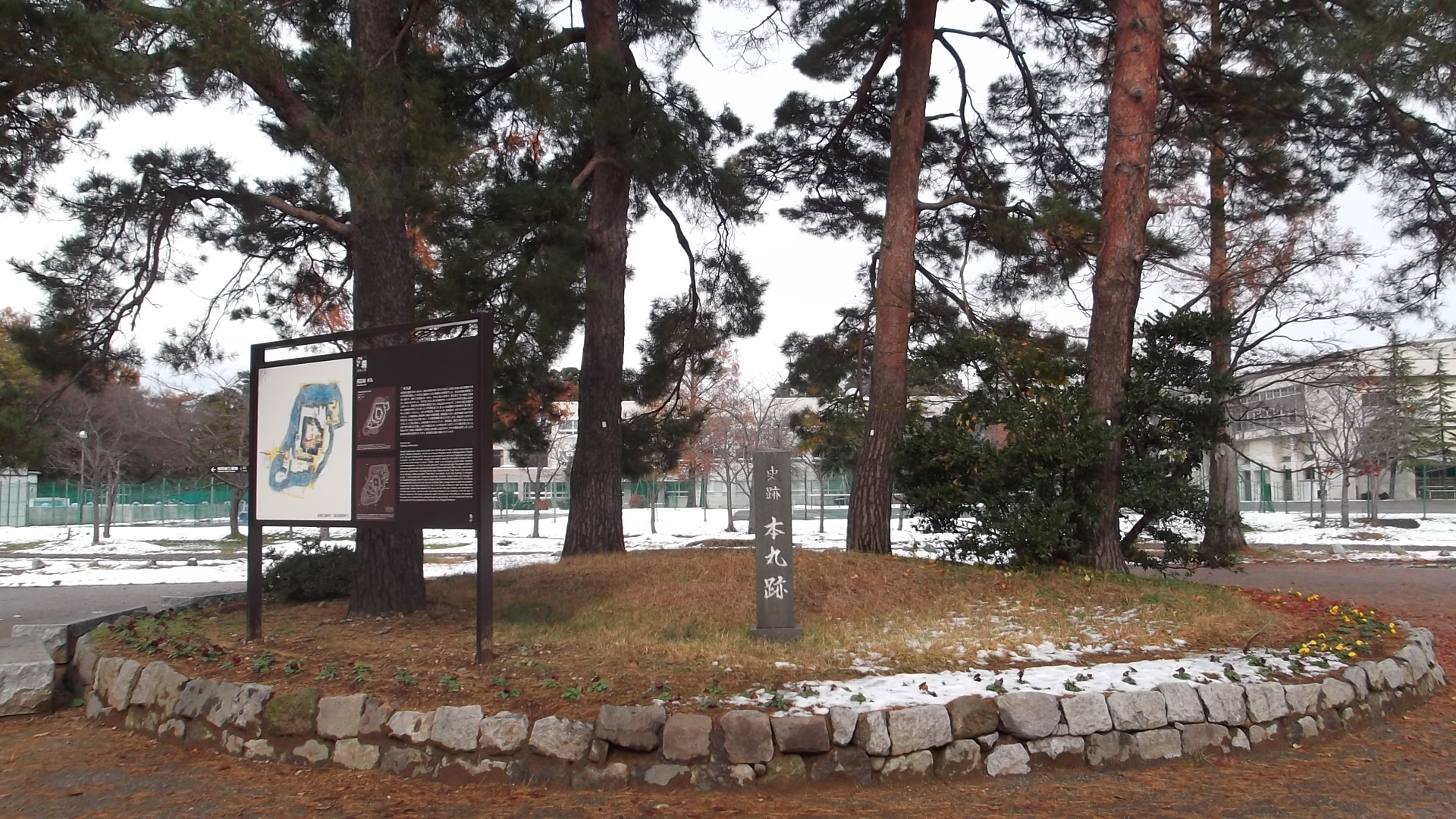
After the Meiji government ordered the remaining castle structures dismantled in 1872, the eastern half became a school and the central section became the base for the Imperial Japanese Army's 13th Infantry Division. It was only after World War II that Takada Castle found its most beloved identity. The central and western grounds became Takada Park, and over 4,000 Somei Yoshino cherry trees were planted across the former fortress. Today, the park is celebrated as one of Japan's top three destinations for nighttime cherry blossom viewing. Each April, roughly 3,000 paper lanterns -- bonbori -- illuminate the blossoms, and the 300-meter Sakura Road south of the castle becomes a corridor of pink and warm light. In 1991, the corner yagura was reconstructed in its original form using surviving plans. Moats were repaired, ramparts restored, and a bridge reconnecting the inner bailey to the Ni-no-maru secondary bailey was rebuilt. The castle was listed among the Continued Top 100 Japanese Castles in 2017.
From the Air
Located at 37.110N, 138.256E in the center of Joetsu city on the Echigo plain. From altitude, look for the rectangular moat system and park grounds -- especially spectacular in early April when 4,000 cherry trees bloom pink against the green moats. The reconstructed three-story yagura at the southwestern corner provides a visual reference point. The Seki and Yashiro rivers curve nearby. Niigata Airport (RJSN) is approximately 120 km northeast, and Toyama Airport (RJNT) lies roughly 130 km southwest. The Sea of Japan coastline is visible just a few kilometers to the northwest.