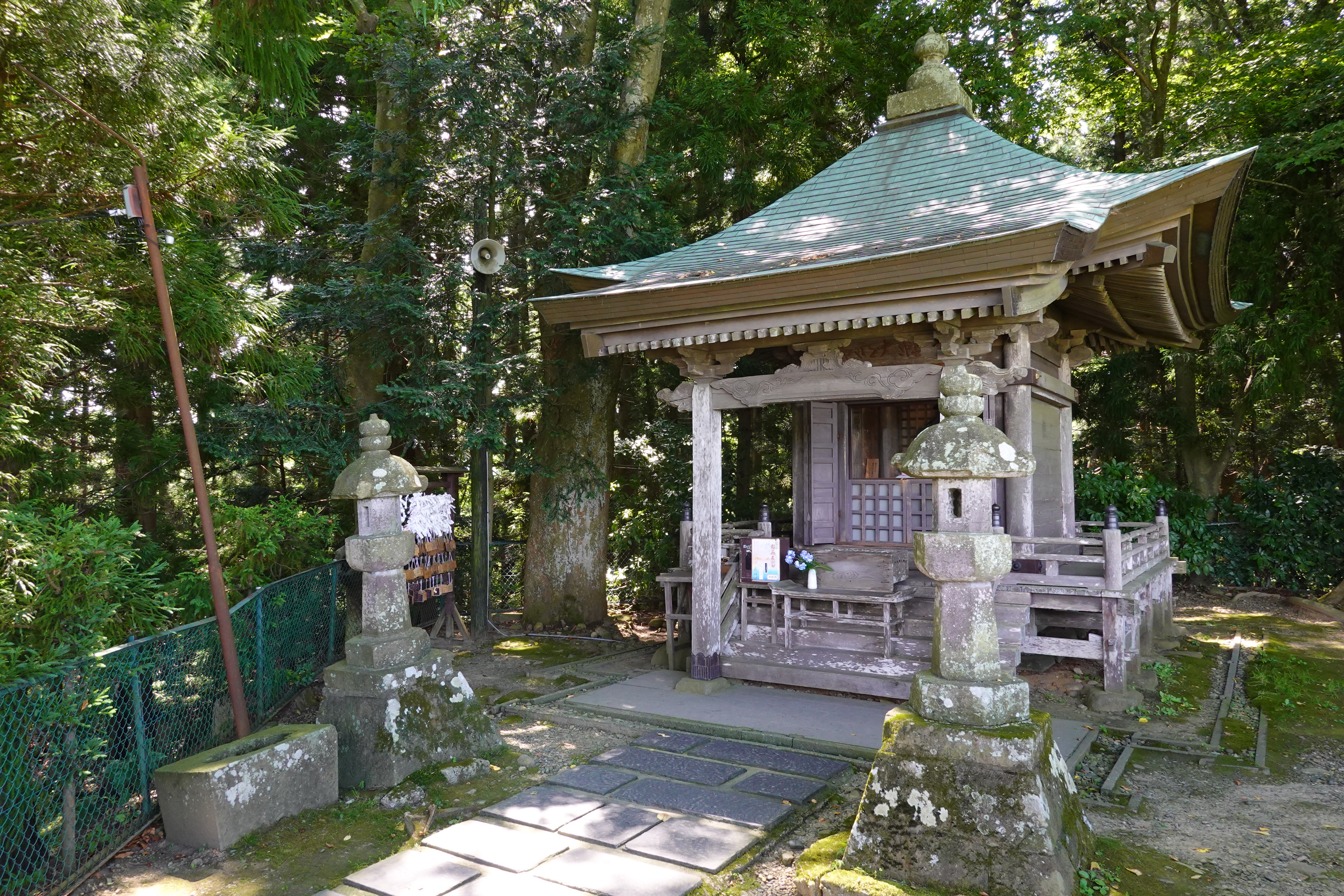
Takadachi Gikeidō
"Summer grasses -- all that remains of warriors' dreams." Matsuo Basho wrote those words in 1689, standing on a hill above the Kitakami River in Hiraizumi, looking down at the spot where Japan's greatest tragic hero died five centuries earlier. The hill is Takadachi, Castle-on-the-Heights. The hero is Minamoto no Yoshitsune. The small chapel perched on that hill, Takadachi Gikeidō, exists because the story of what happened here in 1189 has never stopped haunting the Japanese imagination.
The Brother's Betrayal
Minamoto no Yoshitsune was the brilliant young general who won the Genpei War for his brother Yoritomo, defeating the Taira clan in a series of stunning victories. But brilliance made Yoritomo suspicious. The elder brother, consolidating power as Japan's first shogun, turned against the younger. Yoshitsune fled north to Hiraizumi, where the Northern Fujiwara clan had built a civilization of astonishing refinement at the edge of the known world. Fujiwara no Yasuhira, the fourth and last lord, gave Yoshitsune shelter in his palace on the hill overlooking the Kitakami River, some 500 meters east-southeast of the great temple of Chuson-ji. Yoritomo demanded his brother's head. When Yasuhira hesitated, Yoritomo declared war on the Northern Fujiwara. In 1189, his forces overran Hiraizumi's defenses. Yoshitsune made his final stand on this hill alongside his legendary retainer Benkei, the warrior-monk whose death -- standing upright, pierced by arrows, still guarding his master -- became one of the most celebrated images in Japanese literature.
From Battlefield to Sacred Ground
The medieval account Gikeiki immortalized Yoshitsune's last stand, transforming a political execution into an epic of loyalty and sacrifice. For nearly five centuries, Takadachi remained a ruin -- the Fujiwara palace long destroyed, the hill slowly returning to grass and trees. Then in 1683, Date Tsunamura, the fourth daimyo of Sendai Domain, built a memorial chapel on the site. He enshrined a statue of Yoshitsune inside, converting the place of his death into a place of veneration. The chapel is small and unassuming, but its location on the bluff above the river gives it a gravity that larger buildings lack. From here the Kitakami spreads wide and slow below, and the forested hills of Hiraizumi roll toward the horizon -- the same view Yoshitsune would have seen as his world closed in around him.
Basho's Pilgrimage
Six years after the chapel was built, the poet Matsuo Basho arrived. It was June 29, 1689, and Basho was walking the Narrow Road to the Deep North, the journey that would produce his masterwork Oku no Hosomichi. He climbed Takadachi and looked down at the place where three generations of Fujiwara glory had ended in a single campaign. The summer grasses were tall. Basho sat down and wept. Then he composed: "Natsukusa ya / tsuwamonodomo ga / yume no ato" -- Summer grasses, all that remains of warriors' dreams. A memorial stele on the hillside preserves the poem today. In 2014, the site was designated a nationally designated Place of Scenic Beauty as part of the Landscapes of the Oku no Hosomichi, recognizing that Basho's literary journey had made the landscape itself into a kind of text -- a place where geography and poetry are inseparable.
Reading the Landscape
Takadachi Gikeidō is managed by neighboring Motsuji, the great Tendai temple nearby, and sits within a constellation of Hiraizumi sites that together tell the story of the Northern Fujiwara civilization. Chuson-ji with its Golden Hall is a short walk away. The chapel itself is modest -- visitors come less for the building than for the view it frames. The Kitakami River below, the summer grasses on the hillside, the quiet of a place that was once a killing ground: these are the elements Basho distilled into seventeen syllables. Standing here, looking out over the same river valley, it is easy to understand why a poet who had walked hundreds of miles stopped here and could go no further without putting pen to paper.
From the Air
Located at 39.00N, 141.11E on a prominent hill overlooking the Kitakami River in Hiraizumi, southern Iwate Prefecture. The chapel sits on a bluff east-southeast of Chuson-ji temple. From the air, look for the elevated wooded hilltop along the river's west bank -- the Kitakami is the dominant geographic feature, flowing broadly through the valley. Nearest airport: Iwate Hanamaki Airport (RJSI), approximately 30nm north-northwest. The broader Hiraizumi UNESCO World Heritage area is compact and visible as a cluster of temple grounds and gardens in the river valley. Best approached from the east following the Kitakami River upstream.